









What Are the Main Bones and Functions of the Pelvic Girdle?
The concept of pelvic girdle is essential in biology and helps explain real-world biological processes and exam-level questions effectively.
Understanding Pelvic Girdle
Pelvic girdle refers to the basin-shaped set of bones that connects the trunk of the body to the lower limbs. This critical anatomical structure is part of the appendicular skeleton and is studied in areas like human anatomy, locomotion, and reproduction. The pelvic girdle is mainly composed of a pair of hip bones (also called coxal bones), each made up of three fused bones: the ilium, ischium, and pubis. It plays a crucial role in supporting the body's weight, protecting internal pelvic organs, and allowing movement at the hip joint.
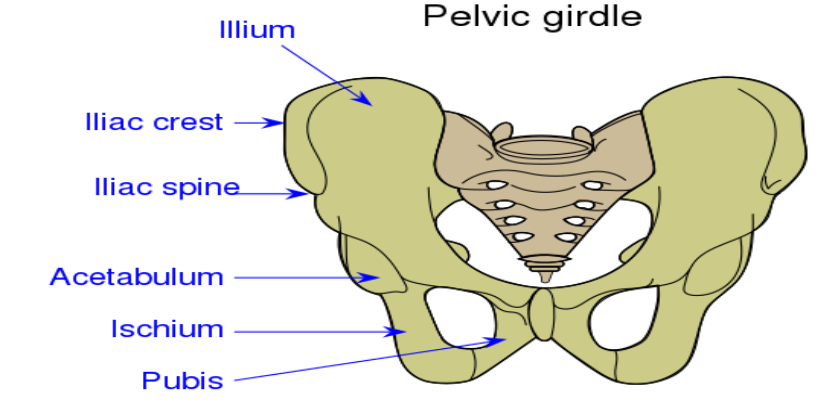
Structure and Bones of the Pelvic Girdle
Each hip bone in the pelvic girdle has three parts:
- Ilium: The broad, flat upper section; forms the superior part of the hip bone.
- Ischium: Located below the ilium; the part we sit on.
- Pubis: The anterior, lower part meeting at the pubic symphysis.
At birth, these three bones are separate in each hip. By puberty, they fuse together, and the socket formed (acetabulum) is where the femur (thigh bone) fits.
Functions of the Pelvic Girdle
- Transfers the weight of the upper body from the trunk to the lower limbs for walking and standing.
- Protects vital organs like the bladder, reproductive organs, and parts of the intestine.
- Provides attachment points for lower limb muscles, supporting movement and balance.
- In females, the wider shape supports fetal development and childbirth.
Differences Between Male and Female Pelvic Girdle
The pelvic girdle structure varies between males and females, primarily to facilitate childbirth in females.
| Feature | Male Pelvic Girdle | Female Pelvic Girdle |
|---|---|---|
| Overall Shape | Narrower, taller, heavier | Wider, broader, lighter |
| Pelvic Inlet | Heart-shaped, narrow | Oval, wide |
| Pubic Arch | Less than 90° | More than 90° |
| Pelvic Cavity | Deep, funnel-like | Shallow, cylindrical |
Mechanism of Pelvic Girdle in Movement
The basic mechanism involves the pelvic girdle distributing the force and body weight from the axial skeleton (trunk) to the lower limbs through the hip joints. Muscle attachments on the ilium, ischium, and pubis enable movement such as walking, running, and sitting. The acetabulum forms a stable ball-and-socket joint with the femur, allowing controlled motion in several directions.
Worked Example – Pelvic Girdle in Locomotion
Let’s understand the process step by step:
1. The pelvis receives upper body weight via the sacrum.
2. This weight is transmitted to both hip bones.
3. Hip bones transfer the weight to femurs (thigh bones) through the hip joints.
4. Muscles pull on the pelvic girdle for leg movement while stabilizing the trunk.
Final Understanding: The pelvic girdle acts as a bridge between the trunk and limbs, making upright posture and walking possible.
Practice Questions
- What are the three main bones forming the pelvic girdle?
- How does the pelvic girdle support body weight?
- List two ways the female pelvic girdle differs from the male pelvic girdle.
- Draw and label a diagram of the pelvic girdle.
- What is the function of the acetabulum in the pelvic girdle?
Common Mistakes to Avoid
- Confusing pelvic girdle with pectoral girdle (shoulder region).
- Mixing up the ilium, ischium, and pubis bones when labeling diagrams.
- Forgetting differences in the pelvic girdle between males and females in MCQs.
Real-World Applications
The concept of pelvic girdle is used in fields like medicine, surgery, sports science, orthopedics, physiotherapy, and forensic science. Understanding pelvic structure helps in treating injuries, diagnosing disorders like pelvic pain (especially in pregnancy), and managing conditions affecting movement or childbirth. Vedantu helps students relate such topics to practical examples in daily life and for medical exam preparation.
In this article, we explored pelvic girdle, its key processes, real-life significance, and how to solve questions based on it. To learn more and build confidence, keep practicing with Vedantu.
To deepen your understanding of the pelvic girdle, you can explore these related topics:
- Pelvic Bone
- Human Skeletal System
- Bones of Leg
- Locomotion and Movement (MCQ)
- Human Body and Its Movements
- Pectoral Girdle
- Vertebrae
- Muscles of the Body
- Difference Between Endoskeleton and Exoskeleton
- Human Reproductive System
FAQs on Pelvic Girdle Explained for NEET: Detailed Anatomy, Functions & Diagrams
1. What is pelvic girdle in NEET and why is it important?
The pelvic girdle is a basin-shaped bony structure connecting the trunk to the lower limbs. It plays a vital role in supporting body weight, enabling locomotion, and protecting pelvic organs. Understanding its anatomy, functions, and differences between male and female pelvis is crucial for NEET aspirants, as it is frequently asked in MCQs and diagram-based questions.
2. How to memorise the bones of the pelvic girdle quickly?
To memorise the three main bones of the pelvic girdle—ilium, ischium, and pubis—students can use simple mnemonics like "IIP" (Ilium, Ischium, Pubis). Visual aids such as labelled diagrams and relating their positions (upper, posterior, and anterior respectively) help reinforce memory effectively for NEET exams.
3. What are the three bones forming the pelvic girdle?
The pelvic girdle is formed by a pair of hip bones called the coxal bones, each consisting of three fused bones: the ilium (upper part), the ischium (posterior part), and the pubis (anterior part). These bones fuse at puberty to form a single hip bone on each side.
4. How does the female pelvic girdle differ from male in NEET MCQs?
The female pelvic girdle differs from the male in several key ways relevant to NEET questions: it is generally wider and broader, with a larger pelvic inlet and outlet to accommodate childbirth, a greater pubic arch angle (>90°), and lighter bones. The male pelvis is narrower, heart-shaped, and heavier. These structural differences are commonly tested in NEET MCQs.
5. Which functions of the pelvic girdle are commonly asked in NEET?
Commonly asked functions of the pelvic girdle in NEET include: weight bearing, transferring body weight from the axial skeleton to the lower limbs, protection of pelvic and lower abdominal organs, support for locomotion and posture, and providing attachment points for muscles involved in movement.
6. Is pelvic girdle pain a NEET topic or clinical only?
While pelvic girdle pain is primarily a clinical topic often related to pregnancy, it is not a main focus in the NEET syllabus. NEET mainly emphasizes the anatomy, structure, and functions of the pelvic girdle rather than clinical conditions. However, basic awareness may be helpful for applied questions in physiology or pathology sections.
7. Why do students often mix up pectoral and pelvic girdles in MCQ?
Students often confuse the pectoral girdle with the pelvic girdle because both connect limbs to the axial skeleton. Key differences to remember: the pectoral girdle connects the upper limbs and allows wide range of movement, while the pelvic girdle connects the lower limbs and provides stability and support. Visual comparisons and mnemonics help avoid this confusion in NEET MCQs.
8. How can I avoid missing pelvic inlet/outlet features in diagrams?
To avoid missing pelvic inlet and outlet in diagrams, practice with multiple well-labeled images highlighting the pelvic brim (pelvic inlet) and pelvic outlet. Use mnemonic aids for shapes and relative positions, and focus on differences between true (lesser) pelvis and false (greater) pelvis. Regular revision through interactive quizzes improves diagram accuracy.
9. Can pelvic girdle questions be diagram-based in NEET?
Yes, NEET frequently includes diagram-based questions on the pelvic girdle. Students should be able to identify and label major parts like the ilium, ischium, pubis, acetabulum, and pelvic inlet/outlet. Accurate diagram familiarity aids in both MCQs and descriptive type questions.
10. What silly mistakes occur with ilium/ischium/pubis labeling?
Common mistakes in labeling the ilium, ischium, and pubis include mixing up their anatomical positions: ilium is the superior and largest part, ischium is the posterior-inferior part, and pubis is the anterior-inferior part. Confusing the acetabulum location or articulations can also cause errors. Careful study of labelled diagrams and repeated practice reduces these mistakes.
11. Are questions on pelvic floor muscles or only bones asked?
NEET mainly focuses on the bones of the pelvic girdle, but basic questions about the pelvic floor muscles are occasionally asked in the context of support and function of pelvic organs. Understanding muscular attachments to the pelvis may help answer applied physiology questions.
12. Do NEET MCQs ask about pelvic disorders or just anatomy?
NEET primarily tests the anatomy and functions of the pelvic girdle rather than detailed pelvic disorders. However, some clinical or applied questions related to common conditions like pelvic girdle pain during pregnancy may appear in physiology or integrated questions. Exam focus remains on structure and function.
