








What are the Steps and Differences of the Hatch and Slack Cycle (C4 Pathway) in NEET Biology?
The concept of Hatch and Slack cycle is essential in biology and helps explain real-world biological processes and exam-level questions effectively. For NEET, understanding this pathway (also called the C4 cycle) is vital to scoring in photosynthesis and plant physiology questions.
Understanding Hatch and Slack Cycle
Hatch and Slack cycle refers to a photosynthetic pathway in certain plants where carbon dioxide (CO₂) is first fixed into a four-carbon compound before entering the usual Calvin cycle. This mechanism is important in areas like C4 pathway, photorespiration reduction, and Kranz anatomy. The Hatch and Slack cycle is seen in C4 plants such as maize, sugarcane, and several grasses. It allows efficient CO₂ fixation, especially under high temperature, intense sunlight, and low CO₂ concentration, giving these plants a photosynthetic advantage over C3 plants.
Mechanism of Hatch and Slack Cycle
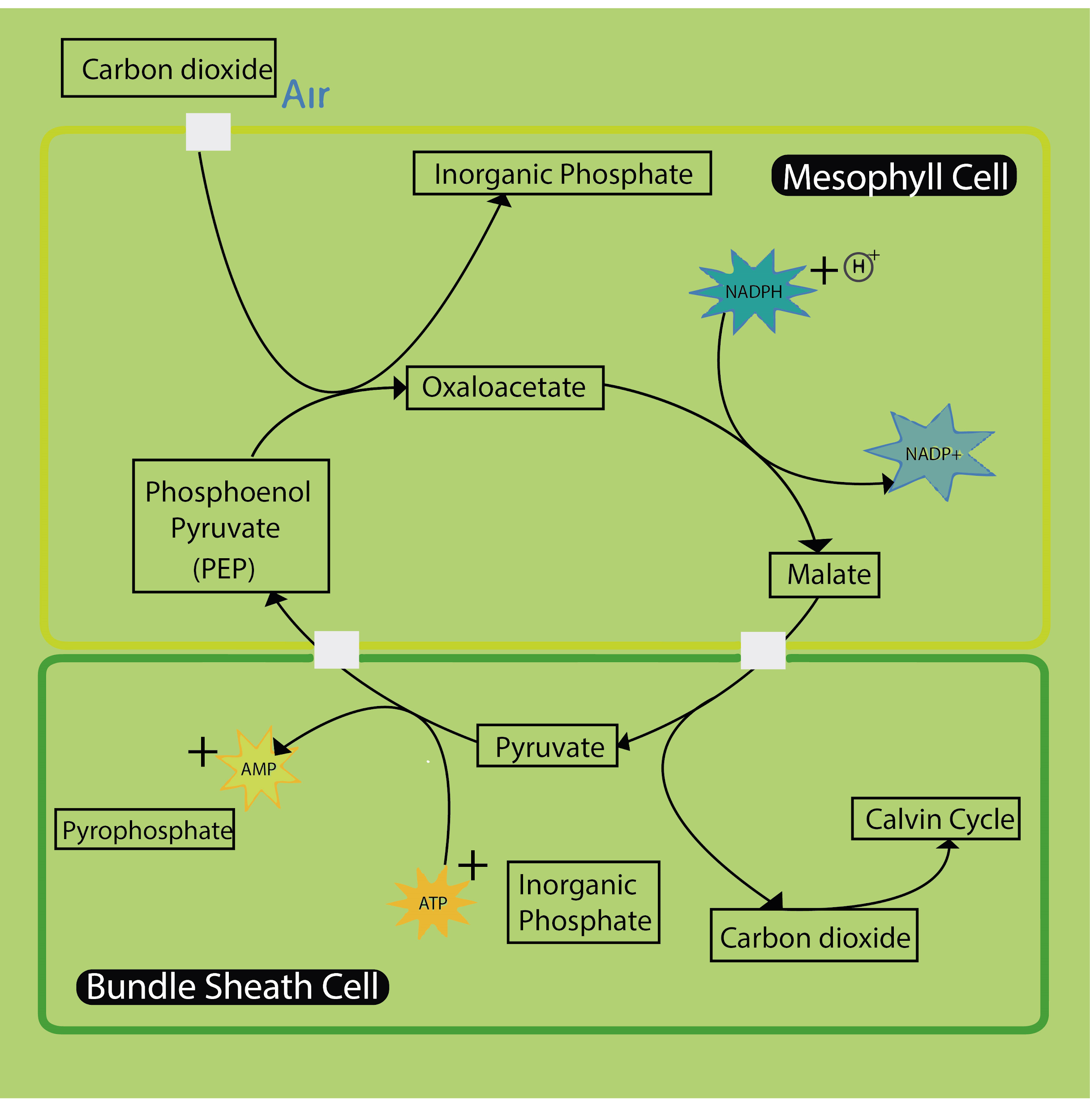
The basic mechanism of the Hatch and Slack cycle involves four key steps, which occur in different types of cells (mesophyll and bundle sheath) because of the specialized Kranz anatomy:
- Carboxylation: In mesophyll cells, CO₂ combines with phosphoenolpyruvate (PEP) forming oxaloacetic acid (OAA), a four-carbon compound, catalyzed by the enzyme PEP carboxylase.
- Breakdown/Reduction: OAA is quickly converted into malate (or sometimes aspartate). This step is aided by malate dehydrogenase or transaminase enzymes.
- Splitting/Decarboxylation: Malate (or aspartate) travels to bundle sheath cells, where it is split to release CO₂ and pyruvate. The CO₂ then enters the Calvin cycle (C3 pathway) in the bundle sheath cells.
- Phosphorylation: Pyruvate returns to the mesophyll, where it is phosphorylated by pyruvate phosphate dikinase—reforming PEP and allowing the cycle to repeat.
Here’s a helpful table to understand Hatch and Slack cycle better:
Hatch and Slack Cycle Table
| Step | Description | Cellular Location |
|---|---|---|
| Carboxylation | CO₂ + PEP → OAA (via PEP carboxylase) | Mesophyll cell |
| Reduction | OAA → Malate/Aspartate | Mesophyll cell |
| Decarboxylation | Malate → Pyruvate + CO₂ | Bundle sheath cell |
| Phosphorylation | Pyruvate + ATP → PEP | Mesophyll cell |
Worked Example – Sequence of the Hatch and Slack Pathway
Let’s understand the process by following CO₂ through the cycle in a C4 plant:
1. CO₂ enters a maize leaf’s mesophyll cell, combines with PEP, and forms OAA.
2. OAA reduces to malate.
3. Malate moves to the bundle sheath cell, where it breaks down to CO₂ and pyruvate.
4. CO₂ is used in the Calvin cycle to make sugars; pyruvate travels back, gets phosphorylated into PEP using ATP, and the process continues.
Final Understanding: This cycle concentrates CO₂ around RuBisCO, limiting photorespiration, and boosting photosynthesis efficiency under tropical conditions.
Comparison Table: Hatch and Slack (C4) vs Calvin (C3) vs CAM Cycles
| Feature | C3 (Calvin) Cycle | C4 (Hatch & Slack) | CAM Cycle |
|---|---|---|---|
| First CO₂ Product | 3C (PGA) | 4C (OAA) | 4C (OAA) |
| Key Enzyme | RuBisCO | PEP Carboxylase | PEP Carboxylase |
| Leaf Anatomy | No Kranz anatomy | Kranz anatomy | No Kranz; uses succulents |
| Examples | Wheat, rice | Maize, sugarcane | Opuntia, pineapple |
Examples of C4 Plants (Hatch and Slack Pathway)
- Maize (corn)
- Sugarcane
- Sorghum
- Amaranthus
- Millets (pearl millet, etc.)
- Many tropical grasses
Common Mistakes to Avoid
- Mixing up the sequential order of steps (Carboxylation comes first, not malate splitting).
- Confusing the initial acceptor of CO₂ (it is PEP in C4; RuBP in C3).
- Forgetting Kranz anatomy is required for the Hatch and Slack cycle.
- Believing only monocots have C4 cycle—it is found in some dicots too.
Practice Questions
- What is the first stable product of the Hatch and Slack (C4) pathway?
- Which enzyme fixes CO₂ in the mesophyll cells during the C4 cycle?
- Name two plants that use the Hatch and Slack cycle.
- Label a diagram showing the steps of the Hatch and Slack pathway.
- Compare the Hatch and Slack cycle with the Calvin cycle.
Real-World Applications
The concept of Hatch and Slack cycle is used in plant physiology, crop science, and genetic engineering. Farmers benefit from growing C4 plants in hot and dry climates because of higher yields and water-use efficiency. Vedantu helps students relate this topic to agricultural practices and environmental adaptation.
In this article, we explored Hatch and Slack cycle, its key processes, real-life significance, common mistakes, and how to approach related NEET questions. To learn more and build confidence, keep practicing with Vedantu and use resources like comparison charts and diagrams for easy recall.
Explore more key topics in plant biology at these helpful links:
FAQs on Hatch and Slack Cycle (C4 Pathway) – Steps, Diagram, and NEET Revision
1. What is the Hatch and Slack Cycle in NEET?
The Hatch and Slack Cycle, also known as the C4 pathway, is a special photosynthetic process in some plants where carbon dioxide is first fixed into a four-carbon compound (oxaloacetic acid) before entering the Calvin cycle. This cycle increases photosynthetic efficiency, especially under high light and temperature conditions, and is a key concept for NEET Biology preparation.
2. How is the C4 pathway different from the Calvin cycle?
The C4 pathway (Hatch and Slack Cycle) differs from the Calvin cycle (C3 pathway) primarily in the first step of carbon fixation. In C4 plants, CO2 is initially fixed into a 4-carbon compound (oxaloacetic acid) by the enzyme PEP carboxylase in mesophyll cells. In contrast, the Calvin cycle fixes CO2 directly into a 3-carbon compound (3-phosphoglyceric acid) by RuBisCO in bundle sheath or mesophyll cells. The C4 pathway involves Kranz anatomy and helps minimize photorespiration.
3. Which plants show the Hatch and Slack cycle?
The Hatch and Slack cycle is observed in C4 plants, which include many tropical grasses such as maize, sugarcane, sorghum, amaranthus, and some members of the Chenopodiaceae, Gramineae, and Cyperaceae families. These plants display the characteristic Kranz anatomy of leaves.
4. What are the steps of the Hatch and Slack (C4) cycle?
The Hatch and Slack cycle comprises four key steps:
1. Carboxylation: CO2 is fixed to phosphoenolpyruvate (PEP) forming oxaloacetic acid in mesophyll cells.
2. Breakdown: Oxaloacetic acid converts into malate and aspartate.
3. Splitting: Malate/aspartate release CO2 in bundle sheath cells for the Calvin cycle.
4. Phosphorylation: Pyruvate regenerates PEP in mesophyll cells using ATP.
5. Draw and label the Hatch and Slack cycle diagram for NEET.
A labelled diagram of the Hatch and Slack cycle should include the mesophyll cells and bundle sheath cells, showing:
- CO2 fixation by PEP carboxylase
- Formation of oxaloacetic acid, conversion to malate/aspartate
- Transport of C4 acids to bundle sheath and release of CO2
- Entry of CO2 into the Calvin cycle
- Regeneration of PEP in mesophyll cells
Include Kranz anatomy details: large bundle sheath cells with chloroplasts, surrounded by mesophyll cells.
6. Is the Hatch and Slack cycle found in finger millet?
No, finger millet is a C3 plant and does not possess the Hatch and Slack cycle. The C4 pathway is typically absent in finger millet, which relies solely on the Calvin cycle for carbon fixation.
7. What is meant by the Hatch and Slack pathway?
The Hatch and Slack pathway refers to the metabolic process of C4 photosynthesis where the initial CO2 fixation produces a 4-carbon acid (oxaloacetic acid). This pathway improves photosynthetic efficiency by minimizing photorespiration, especially in plants adapted to hot and dry climates.
8. What are the main enzymes involved in the Hatch and Slack Cycle?
Key enzymes in the Hatch and Slack Cycle include:
- PEP carboxylase: fixes CO2 to PEP in mesophyll cells.
- Malate dehydrogenase: reduces oxaloacetic acid to malate.
- Aspartate transaminase: converts oxaloacetic acid to aspartate.
- Malic enzyme: decarboxylates malate to release CO2 in bundle sheath cells.
- Pyruvate phosphate dikinase: regenerates PEP from pyruvate.
9. What is the significance of the Hatch and Slack cycle in plants?
The Hatch and Slack cycle enhances photosynthetic efficiency by concentrating CO2 around RuBisCO, thus reducing photorespiration and energy loss. This leads to higher growth rates in C4 plants, especially under conditions of high temperature, light intensity, and dryness.
10. What is Kranz anatomy, and how is it related to the Hatch and Slack Cycle?
Kranz anatomy is a specialized leaf anatomy found in C4 plants, characterized by wreath-like (Kranz means wreath in German) arrangement where large bundle sheath cells surround vascular bundles and are themselves surrounded by mesophyll cells. This anatomical adaptation supports the division of labor between cells during the Hatch and Slack Cycle, facilitating efficient CO2 fixation and concentration.
11. Why do students mix up the sequence of steps in C4 cycle MCQs?
Students often confuse the sequence of steps in the C4 cycle because the process involves multiple cellular compartments (mesophyll and bundle sheath cells) and several enzymatic reactions that are similar yet distinct from the Calvin cycle. Careful memorization of the order—Carboxylation → Breakdown → Splitting → Phosphorylation—and understanding cell-specific roles help avoid this confusion.
12. How can I avoid drawing Kranz anatomy incorrectly?
To accurately draw Kranz anatomy, remember that:
- The bundle sheath cells form a ring (wreath) surrounding the vascular bundle.
- Bundle sheath cells are larger, have chloroplasts with starch grains, and lack grana.
- Mesophyll cells surround bundle sheath cells and contain smaller chloroplasts with grana.
Practicing labelled diagrams with these key features will improve accuracy and clarity for NEET.
