






How NEET Negative Mark Calculation Works? Smart Strategy to Avoid Score Reduction
The NEET Exam is not just about how much you know; it’s also about how smartly you attempt the paper. As NEET 2026 approaches, most students are focused on revision and practice. But one factor that silently impacts scores is the negative mark in NEET UG 2026, which can turn even a good attempt into a lower score.
Many students face a common dilemma in the exam hall; Should I attempt this question or skip it? This confusion often leads to guesswork, and that’s where the NEET negative mark system comes into play. One wrong answer can cancel out the marks of a correct one, making accuracy just as important as knowledge.
In this guide, we’ll break down how the negative marking scheme actually works, how it affects your final score, and most importantly, how you can avoid unnecessary marks deduction with smart strategies; both during preparation and in the exam hall.
NEET Negative Marking Scheme 2026 Overview and Exam Pattern
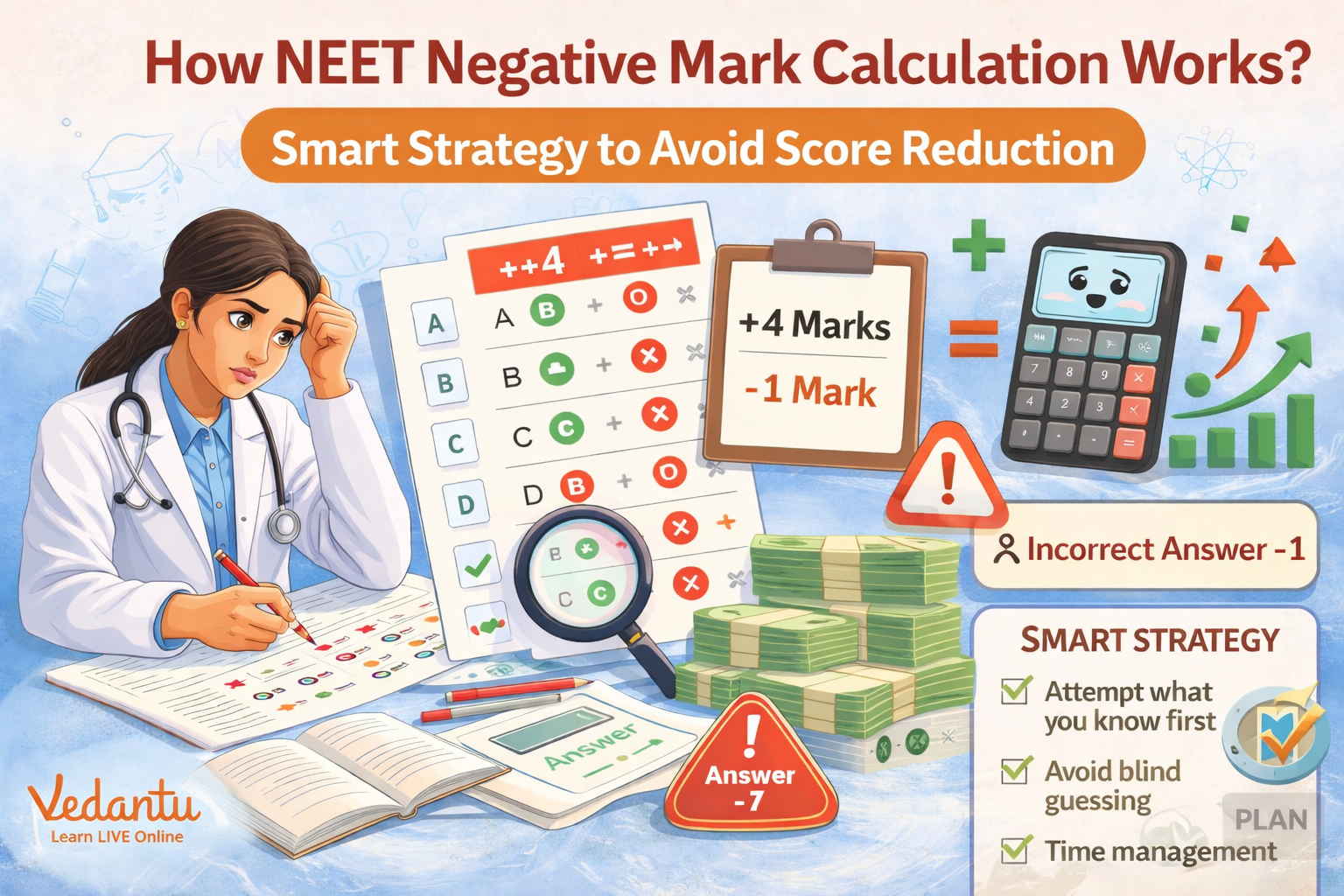
Understanding the NEET marking system is important to avoid unnecessary marks deduction. In NEET UG 2026, each correct answer gives you +4 marks, while every wrong answer results in a -1 penalty. No marks are deducted for unattempted questions, making smart question selection very important.
Also Check: NEET Exam Pattern
NEET Negative Marking Rules Explained
To score well in NEET UG 2026, understanding the marking rules is just as important as studying the NEET 2026 Syllabus. The exam is divided into Physics, Chemistry, and Biology (Botany & Zoology), and each question has four options with only one correct answer.
Here’s how the marking works:
Correct Answer: +4 marks awarded
Incorrect Answer: -1 mark deducted
Unattempted Question: 0 marks (no gain, no loss)
This system ensures that accuracy matters more than guesswork. Students who answer confidently and avoid random attempts are more likely to achieve a higher score.
Also Read: NEET Total Marks
How to Calculate Negative Marking in NEET 2026?
Understanding how your NEET score is calculated can help you avoid unnecessary mark deductions and attempt questions more strategically. The calculation is simple and based on your correct and incorrect answers.
Step-by-Step method:
Count the number of correct answers and multiply by 4
Count the number of incorrect answers and multiply by 1
Subtract the negative marks from the total positive marks
Formula:
NEET Score = (Correct Answers × 4) − (Incorrect Answers × 1)
Example Calculation
Let’s take another example to understand it better:
Correct Answers = 120 → 120 × 4 = 480 marks
Incorrect Answers = 15 → 15 × 1 = 15 marks deducted
Final Score = 480 − 15 = 465 marks
Also Check: NEET 500 Challenging Most Repeated Questions
How Negative Marking in NEET 2026 Can Lower Your Rank Even After Good Attempts?
In NEET 2026, even a single mark can significantly impact your All India Rank. Since many students score similar marks, a small loss due to negative marking can affect your chances of getting into your preferred medical college.
Negative marking can quickly bring down your total score. Even if you answer many questions correctly, a few incorrect attempts can reduce your final marks and rank. For example, if two students have the same number of correct answers, the one with fewer wrong answers will always have a better rank.
That’s why smart answering is key. Avoiding unnecessary guesses and knowing when to skip a question can make a big difference in your overall performance. In NEET, accuracy matters just as much as knowledge.
Read: How Many Students Will Appear for NEET?
Best Strategies to Avoid Negative Marking in NEET 2026
Negative marking can lower your NEET score faster than you expect, especially when wrong answers come from guesswork, panic, or poor time management. The good news is that you can reduce unnecessary mistakes by following a few smart exam strategies. Here are some practical tips to avoid negative marking in NEET Exam 2026:
1. Do Not Guess Randomly
Random guessing is one of the biggest reasons students lose marks in NEET UG 2026. If you are completely unsure about an answer, it is better to leave the question than risk a wrong attempt. Attempt only when you have enough confidence.
2. Skip Tricky Questions First
If a question looks confusing or takes too much time, move ahead and come back to it later. This helps you protect your score and prevents panic during the exam.
3. Use the Elimination Method
When you are not fully sure, try removing the options that are clearly incorrect. This improves your chances of selecting the right answer and makes your attempt more logical instead of random.
4. Attempt Easy Questions First
Start with questions you are confident about. This saves time, boosts confidence, and helps you secure marks early in the paper. Once the easier questions are done, you can use the remaining time for tougher ones.
5. Manage Your Time Smartly
Do not spend too long on one question. If you get stuck, move on and return later if time is left. Good time management helps you avoid rushed decisions and silly mistakes.
6. Practice with Mock Tests
Regular mock tests help you understand your accuracy level, weak areas, and question selection strategy. They also train you to avoid guesswork and improve speed under exam pressure.
Also Check:
FAQs on Negative Mark in NEET 2026: Marking Scheme, Impact, How to Calculate to Avoid Marks Loss
1. How many marks are given for a correct answer in NEET 2026?
You get +4 marks for every correct answer, while a negative mark in NEET UG 2026 is applied for wrong answers.
2. What happens if I skip a question in NEET 2026?
No marks are given or deducted. Skipping helps you avoid unnecessary negative marks.
3. How can I calculate my NEET score 2026?
Use this formula: (Correct × 4) − (Wrong × 1). This helps you understand how a negative mark in the NEET exam affects your total score.
4. How can I avoid negative marking in NEET 2026?
Attempt only the questions you are confident about. Avoid guessing to reduce negative marks for NEET 2026.
5. Is there any negative mark in NEET 2026?
Yes, there is negative marking in NEET. You get +4 marks for correct answers, -1 for wrong answers, and 0 for unattempted questions, so it’s better to skip than risk a negative mark in NEET UG 2026 exam.
6. How does NEET negative mark calculation work?
The NEET negative mark calculation is simple: multiply correct answers by 4, wrong answers by 1, and subtract the negative marks from the total.
7. Can I use a NEET negative marking calculator?
Yes, a NEET negative marking calculator helps you quickly estimate your score based on correct and incorrect answers.
8. Does negative marking affect NEET rank significantly?
Yes, even a few wrong answers can lower your score and rank, especially in competitive ranges where small differences matter.
9. Should I guess answers in NEET 2026 if I am unsure?
No, random guessing increases the risk of losing marks due to negative marking. It is better to skip uncertain questions.
10. How many wrong answers can reduce my NEET score?
Each wrong answer deducts 1 mark, so multiple incorrect attempts can significantly reduce your overall score.
