Well Labelled Diagram of Kidney and Nephron with Functions (for NEET)
The concept of diagram of kidney and nephron is essential in biology and helps explain real-world biological processes and exam-level questions effectively.
Understanding Diagram of Kidney and Nephron
Diagram of kidney and nephron refers to the visual representation of the structure and arrangement of the human kidney and its functional unit—the nephron. This concept is important in areas like human excretory system diagram, structure of nephron, and kidney diagram for NEET. Understanding these diagrams helps in labelling questions, remembering functions, and solving NEET Biology MCQs related to the excretory system.
Structure and Parts of Kidney and Nephron
The human kidney is a bean-shaped organ responsible for filtering blood and producing urine. Each kidney contains about 1 million nephrons, which are the functional units that carry out filtration and reabsorption. Below are the key parts:
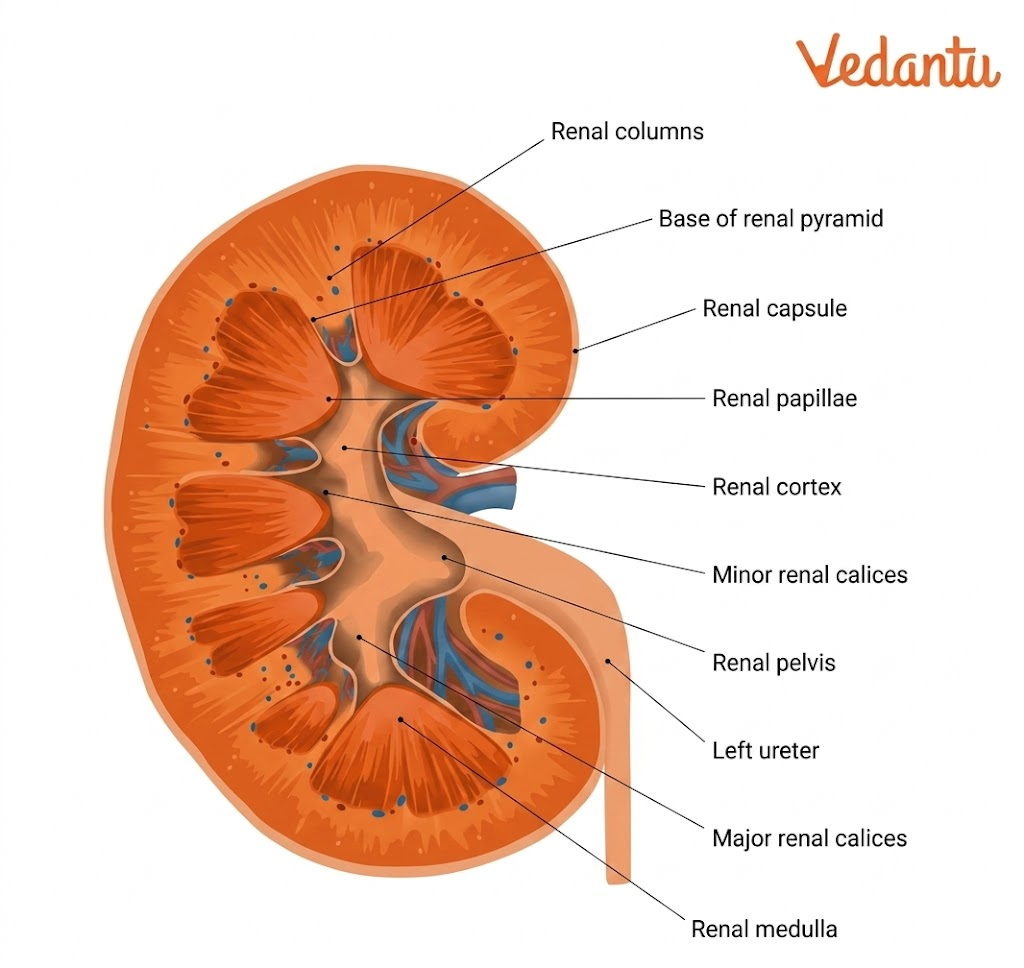
- Renal cortex: Outer layer containing glomeruli and convoluted tubules.
- Renal medulla: Inner region containing renal pyramids.
- Renal pelvis: Funnel-shaped structure collecting urine from calyces.
- Renal artery and vein: Blood supply in and out of the kidney.
- Ureter: Drains urine to the urinary bladder.
- Hilum: Curved notch where vessels and ureter enter/exit.
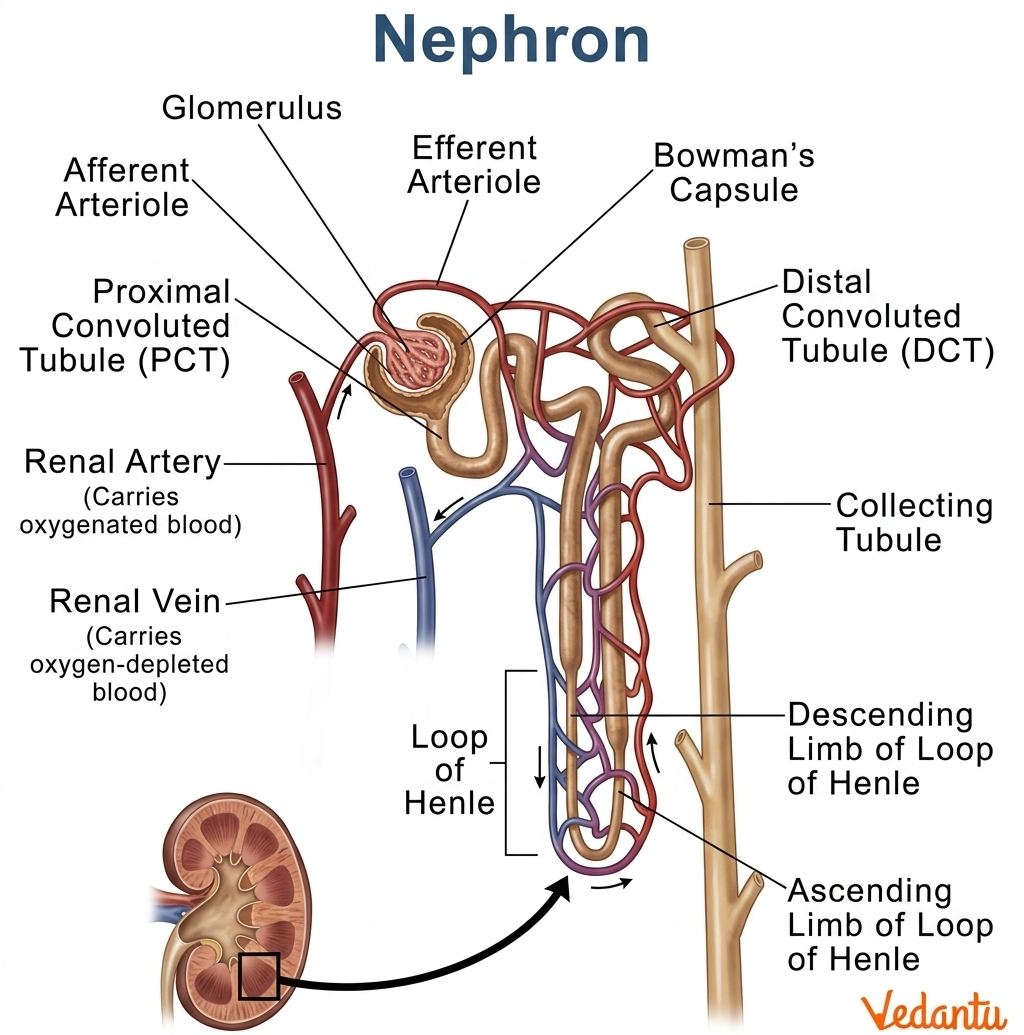
Parts of a nephron: Glomerulus, Bowman's capsule, Proximal Convoluted Tubule (PCT), Loop of Henle, Distal Convoluted Tubule (DCT), and Collecting duct. Each part has a unique function in the process of urine formation.
Here’s a helpful table to understand diagram of kidney and nephron better:
Kidney and Nephron Parts & Functions
| Part | Function | Occurs In |
|---|---|---|
| Renal cortex | Houses glomeruli and convoluted tubules | Kidney |
| Renal medulla | Contains pyramids, important for urine concentration | Kidney |
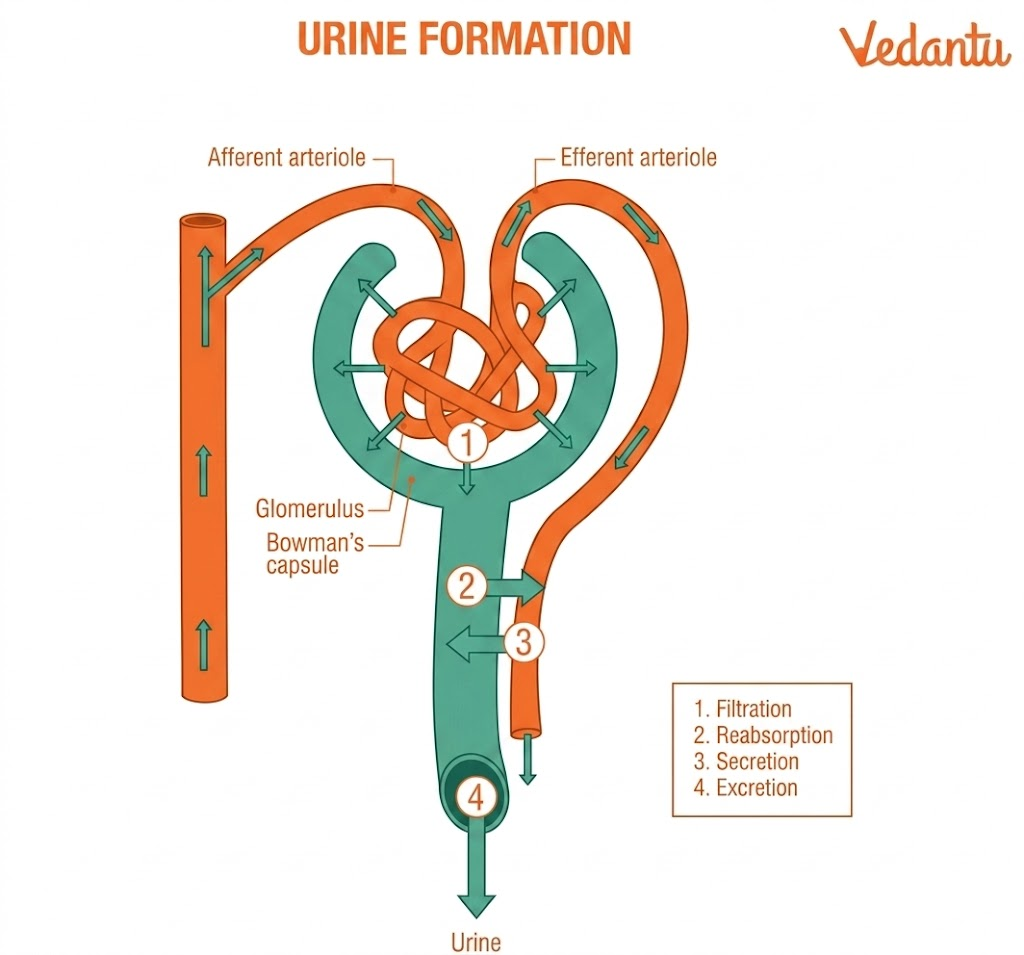
| Glomerulus | Filters blood plasma | Nephron |
| Bowman's capsule | Receives filtrate from glomerulus | Nephron |
| PCT | Reabsorbs water, ions, nutrients | Nephron |
| Loop of Henle | Forms osmotic gradient, concentrates urine | Nephron |
| DCT | Reabsorbs salts, secretes ions | Nephron |
| Collecting duct | Final concentration, channels urine to pelvis | Nephron/Kidney |
Quick Memory Aids for NEET Diagrams
- Remember “CBPLDC” for nephron order: Capsule, Bowman's, Proximal, Loop, Distal, Collecting duct.
- Renal cortex is always superficial; medulla is deeper.
- Draw arrows for filtration and flow direction.
- Avoid confusing DCT and PCT locations in diagrams.
- Practice labelling online quizzes to reinforce memory.
Worked Example – Diagram Labelling
Let’s understand how to label the diagram step by step:
1. Draw the kidney outline with cortex, medulla, pelvis, and hilum.
2. Sketch in major blood vessels: renal artery (entry), renal vein (exit), ureter.
3. Inside, show a basic nephron with glomerulus and tubules—label Glomerulus, Bowman's capsule, PCT, Loop of Henle, DCT, Collecting duct.
Final Understanding: Each labelled part matches a key function asked in NEET MCQs.
Practice Questions
- Draw and label a well-labelled diagram of kidney and nephron for NEET.
- List the main parts of a nephron and their functions.
- What is the role of the loop of Henle in urine concentration?
- How do renal cortex and medulla differ in structure and function?
- Which part of the nephron is mainly responsible for blood filtration?
Common Mistakes to Avoid
- Confusing diagram of kidney and nephron with other excretory system diagrams (such as liver or bladder).
- Swapping PCT and DCT positions or omitting Bowman's capsule in nephron.
- Forgetting to label cortex and medulla in the kidney outline.
- Not indicating flow of filtrate or blood in diagrams.
Real-World Applications
The concept of diagram of kidney and nephron is used in fields like medicine (nephrology), dialysis, urine analysis, and kidney transplantation. It is also important for understanding clinical cases such as kidney stones, renal failure, and urine infections. Vedantu helps students relate such topics to practical examples in daily life and ace their NEET Biology exam.
In this article, we explored diagram of kidney and nephron, its key processes, real-life significance, and how to solve questions based on it. To learn more and build confidence, keep practicing with Vedantu and review topic pages regularly before NEET exams.
Further Reading – Related Concept Links
- Human Excretory System – Complete overview of organs and functions
- Nephron – Structure and function in detail
- Structure of Kidney – In-depth study of kidney zones
- Excretion and Its Importance – Why excretion is vital for living systems
- Modes of Excretion – Animal excretory products and strategies
- Countercurrent Mechanism – Urine concentration in nephrons
- Loop of Henle – Special segment of nephron for NEET
- Kidney Failure Symptoms – Clinical connections for NEET application
- Renal Pyramids – Medulla structures and their labelling
- Kidney Stone Symptoms – Disease applications in diagram studies
FAQs on Kidney and Nephron Diagram for NEET – Parts and Structure Explained
1. What is the structure of the kidney and nephron in NEET?
The **kidney** is a bean-shaped organ consisting of the **renal cortex** (outer layer) and **renal medulla** (inner layer). It includes parts like the **renal artery**, **renal vein**, **ureter**, **pelvis**, and **renal calyces**. The **nephron**, the functional unit of the kidney, is composed of the **renal corpuscle** (including the **glomerulus** and **Bowman’s capsule**) and the **renal tubule** (consisting of the **proximal convoluted tubule (PCT)**, **loop of Henle**, **distal convoluted tubule (DCT)**, and **collecting duct**). This structure filters blood to form urine and maintain homeostasis, all crucial points for NEET Biology.
2. How to memorise the diagram of kidney and nephron quickly?
To memorise the **kidney and nephron diagram** quickly, use these tips:
• Focus on learning parts in logical order from outer **renal cortex** to inner **medulla**.
• Use visual mnemonics to remember the sequence of nephron parts: glomerulus → Bowman’s capsule → PCT → loop of Henle → DCT → collecting duct.
• Practice drawing and labelling regularly.
• Compare diagrams with real images to avoid confusion between similarly named parts like **PCT** and **DCT**.
• Create flashcards to reinforce terms and functions.
3. What are the parts of a nephron?
A **nephron** consists of:
1. **Renal corpuscle**:
• **Glomerulus** – a network of capillaries for blood filtration.
• **Bowman’s capsule** – cup-shaped structure enclosing the glomerulus.
2. **Renal tubule**:
• **Proximal convoluted tubule (PCT)** – site of reabsorption.
• **Loop of Henle** – establishes concentration gradient.
• **Distal convoluted tubule (DCT)** – secretion and selective reabsorption.
3. **Collecting duct** – collects urine from multiple nephrons and directs it to renal pelvis.
4. How to draw a well labelled diagram of kidney for NEET?
To draw a **well-labelled diagram of the kidney** for NEET:
• Start with a **bean-shaped outline** representing the kidney.
• Mark the **renal cortex** (outer layer) and **renal medulla** (inner pyramids).
• Indicate the **renal hilum**, where **renal artery**, **renal vein**, and **ureter** are located.
• Draw the **renal pelvis**, formed by **major and minor calyces**.
• Include a detailed **nephron diagram** alongside, labelling all parts clearly.
• Use clear, legible handwriting and arrows for parts to avoid confusion.
• Practice multiple times to improve speed and accuracy under exam conditions.
5. Can labels of kidney and nephron be asked in NEET MCQ?
Yes, **label-based questions** on the **kidney and nephron** are common in NEET MCQs and diagram-based questions. These may involve:
• Identifying labelled parts like **glomerulus**, **Bowman’s capsule**, or **loop of Henle**.
• Recognising the function of labelled kidney parts.
• Differentiating between structures such as **renal artery** and **renal vein**.
Careful diagram revision and understanding of structure-function relationships are essential to correctly answer these questions.
6. Why do students often confuse PCT and DCT in labelling?
Students often confuse the **proximal convoluted tubule (PCT)** and **distal convoluted tubule (DCT)** because both are convoluted tubules part of the nephron tubule system. The confusion arises due to:
• Similar appearance in diagrams.
• Close physical proximity in the nephron.
Tip: Remember that the **PCT** comes immediately after **Bowman’s capsule** and is involved mainly in reabsorption, while the **DCT** is located further along after the loop of Henle and primarily handles secretion and selective reabsorption.
7. How to avoid missing renal artery/vein when labelling under time pressure?
To avoid missing the **renal artery** and **renal vein** during labelling in exams:
• Memorise that both enter and exit through the **renal hilum**, the concave part of the kidney.
• Practice quick sketches highlighting the hilum with clear marking of artery (usually depicted in red) and vein (depicted in blue).
• Use mnemonic devices linking arteries with 'Oxygenated blood IN' and veins with 'Deoxygenated blood OUT'.
• Time yourself during practice to build speed and accuracy.
8. Why is marking the loop of Henle direction important?
Marking the **loop of Henle's** direction is important because:
• The descending limb is permeable to water but not solutes, while the ascending limb is impermeable to water but actively transports salts.
• Correct direction shows understanding of its role in urine concentration and countercurrent mechanism.
• Errors in drawing can lead to loss of marks in diagram-based NEET questions.
• It reflects conceptual clarity about **osmotic gradient formation** in the kidney medulla.
9. Are spellings like “Bowman's capsule” checked in NEET OMR-type?
Yes, correct spelling of terms such as **"Bowman’s capsule"** is important in NEET exams, especially in descriptive and diagram labelling sections. Though NEET OMR-type MCQs may not directly assess spelling, clarity and accuracy in written answers enhance examiner confidence and can impact partial scores in diagram and short-answer questions.
10. Does every NEET set have a diagram question on the kidney/nephron?
While not guaranteed, it is very common for NEET exam sets to include at least one **diagram-based question** on the **kidney/nephron** due to its high syllabus weightage in the **Human Excretory System** chapter. Students should prepare thoroughly for drawing, labelling, and explaining this diagram to secure marks in the exam.