



Stepwise Answers and Physical vs Chemical Changes Explained
Question 1.
(Page 57)
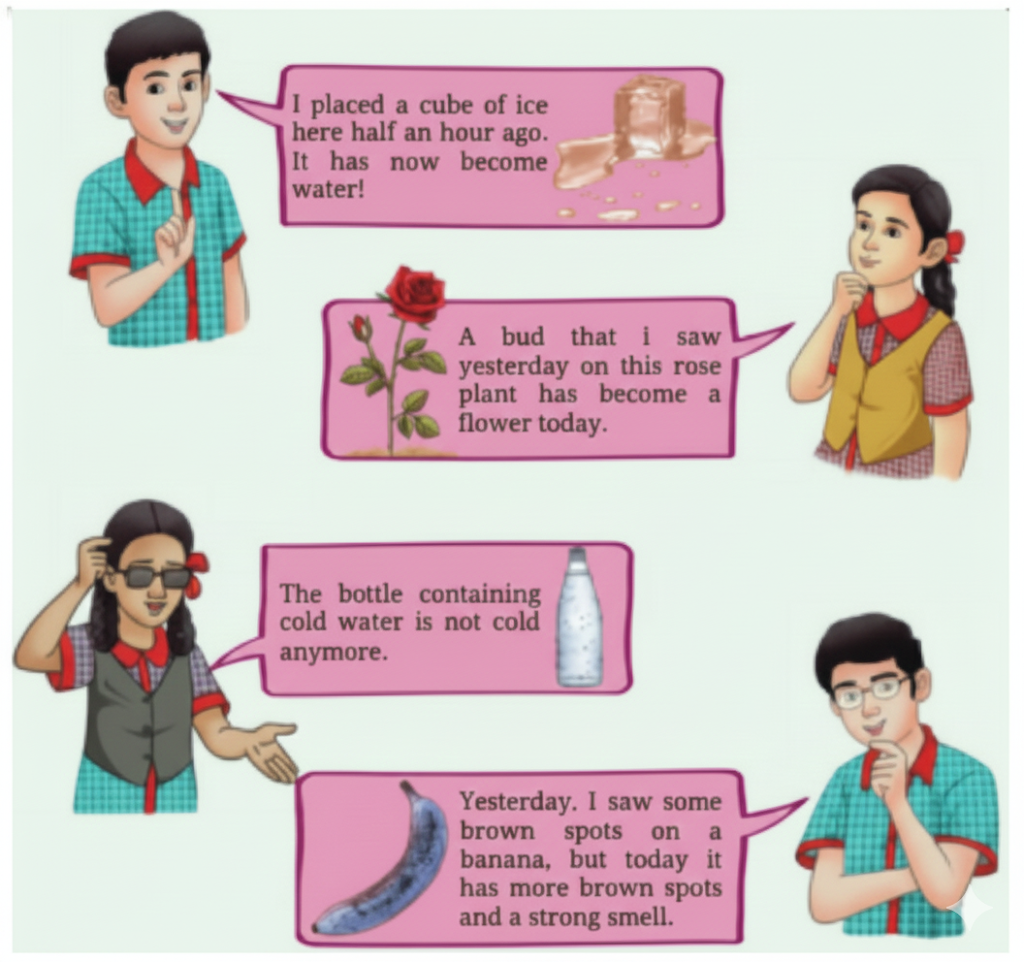
These students are describing some changes. What kinds of changes are they talking about?
Answer:
Ice melts to form water. This is a physical change because only the state of water changes from solid to liquid, while the substance remains the same.
A bud blooming into a flower is a chemical change because it cannot return to its original bud stage, and internal chemical changes occur.
Cold water becomes warm when kept in the open. This is a physical change since the water itself remains unchanged and only its temperature increases.
The rotting of a banana is a chemical change because its composition and texture are permanently altered.
Let Us Enhance Our Learning
Question 1.
Which of the following statements are the characteristics of a physical change?
(i) The state of the substance may or may not change.
(ii) A substance with different properties is formed.
(iii) No new substance is formed.
(iv) The substance undergoes a chemical reaction.
(a) (i) and (ii)
(c) (i) and (iii)
(b) (ii) and (iii)
(d) (iii) and (iv)
Answer:
(c) (i) and (iii)
(i) The state of a substance may change or remain the same—physical changes can include changes in state, such as melting or freezing, but they do not produce a new substance.
(iii) No new substance is formed—in a physical change, the material stays the same and only its form or state is altered.
Question 2.
Predict which of the following changes can be reversed and which cannot be reversed. If you are not sure, you may write that down. Why are you not sure about these?
(i) Stitching cloth to a shirt
Answer:
Stitching cloth into a shirt – This change cannot be easily reversed, as undoing the stitching may damage the fabric.
(ii) Twisting of straight string
Answer: Twisting a straight string – This change is reversible, as the string can be untwisted.
(iii) Making idlis from a batter
Answer: Making idlis from batter – This change is irreversible, as the batter cannot be brought back to its original state after steaming.
(iv) Dissolving sugar in water
Answer:
Dissolving sugar in water – This is a reversible change, as the sugar can be obtained again by evaporating the water.
(v) Drawing water from a well
Answer: Drawing water from a well – This is a reversible action, as the water can be put back into the well.
(vi) Ripening of fruits
Answer: Ripening of fruits – This change is irreversible, as fruits cannot return to their unripe state once they have ripened.
(vii) Boiling water in an open pan
Answer: Boiling water in an open pan – This is a reversible change, as the water vapour can be converted back into liquid water through condensation.
(viii) Rolling up a mat
Answer: Rolling up a mat – This is a reversible change, as the mat can be easily unrolled again.
(ix) Grinding wheat grains to flour
Answer: Grinding wheat grains into flour – This change is irreversible, as the flour cannot be converted back into whole grains.
(x) Forming of soil from rocks
Answer: Formation of soil from rocks – This is an irreversible change, as soil is produced over a long period and cannot be converted back into rock.
Question 3.
State whether the following statements are True or False. In case a statement is False, write the correct statement.
1. Melting of wax is necessary for burning a candle. (True/False)
Answer:
True
2. Collecting water vapour by condensing involves a chemical change. (True/False)
Answer:
False: Condensing water vapour to collect it is a physical change.
3. The process of converting leaves into compost is a chemical change. (True/False)
Answer:
True
Question 4.
Mixing baking soda with lemon juice is a chemical change. (True/False)
Answer:
True
Question 4.
Fill in the blanks in the following statements:
(i) Nalini observed that the handle of her cycle has got brown deposits. The brown deposits are due to ______ and this is a ______ change.
Answer:
rusting, chemical
(ii) Folding a handkerchief is a ______ change and can be ______ .
Answer:
physical, reversed
(iii) A chemical process in which a substance reacts with oxygen with evolution of heat is called ______, and this is a ______
change.
Answer:
combustion, chemical
(iv) Magnesium, when burnt in air, produces a substance called ______. The substance formed is ______ in nature. Burning of magnesium is a ______ change.
Answer:
magnesium oxide, basic, chemical
Question 5.
Are the changes of water to ice and water to steam, physical or chemical? Explain.
Answer:
Both the change of water into ice and the change of water into steam are physical changes. In both cases, the chemical nature of water remains unchanged, and only the state changes—from liquid to solid in ice and from liquid to gas in steam. Since no new substance is produced, these changes are classified as physical changes.
Question 6.
Is curdling of milk a physical or chemical change? Justify your statement.
Answer:
The curdling of milk is a chemical change because the milk undergoes a reaction with acids or bacteria, resulting in the formation of new substances such as curd. Since this change cannot be reversed, it is classified as a chemical change.
Question 7.
Natural factors, such as wind, rain, etc., help in the formation of soil from rocks. Is this change physical or chemical and why?
Answer: The formation of soil from rocks occurs through a combination of physical and chemical changes. Natural agents such as wind, rain, and temperature variations break rocks into smaller fragments, which is a physical change. At the same time, chemical processes like weathering alter the minerals present in the rocks. Together, these physical and chemical changes lead to the formation of soil.
Question 8.
Read the following story titled ‘Eco-friendly Prithin’, and tick the most appropriate option(s) given in the brackets. Provide a suitable title of your choice for the story.
Prithvi is preparing a meal in the kitchen. He chops vegetables, peels potatoes, and cuts fruits (physical changes/chemical changes). He collects the seeds, fruits, and vegetable peels into a clay pot (physical change/ chemical change). The fruits, vegetable peels, and other materials begin to decompose due to the action of bacteria and fungi, forming compost (physical change/chemical change). He decides to plant seeds in the compost and water them regularly. After a few days, he notices that the seeds begin to germinate and small plants start to grow, eventually blooming into colourful flowers (physical change/chemical change). His efforts are appreciated by all his family members.
Answer:
Prithvi’s Green Kitchen
Prithvi chops vegetables, peels potatoes, and cuts fruits — these are physical changes.
He gathers seeds, fruit scraps, and vegetable peels in a clay pot — this is a physical change.
The collected fruits, vegetable peels, and other waste gradually decompose to form compost — this is a chemical change.
The seeds then germinate and grow into plants — this is also a chemical change.
Question 9.
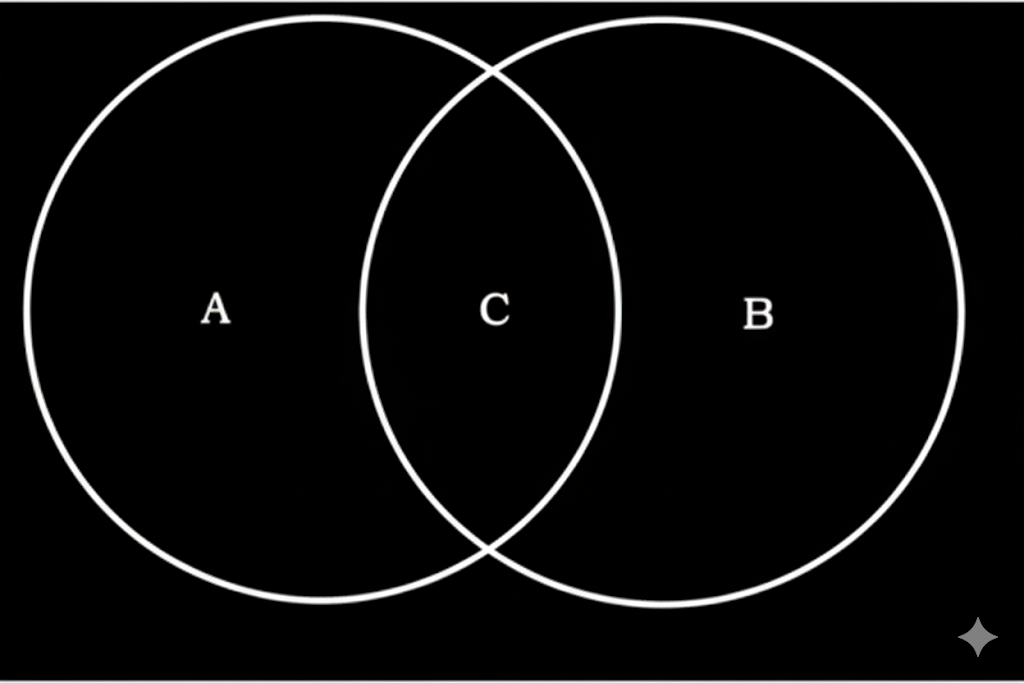
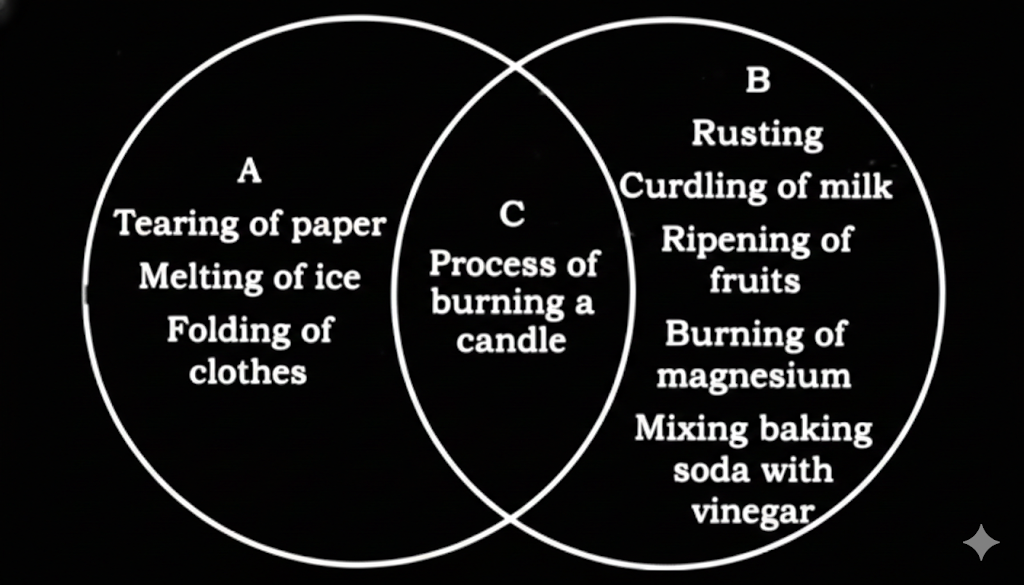
Some changes are given here. Write physical changes in the area marked ‘A’ and chemical changes in the area marked ‘B’. Enter the changes which are both physical and chemical in the area marked ‘C
Process of burning a candle; Tearing of paper; Rusting; Curdling of milk; Ripening of fruits; Melting of ice; Folding of clothes; Burning of magnesium and Mixing baking soda with vinegar.
Answer:
Question 10.
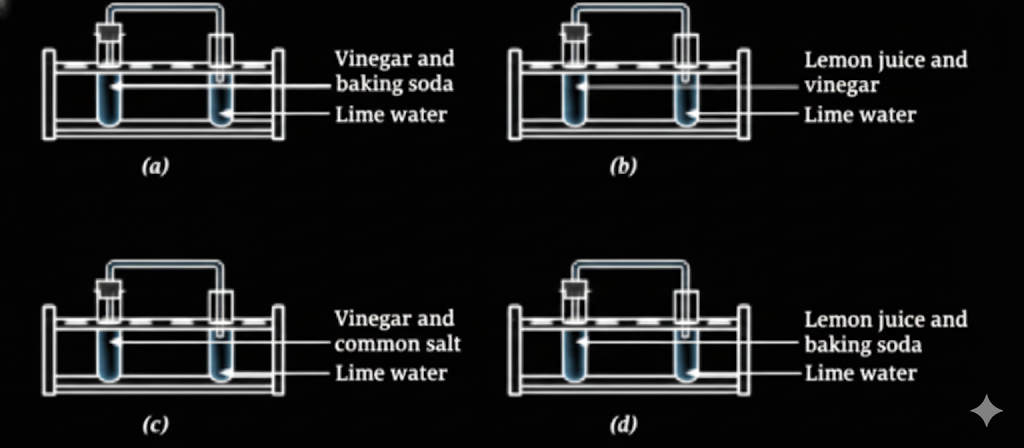
The experiments shown in Fig. 5.11a, b, c, and d were performed. Find out in which case(s) did lime water turn milky and why?
Answer:
In Figure (a), vinegar reacts with baking soda to produce carbon dioxide gas. This gas passes through the straw into the test tube containing lime water, where it reacts to form calcium carbonate. The formation of this white solid makes the lime water turn milky.
Carbon dioxide + Lime water (Calcium hydroxide) → Calcium carbonate (white insoluble substance) + Water
Activity 5.1 Let Us Think and Reflect (Page 58)
Conclusion:
These changes can be grouped into two categories: one in which only the shape, size, or state of a substance changes, and another in which one or more new substances are formed.
Activity 5.2: Let Us Create and Discuss (Page 59)
Changes listed in A, B and C are as follows:
A. Creating some objects with paper: When we create different objects like aeroplane, boat, bird, etc. by folding a sheet of paper, only shape and size changes. We can get back the original sheet by unfolding it again.
B. Playing with a balloon: When we loosen the grip of the inflated balloon we get the original shape of balloon back, and we can inflate it again but when we prick the inflated balloon with a pin, it gets deflated with a hole in it, so we cannot able to inflate it again.
C. Crushing a piece of chalk: When we crushed a piece of chalk to powder form, we cannot can get back the original piece of a chalk.
Observation and conclusion: In all these types of changes, material (piece of paper, balloon, chalk) remains the same but their size and shape changes only. Thus, these are examples of physical changes.
Activity 5.3: Let Us Create and Discuss (Page 60)
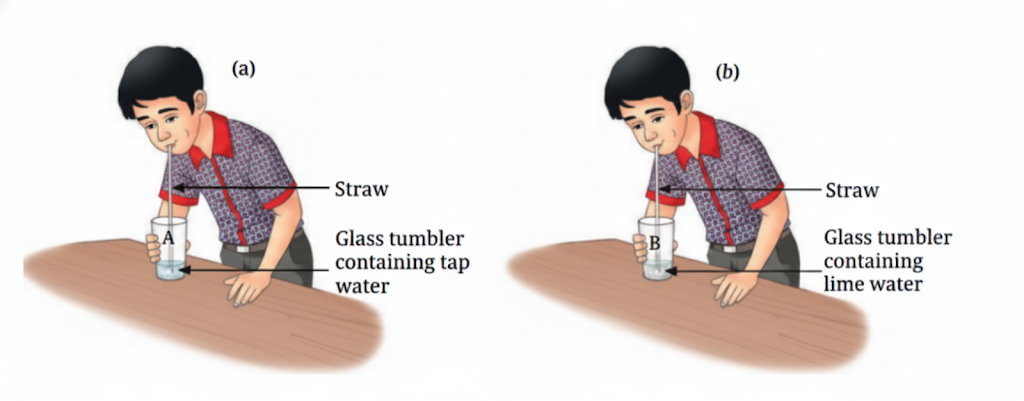
Observation and Conclusion:
When air (carbon dioxide) is blown into tumbler A containing water, no change in the colour of the water is observed. However, when air is blown into tumbler B containing lime water (calcium hydroxide), the lime water turns milky and a white, insoluble substance called calcium carbonate settles at the bottom. This change is classified as a chemical change because a new substance is formed.
Carbon dioxide + Lime water (calcium hydroxide) → Calcium carbonate (milky) + Water
Activity 5.4: Let Us Experiment (Page 61)
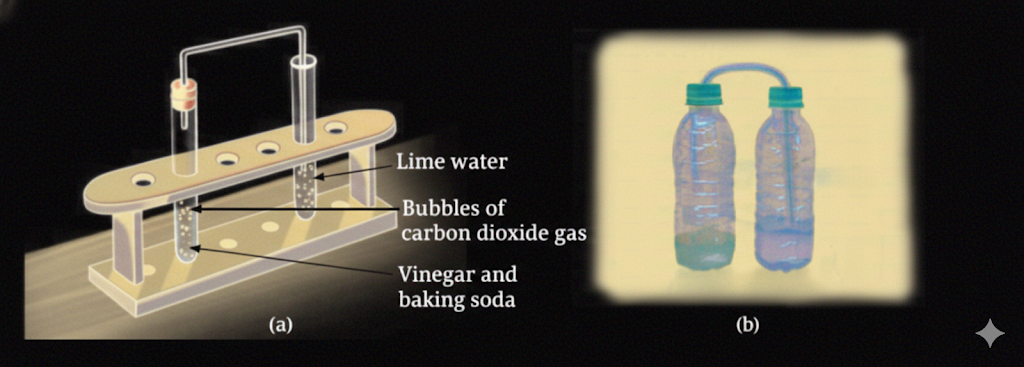
Vinegar + Baking soda → Carbon dioxide + Other substances
Observation and Conclusion:
When a small amount of baking soda (sodium hydrogen carbonate) is added to vinegar or lemon juice, carbon dioxide gas is released with a fizzing sound. Passing this gas through lime water turns it milky. Since new substances are formed during this process, it is identified as a chemical change.
Activity 5.5: Let Us Investigate (Pages 62-63)
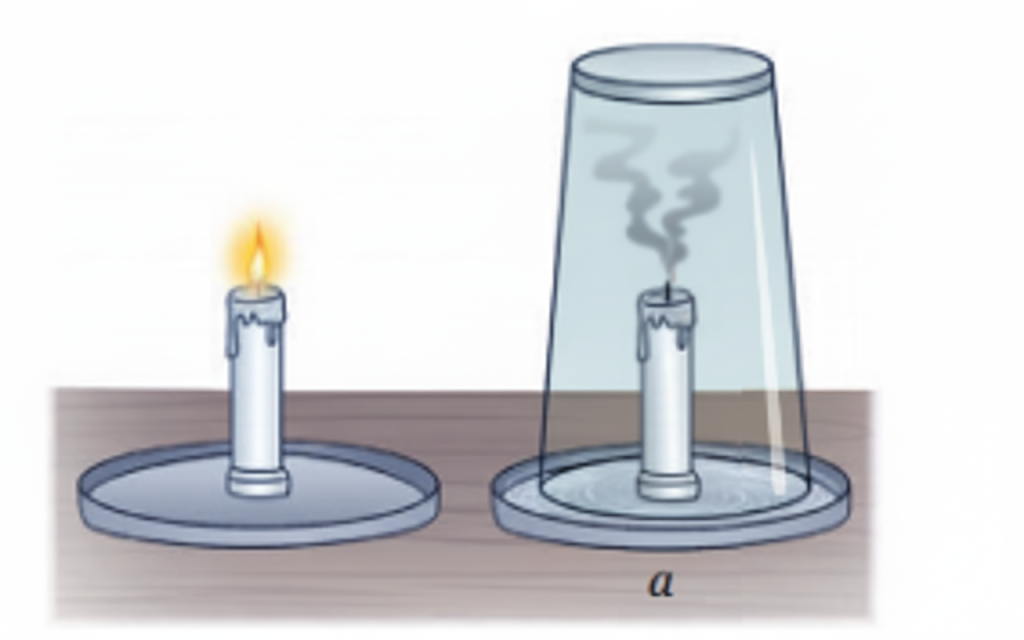
Observation and Conclusion:
In figure (a), the candle continues to burn because it is uncovered and has a constant supply of air (oxygen). In figure (b), the candle is covered with a glass tumbler, which cuts off the continuous supply of air, causing the flame to go out. This shows that oxygen is necessary for combustion.
Activity 5.6: Let Us Investigate (Page 64)
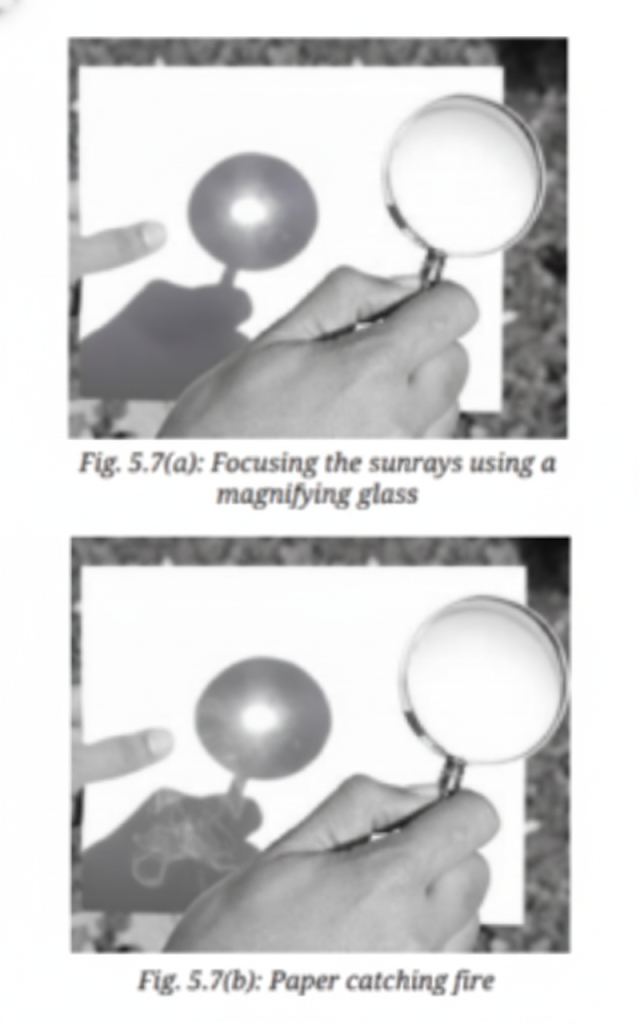
Observation and conclusion: The substance catches fire only when its ignition temperature is reached. Ignition temperature is the minimum temperature at which the substance catches fire. When a lighted matchstick is brought near to the paper it catches fire immediately because the temperature of the matchstick is already higher that the ignition temperature of the paper. In another case, when sunrays are focused using a magnifying glass on a piece of paper, it gets heated up and the temperature of paper increases and it attains its ignition temperature and starts burning and emit smoke.
Requirements for combustion process to occur:
A combustible substance (fuel)
Oxygen
Attainment of ignition temperature.
Activity 5.7: Think, Pair, and Share (Page 65)
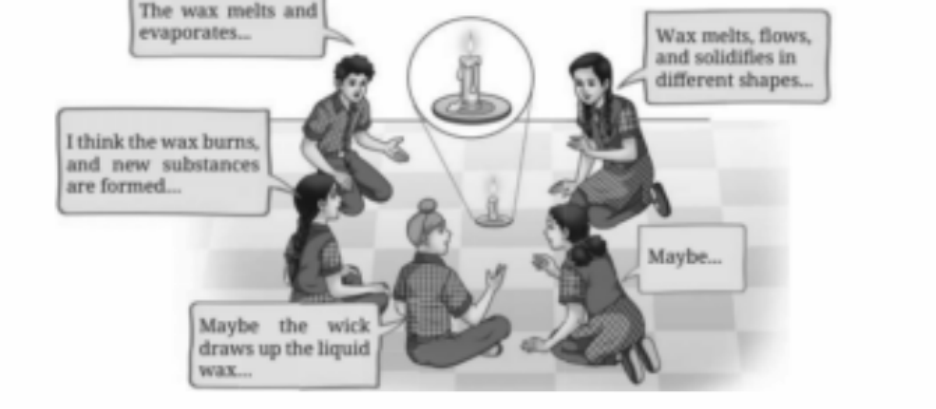
Conclusion:
The burning of a candle includes both physical and chemical changes. The melting of wax, its evaporation into wax vapour, and the re-solidification of melted wax are physical changes. However, when the wax burns and forms new substances such as carbon dioxide, it is a chemical change.
Activity 5.8: Let Us Think (Page 66)
Table 5.2; Can changes be reversed?
Conclusion: Changes around us can be grouped into reversible (original substance can be brought back) and irreversible (original substance cannot be brought back) changes.
Changes Around Us: Physical and Chemical – Key Concepts for Class 7 Science
Learning the difference between physical and chemical changes is crucial for Class 7 students. Understanding what happens when substances react or change state can help build a strong science foundation for higher classes and competitive exams.
With plenty of real-life examples like rusting of iron or melting ice, this chapter builds curiosity. Exam questions often test your conceptual clarity, so focus on the observable features of each change in your daily life.
Practice identifying reversible and irreversible changes in activities and MCQs. Use diagrams and always note when a new substance is formed to excel in the “Changes Around Us: Physical and Chemical” chapter for the 2026-27 session.
FAQs on NCERT Solutions For Class 7 Science Chapter 5 Changes Around Us: Physical and Chemical - 2026-27 Free PDF Download (Sign-in Required)
1. What are physical and chemical changes?
Physical and chemical changes are two types of changes observed in science, especially in NCERT Solutions for Class 7 Science Chapter 5.
Physical Change:
- No new substance is formed
- Often reversible (e.g., melting ice)
- Properties like shape or state may change
Chemical Change:
- New substance(s) are produced
- Generally irreversible (e.g., rusting of iron)
- Accompanied by changes in colour, heat, gas, or precipitate
Understanding these changes helps in differentiating between various processes around us, which is crucial for CBSE exams.
2. How to differentiate between physical and chemical changes?
To differentiate, observe the outcome and process characteristics:
Physical Changes:
- No new substance formed
- May be reversible
- Change mainly in state, shape, or size
Chemical Changes:
- Accompanied by production of new substance(s)
- Usually irreversible
- Signs: change in colour, formation of gas, heat, or precipitate
Use these criteria in your NCERT Solutions for Class 7 Science Chapter 5 answers for full CBSE marks.
3. Is burning a physical or chemical change?
Burning is a chemical change because it forms new substances and cannot be reversed.
Key points:
- Produces new substances (ash, gases like CO₂)
- Heat and light are released
- Original material is changed permanently
This concept is explained in detail in Class 7 Science Chapter 5: Changes Around Us.
4. Are diagrams or definitions mandatory in answers?
Yes, in CBSE Class 7 Science exams, including diagrams and definitions is important for full marks.
- Accurate, labelled diagrams can fetch step marks
- Definitions help in answering theory-based questions confidently
- Follow NCERT language and marking guidelines
Always check the question type: diagrams are necessary for practical/process questions.
5. What are the most important topics from Class 7 Science Chapter 5?
Key topics for Chapter 5: Changes Around Us include:
- Definition and examples of physical and chemical changes
- Differences between the two
- Everyday examples (dissolving salt, burning paper, melting wax, rusting)
- Indicators of chemical change (gas, colour change, precipitate)
- Effects of heating and cooling
Focus on these areas to prepare well for board exams and NCERT-based questions.
6. How to write stepwise NCERT answers to score full marks?
To score full marks in CBSE and NCERT exercises:
- Write in clear, sequential steps
- Start with definitions or key statements
- Give relevant examples from the textbook
- Use neat diagrams and labels where required
- Follow the CBSE word limit and marking scheme
Use the stepwise format in your Class 7 Science Chapter 5 answers for best results.
7. Where can I download the Class 7 Science Chapter 5 NCERT Solutions PDF?
You can download free PDF NCERT Solutions for Class 7 Science Chapter 5 from trusted educational platforms.
- Look for the 'Free PDF Download' button on the solutions page
- PDFs are useful for offline revision and last-minute preparation
- Ensure the solutions match the 2026–27 CBSE syllabus
8. Are NCERT Solutions enough for Class 7 Science exams?
NCERT Solutions for Class 7 Science provide a strong foundation and cover almost all exam questions.
- Syllabus-aligned answers
- Stepwise explanations and examples
- Include definitions, diagrams, and revision tips
- For higher scores, practice with additional worksheets and exemplars
9. How do I structure long answers in CBSE Science to get better marks?
For long answers in Class 7 Science Chapter 5:
- Begin with an introduction or definition
- Use headings, sub-points, and examples
- Include relevant diagrams and label them clearly
- Summarise with a concluding line
- Use correct scientific terms and CBSE keywords
Organised answers help you secure full or stepwise marks.
10. Do examiners award partial marks for correct steps even if the final answer is wrong?
Yes, in CBSE exams, partial marks are awarded for correct steps or methods shown, even if the final answer is incorrect.
- Write every step clearly
- Show diagrams, calculations, and key reasoning
- Attempt all parts for best scoring
This method encourages thorough understanding and rewards effort.
11. How do I learn diagrams and map labelling for this chapter?
To master diagrams in Class 7 Science Chapter 5:
- Practice drawing labelled diagrams as in NCERT
- Use sharp pencils and clear labels
- Learn standard conventions (arrows, titles)
- Refer to solved NCERT examples
Accurate diagrams help gain easy marks in board and school exams.
12. What are some examples of physical and chemical changes from Class 7 Science Chapter 5?
Examples found in Chapter 5 NCERT Solutions:
Physical Changes:
- Melting of ice
- Dissolving salt in water
- Tearing paper
Chemical Changes:
- Burning of paper
- Rusting of iron
- Formation of curd from milk
Use these in answers to demonstrate understanding during exams.
