




Stepwise Answers & Marking Scheme for NCERT Class 5 EVS Chapter 3
Think (Page 42)
Question 1.
Have you ever had an upset stomach? Do you know what could have caused it? What could happen if spoiled food is eaten by mistake? If yes, what did you do to get well? Share your experiences with the class.
Answer:
Yes, I once had an upset stomach after eating something from a street vendor. The food didn’t seem fresh and was probably spoiled. Eating such food can lead to stomach ache, vomiting, diarrhoea, or even food poisoning. To recover, I visited a doctor, took the prescribed medicine, drank plenty of water, and ate light meals like curd and rice. Since then, I avoid street food and always check whether the food looks and smells fresh before eating it.
Intext (Page 42)
Question 1.
Why does some food spoil fast, and some last for a long time?
Answer:
Some foods get spoiled quickly because they have a lot of moisture and are easily affected by germs. But items like pickles stay good for a long time because they are kept in oil, salt, or vinegar, which prevent microbes from growing. Storing food properly helps it remain fresh for a longer period.
Write (Page 42)
Question 1.
Why do you think food gets spoiled?
Answer:
Food gets spoiled when bacteria and fungi start growing on it. These microbes multiply quickly when there is enough moisture, air, and suitable temperature. If food is not stored correctly, the microbes increase and make the food go bad.
Write (Page 44)
Question 1.
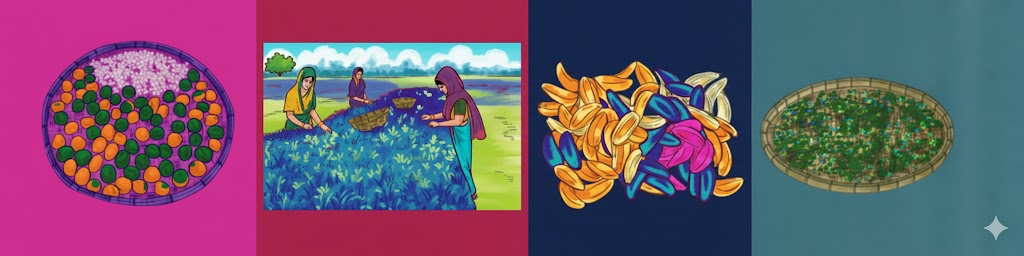
What other things are dried so that they remain unspoilt throughout the year?
Answer:
Other items that are dried to keep them from spoiling throughout the year include:
Fish
Herbs such as mint leaves
Potato chips
Amla (Indian gooseberry) pieces
Pumpkin seeds
Pulses
Turmeric
Red chillies
Dried raw mango slices
Activity 1 (Page 44)
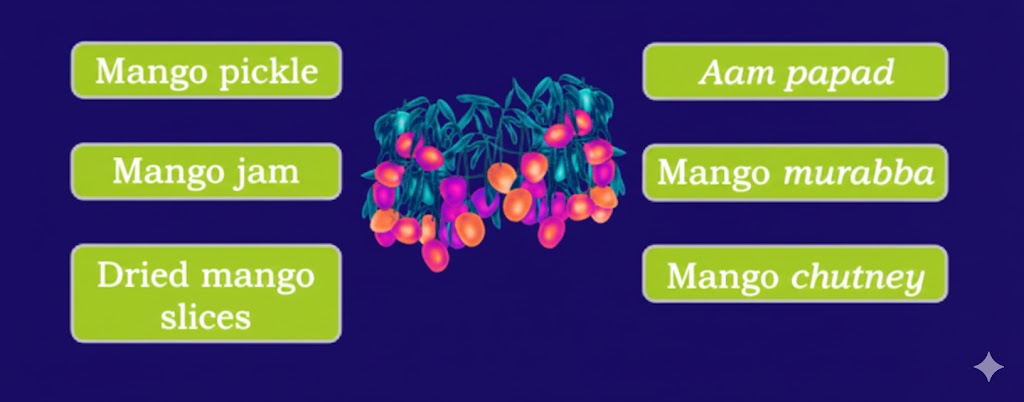
What items can be made from mangoes to enjoy them for longer durations? Write their names in the space given below.
Answer:
We can prepare various items using mangoes so that they can be enjoyed for a longer time, such as:
Activity 2 (Page 45)
1. Take a tomato and cut it into slices.
2. Put the slices of tomatoes on a tray and place it on the window where the sunlight comes through.
3. What changes did you observe in the fruit?
Can you think of a way to preserve items like tomato?
Answer:
After some days, the tomato slices became dry and smaller in size. They lost all their moisture and turned hard.
Yes, sun-drying is a preservation method that helps tomatoes and other foods stay fresh for a longer time without spoiling.
Discuss (Page 45)
Question 1.
What would happen to this pickle if no oil had been added?
Answer:
If oil were not added to the pickle, air could easily reach the mango pieces, allowing microbes to grow on them. This would cause the pickle to spoil quickly and become unsafe to eat. Oil acts as a barrier that blocks air and prevents the growth of microbes, which is why it is an important part of pickle making.
Intext (Page 46)
Question 1.
Why does butter need refrigeration and ghee does not?
Answer:
Butter must be kept in the refrigerator because it contains some water, and this moisture allows microbes to grow and spoil it. Ghee, on the other hand, is pure fat with no water content, so microbes cannot survive in it. This is why ghee can be stored without refrigeration.
Activity 3 (Page 46)
Question 1.
Find out about food preservation practices at your family by asking the elders at home. Write at least one such practice.
Answer:
(Answers may differ)
Dehydrating food
Keeping food in the refrigerator
Preserving through pickling and adding oil
Using salt for preservation
Salting
Salting is a method of preserving food by adding a large amount of salt. The salt draws out moisture from the food, making it difficult for microbes to survive. This technique is often used for fish, meat, and certain vegetables. With salting, the food stays unspoiled for a longer time and can be kept without refrigeration for several days or even weeks.
Intext (Page 47)
Question 1.
Can you find how idlis are made? Is there something that makes the idli batter fluffy? Do you know what it is?
Answer:
Idlis are prepared using soaked rice and lentils, which are ground to form a thick batter. This batter is left to rest for a while and is then steamed to make soft idlis. The batter becomes airy because of a process called fermentation. During fermentation, helpful bacteria create tiny air bubbles, making the idlis light and fluffy.
Think (Page 48)
Question 1.
Did you ever have an upset stomach, vomiting or indigestion? Did you use any home remedies? Write about the home remedy given to you.
Answer:
Yes, I once experienced indigestion and an upset stomach. As a home remedy, my mother gave me a small glass of buttermilk mixed with a little roasted cumin powder and salt. The good microbes present in buttermilk aid digestion and help calm the stomach.
Activity 4 (Page 49)
Question 1.
Do you ever accompany your elders for buying vegetables and fruits? During such visits, observe how elders select fruits and vegetables in the market.
Write one thing that you learnt from your shopping trip and write it as a Finding #9, the way Disha would write.
Answer:
Yes, I once accompanied my grandfather to the vegetable market. He always checked each fruit and vegetable carefully to make sure they were fresh, clean, and free from cuts or spots. Produce with damage spoils more quickly and can carry microbes that may cause illness if eaten. From him, I learned the importance of choosing fresh and good-quality fruits and vegetables to stay healthy and avoid falling sick.
Finding #9
Fruits and vegetables that have cuts or blemishes can contain microbes. These microbes can lead to faster spoilage and may cause illness when consumed.
Write (Page 50)
Question 1.
Name three seasonal fruits or vegetables of your region. For example, amla in winter and jamun in summer.
………..
………..
Answer:
Mangoes are available in summer.
Oranges are found in winter.
Ladyfinger grows mainly in the summer season.
Intext (Page 50)
Question 1.
What happens to food after we eat it?
Answer:
After we eat, the food enters the stomach, where it is broken down into simpler parts. The useful nutrients provide energy and support our growth, while the unwanted waste is later removed from the body.
Activity 5 (Page 50)
Question 1.
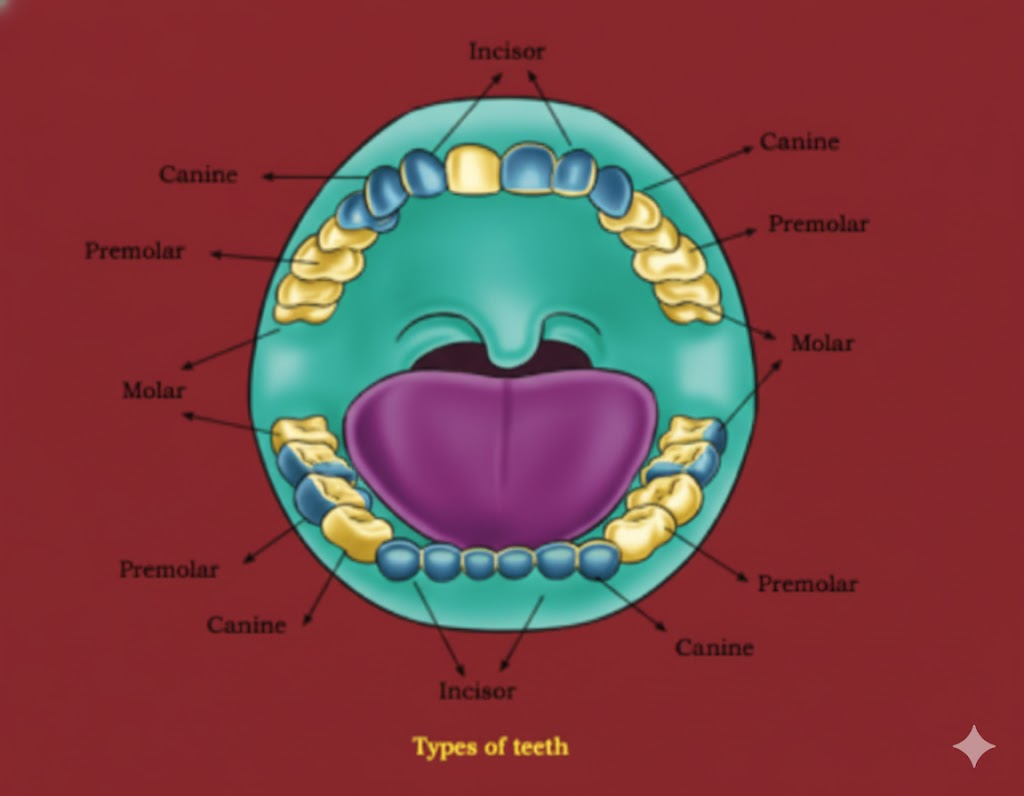
When you eat, try chewing each item properly till it breaks down into smaller pieces and then into mush. Which teeth did you use to cut and chew? Look at diagram given on page 51 and name them.
Answer:
I used my incisors to bite the food into smaller pieces, and then my molars helped crush and chew it until it became soft and easy to swallow.
Write (Page 53)
Question
How can you avoid choking?
………..
………..
………..
Answer:
To prevent choking, we should:
Take small bites.
Chew the food well before swallowing.
Eat at a slow pace and avoid talking or laughing while chewing.
Sit upright while eating and never lie down with food in the mouth.
Let Us Reflect (Pages 53-54)
Question 1.
Why do some food items last for weeks and others spoil in just a few days?
Answer:
Some foods stay good for many weeks because they are preserved by drying, salting, or storing in oil or sugar. These methods prevent microbes from growing and keep the food safe. Other foods go bad in just a few days because they contain moisture and are not preserved, allowing microbes to grow quickly and spoil them.
Question 2.
You are going on a field trip for two days. List five food items you will carry. How will you keep them from getting spoiled?
Answer:
Five food items I would take on a two-day field trip are:
Roasted snacks such as namkeen or puffed rice
Fruits like apples or bananas
Biscuits or cookies
Whole-wheat peanut-butter sandwiches
Dry fruits such as almonds and cashews
To prevent these foods from spoiling:
I would store them in airtight containers to protect them from air and moisture.
I would avoid carrying foods that contain a lot of water, as they spoil more quickly.
Question 3.
What if food cannot be preserved? Imagine a world without food preservation and discuss the consequences.
Answer:
If food were not preserved, it would spoil very quickly, and we would have to consume everything as soon as it was cooked or harvested. This would force us to buy or prepare fresh food all the time, which would be tiring and inconvenient. We would also struggle to store food for emergencies or long journeys. Without preservation, there could be food shortages, especially for fruits and vegetables that grow only in certain seasons and cannot be kept for long. Spoiled food can also cause illness. This is why preserving food is essential—it keeps our food safe, fresh, and usable for a longer period.
Question 4.
Match the following.
Which method is used to preserve the following food items (A) to make the final product (B).
Answer:
Food Spoilage and Preservation in Everyday Life
Learning about food spoilage and preservation helps students make better choices for health and hygiene. Understanding why food gets spoiled and how to keep it safe supports better eating habits and reduces waste in daily life.
This NCERT Class 5 EVS chapter explains how microbes affect food and introduces simple preservation methods. By exploring sun-drying, pickling, refrigeration, and other techniques, learners gain practical knowledge useful at home and school.
Regular revision of NCERT exercise-based answers sharpens your understanding and boosts exam confidence. Remember to practice question-based learning for better scores, and always maintain healthy food hygiene for overall well-being.
FAQs on NCERT Solutions For Class 5 Our Wonderous World Chapter 3 The Mystery Of Food - 2026-27 Free PDF Download (Login Required)
1. What are the answers of The Mystery of Food class 5?
NCERT Solutions for Class 5 EVS Chapter 3, The Mystery of Food, provide stepwise answers for all textbook exercises, covering food sources, balanced diet, and food habits.
- Solutions include definitions, diagrams, and structured explanations based on the 2026–27 CBSE syllabus.
- Each answer follows CBSE marking schemes for full marks.
- Free PDF downloads are available for Class 5 Our Wondrous World Chapter 3 solutions.
2. How do I write NCERT Class 5 EVS answers?
To write Class 5 EVS answers well, use clear, stepwise points and proper keywords from the textbook.
- Always start with a direct sentence answering the question.
- Include definitions and examples where asked.
- Use headings, bullet points, and underline important words for neatness.
- Add diagrams if the question requires, labelling each part.
3. Is diagram required in Class 5 EVS answers?
Diagrams are required in Class 5 EVS answers if the question asks for them.
- Use neat, labeled diagrams to explain parts of food, food chains, or food sources.
- Practice common diagrams from the textbook to score easy marks.
- Always title your diagrams and label parts as shown in the NCERT book.
4. How to present long answers to match CBSE marking?
Present long answers stepwise for CBSE EVS exams to score full marks.
- Start with an introductory sentence.
- Break your answer into logical steps, facts, or points (use bullets or numbers).
- Highlight or underline keywords, important dates, or terms.
- End with a concluding line if appropriate.
- Follow guidance from NCERT Solutions Class 5 Our Wondrous World Chapter 3 The Mystery of Food for sample answers.
5. Where can I download the chapter’s solutions PDF?
You can download NCERT Solutions for Class 5 EVS Chapter 3 PDF for free from trusted study websites offering CBSE content.
- Look for the 'Free PDF Download' or 'Download PDF' button on the solutions page.
- Choose websites that align with the 2026–27 CBSE syllabus for accuracy.
6. What is covered in NCERT Solutions for Class 5 Our Wondrous World Chapter 3, The Mystery of Food?
The solutions for Class 5 EVS Chapter 3 cover all exercise questions, definitions, and diagrams about food sources, balanced diets, and food habits.
- Key themes include importance of food, types of foods, what makes a meal balanced, and hygienic eating habits.
- Structured, syllabus-aligned answers help in scoring full marks in school exams.
7. Are NCERT Solutions enough for Class 5 EVS exams?
NCERT Solutions are sufficient for most Class 5 EVS exams as they follow the latest CBSE syllabus.
- They provide accurate, stepwise answers as per school examination patterns.
- For extra practice, attempt MCQs, revision notes, and important questions from the chapter.
8. What are the important topics from The Mystery of Food Class 5 EVS chapter?
Important topics in Chapter 3 include:
- Types of food (energy-giving, body-building, protective foods)
- Sources of food (plant and animal)
- Balanced diet and food habits
- Food groups and nutrient functions
- Safe and hygienic food practices
9. How to revise Class 5 EVS Chapter 3 quickly before exams?
Quickly revise Chapter 3 by:
- Reviewing key definitions and diagrams from the NCERT Solutions PDF
- Practising back exercise questions and MCQs
- Making short notes of food groups and their examples
- Labeling diagrams of food chains or food groups
10. Do examiners award partial marks for correct steps even if the final answer is wrong?
Yes, in CBSE School exams, examiners often give partial marks for correct steps and use of correct keywords, even if the final answer isn’t fully correct.
- This is why structured, step-by-step answers from NCERT Solutions Class 5 Our Wondrous World Chapter 3 help maximise marks.
