



Step-by-Step Answers for NCERT Class 4 Maths Chapter 8 (Weigh It Pour It)
Class 4 Maths Chapter 8 Weigh it, Pour it Question Answer Solutions
NCERT Textbook Page 115
In Grade 3, we learnt about measuring weight and capacity. Do you remember the 1 kilogram salt packet and 1 litre bottle? Let us learn some more about measuring weight and capacity.
Question 1. Look at the pictures given and write the names of the animals from heaviest to lightest.
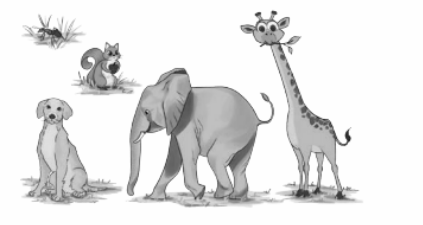
Solution: Elephant > Giraffe > Dog > Squirrel > Ant
Question 2. Write the name of the heaviest object in your home. How did you know?
Solution: Students should do it by themselves.
Question 3. Do you carry your school bag with ease or with some effort?
Solution: Students should do it by themselves.
Question 4. Write the name of the heaviest book in your bag. How did you know?
Solution: Students should do it by themselves.
Question 5. What is your weight? How did you know?
Solution: Students should do it by themselves.
NCERT Textbook Page 115
Fun at Vegetable Market!
Rita and Shabnam went to the market to buy some fruits and vegetables. They saw the vegetable seller weighing vegetables.
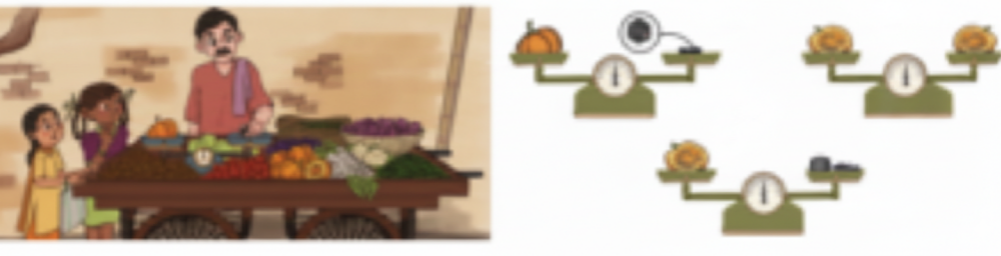
What do you think will be the weight of half pumpkin?
Solution:
The weight of a full pumpkin = 1 kg
So, the weight of half cut pumpkin = \(\frac{1}{2}\) of full pumpkin = \(\frac{1}{2}\) kg
NCERT Textbook Page 116 – Let Us Do
Estimate the weight of the following and put a tick mark (✓) in the appropriate cell. Try to verify if your guess is correct by using a weighing balance.
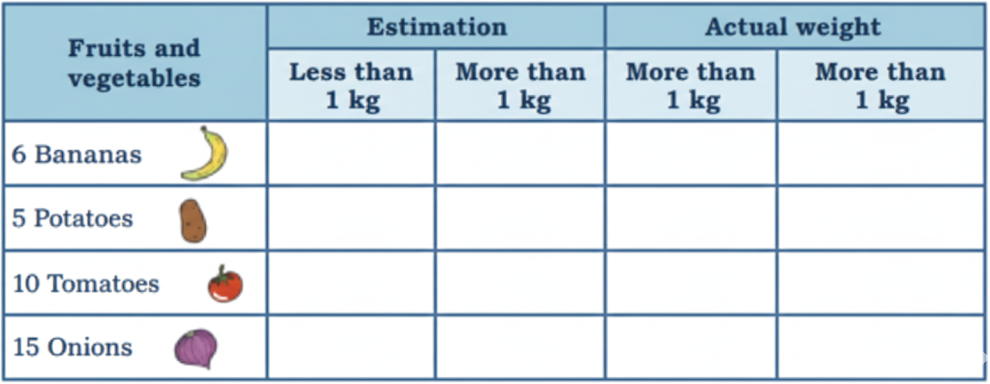
Solution: Students should do it by themselves.
NCERT Textbook Pages 116-117 – Let Us Explore
a. Look at the picture. You may also try doing the same
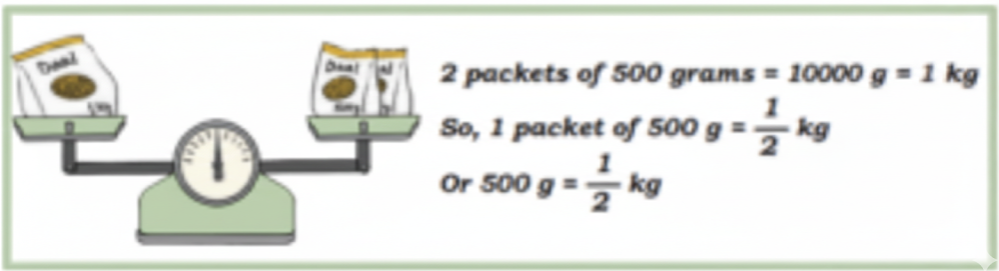
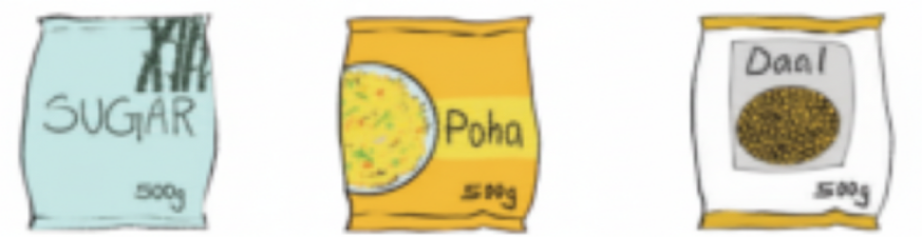
Solution: Students should do it by themselves.
b. Look at the picture. You may also try doing the same.
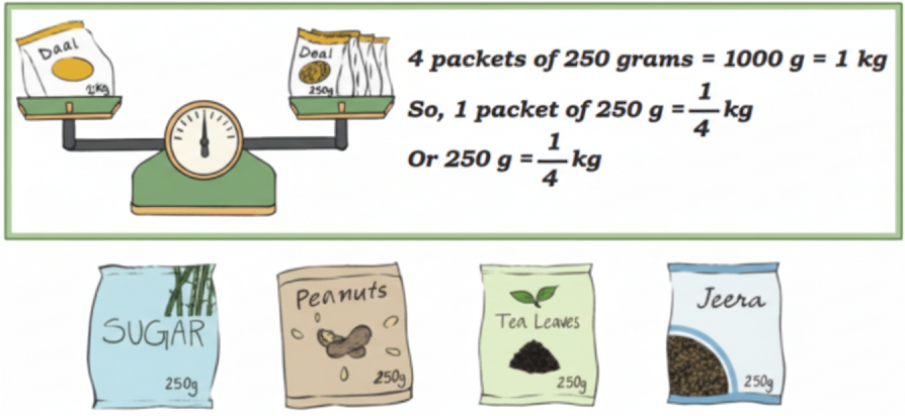
Solution: Students should do it by themselves.
c. Look at the picture. You may also try doing the same.
Solution: Students should do it by themselves.
NCERT Textbook Pages 117-118 – Let Us Find
Question 1. How many 250 g daal packets will balance one 500 g daal packet?
Solution: 250 g = \(\frac{1}{2}\) of 500 g (\(\frac{1}{2}\), 2)
Question 2. Draw arrows to indicate which side the pan balance will tilt? One is shown for you.
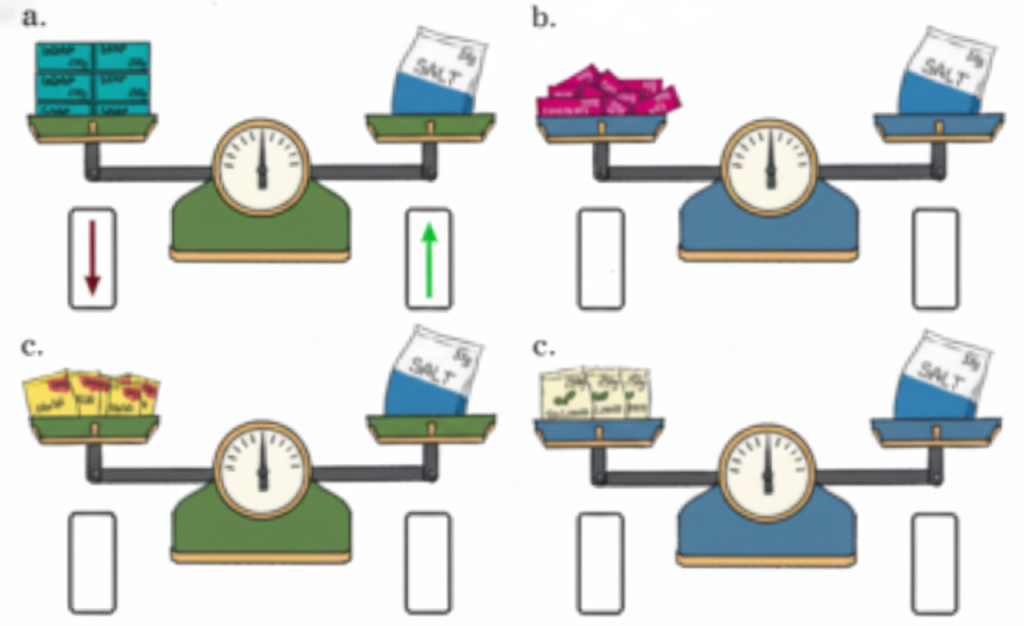
Solution:
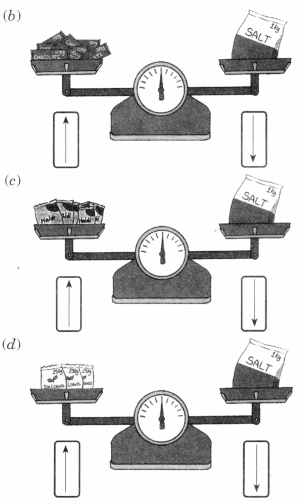
Question 3. Match the unit convenient for measuring each of the following objects.
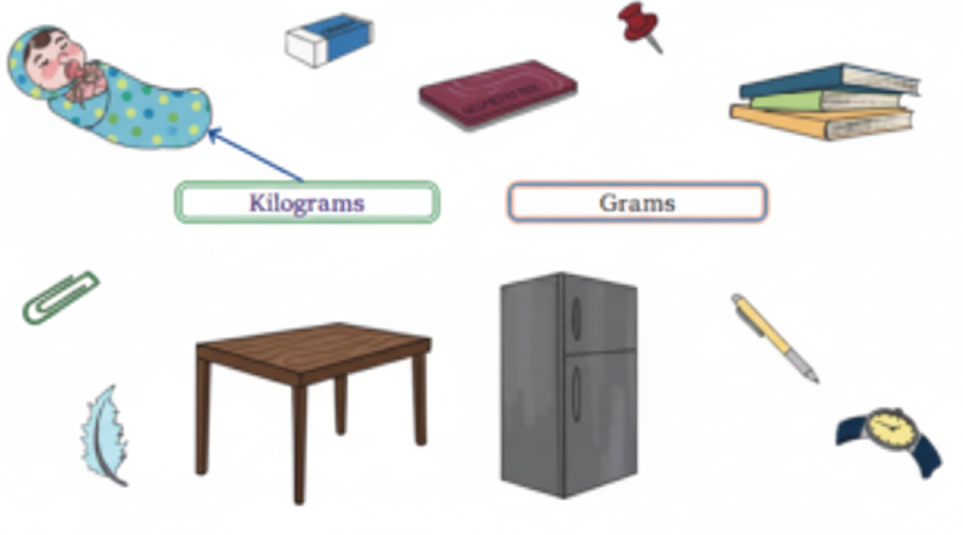
Solution:
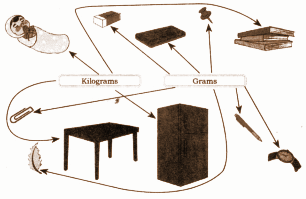
NCERT Textbook Page 119 – Let Us Do
Question 1. How many erasers will weigh the same as a 50 g Haldi packet?
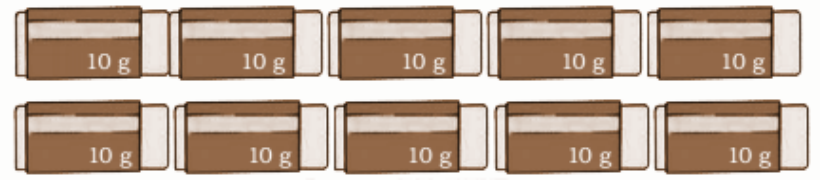
Solution:
10 g = 1 eraser
⇒ 50 g = 5 × 10 g = 5 × 1 eraser = 5 erasers
So, 5 erasers have the same weight as a 50 g haldi packet.
Question 2. A 100 g soap bar will weigh the same as ________ erasers.
Solution:
Since 1 eraser = 10 g,
100 g = 10 × 10 g = 10 erasers.
Therefore, a 100 g soap bar weighs the same as 10 erasers.
Question 3. ________ erasers will weigh the same as 250 g sugar.
Solution:
Since 1 eraser = 10 g,
250 g = 25 × 10 g = 25 erasers.
So, 25 erasers weigh the same as 250 g of sugar.
NCERT Textbook Page 119 – Let Us Think
Boxes of Sweet
Mr Shrinathan, a sweet shop owner, has several orders for 1 kg Kaju-katli but he has to pack them in different sized boxes.
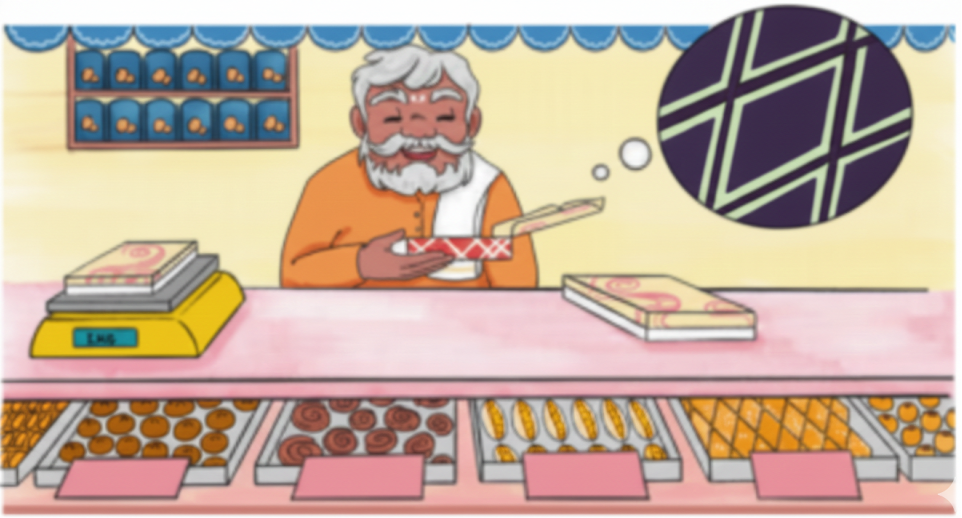
Write down the number of boxes needed to pack 1 kg Kaju-katli in the blank space:
Question 1. Mr Das wants the sweets in boxes weighing 500 g each.
Solution:
Since 1 kg = 1000 g and 1000 g = 500 g + 500 g = 2 × 500 g,
Mr. Shrinathan needs 2 boxes of 500 g each to pack 1 kg of Kaju Katli.
Question 2. Mrs Fernandes wants the sweets in boxes weighing 250 g each.
Solution:
Since 1 kg = 1000 g and 1000 g = 250 g + 250 g + 250 g + 250 g = 4 × 250 g,
Mr. Shrinathan needs 4 boxes of 250 g each to pack 1 kg of Kaju Katli.
Question 3. Mrs Khan wants the sweets in boxes weighing 100 g each.
Solution:
Since 1 kg = 1000 g and
1000 g = 10 × 100 g (i.e., ten 100 g portions),
Mr. Shrinathan needs 10 boxes of 100 g each to pack 1 kg of Kaju Katli.
Question 4. Mr Patel wants the sweets in boxes weighing 50 g each.
Solution:
Since 1 kg = 1000 g and
1000 g = 10 × 100 g = 10 × (2 × 50 g) = 20 × 50 g,
Mr. Shrinathan will need 20 boxes of 50 g each to pack 1 kg of Kaju Katli.
NCERT Textbook Page 120 – Weighing Machines
Do you know the different types of weighing machines used to weigh different objects?
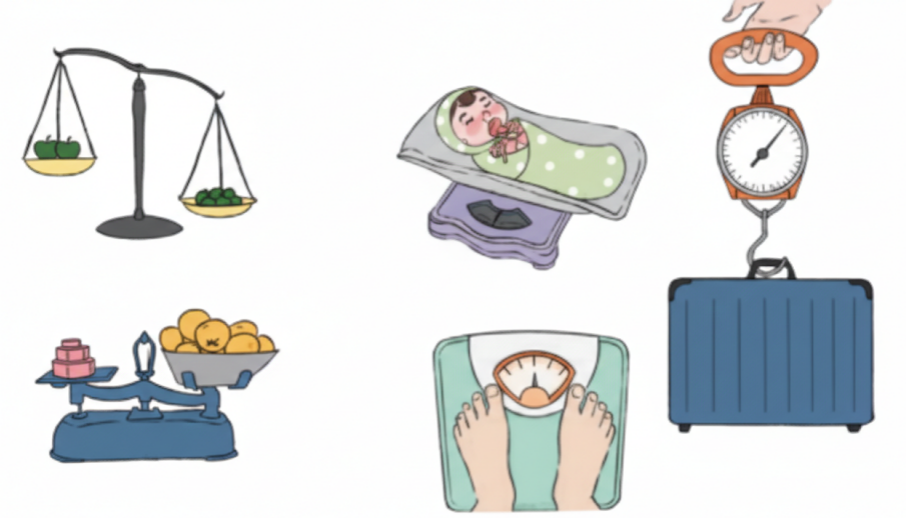
Solution: Students should do it by themselves.
NCERT Textbook Page 120 – Let Us Do
Ask your parents and find the amount of consumption of the following items at your home in a month.
Solution: Students should do it by themselves.
Taran and his sister are lifting packets of flour, rice and salt.

What do you think they are experiencing while lifting these packets?
Have you ever lifted such packets at your home? What do you experience? Discuss.
Solution: The wheat flour packet weighs 10 kg, and the rice packet weighs 5 kg, both of which are challenging to lift for an extended period.
NCERT Textbook Page 121 – Let Us Do
Question 1. Try to lift some objects around you and write the names of three objects that you can lift easily. Estimate and write their weights.
1. ________
2. ________
3. ________
Solution: Students should do it by themselves.
Question 2. Now write the name of things that you can lift with a lot of effort. Estimate and write their weights.
1. ________
2. ________
3. ________
Solution: Students should do it by themselves.
Question 3. How many 1 kg packets are in
(a) 10 kg
(b) 20 kg
(c) 50 kg
(d) 25 kg
Solution:
(a) 10 kg = 10 × 1 kg
There are 10 packets of 1 kg each in 10 kg.
(b) 20 kg = 20 × 1 kg
There are 20 packets of 1 kg each in 20 kg.
(c) 50 kg = 50 × 1 kg
There are 50 packets of 1 kg each in 50 kg.
(d) 25 kg = 25 × 1 kg
There are 25 packets of 1 kg each in 25 kg.
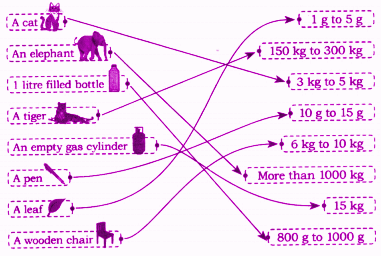
Question 4. Match the objects in the left column with their estimated weights in the right column.
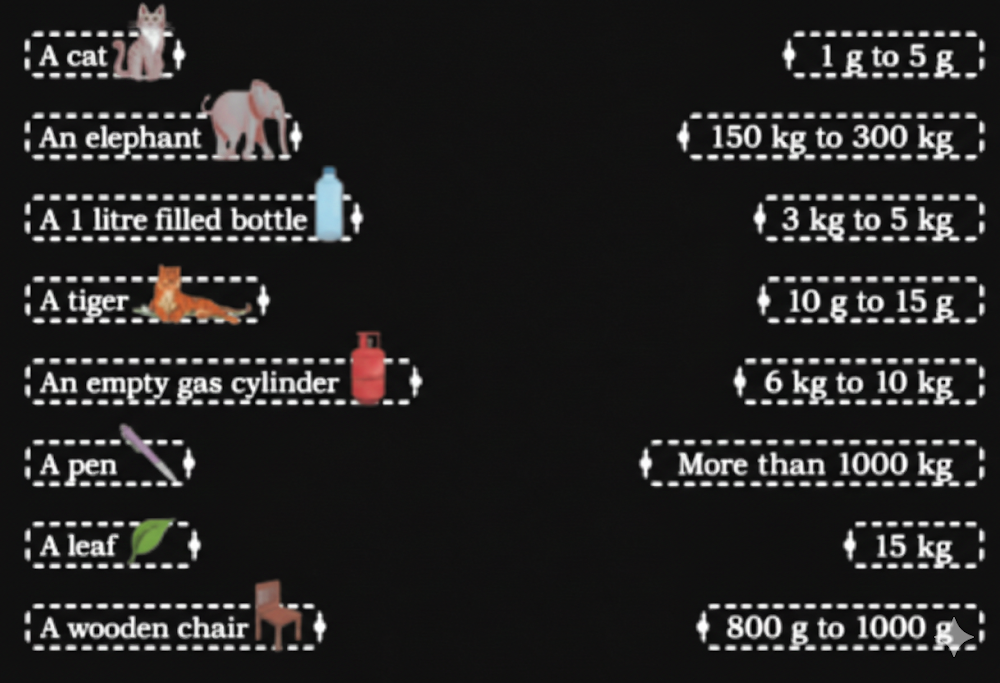
Solution:
NCERT Textbook Page 122 – Measuring Capacity
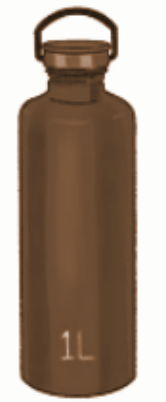
Do you remember the 1 litre bottle? How much water does your water bottle hold?
Find bottles and containers that can hold the following quantities of water. Write their names in the appropriate columns in the table given below.
Solution:
Students should do it by themselves.
Take help from your teachers and parents to collect different bottles with different capacities – 500 ml, 250 ml, 100 ml, 50 ml and 10 ml.
Try to fill one litre bottle with the water contained in different smaller bottles.
Solution: Students should do it by themselves.
NCERT Textbook Pages 123-124 Let Us Find
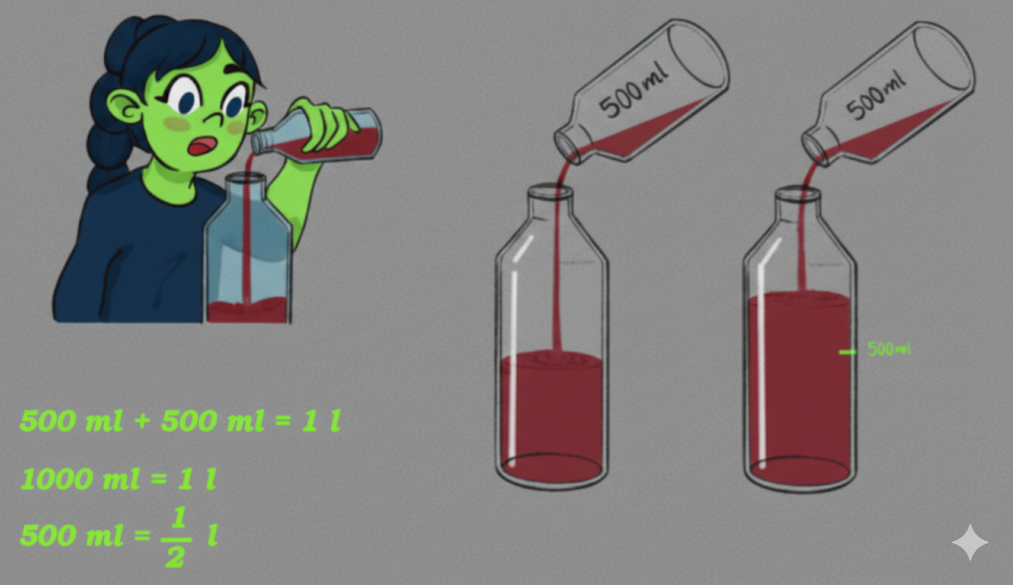
(a) How many 500 ml bottles will fill a 11 bottle?
Solution:
Since 11 = 1000 ml = 500 ml + 500 ml
= 2 × 500 ml
Thus, two 500 ml bottles will fill a 1 l bottle.
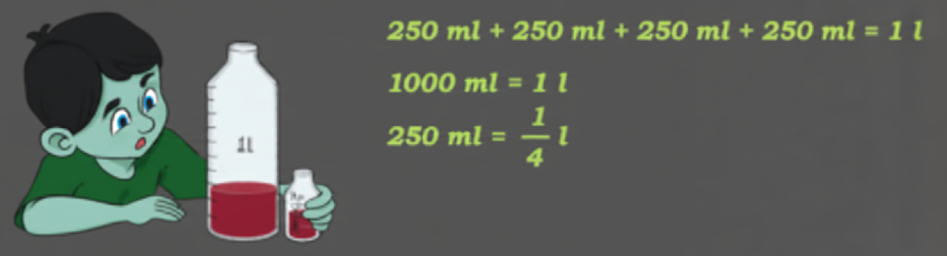
(b) How many 250 ml bottles will fill 11 bottle?
Solution:
Since 1 l = 1000 ml
= 250 ml + 250 ml + 250 ml + 250 ml
= 4 × 250 ml
Thus, four 250 ml bottles will fill a 1 litre bottle,
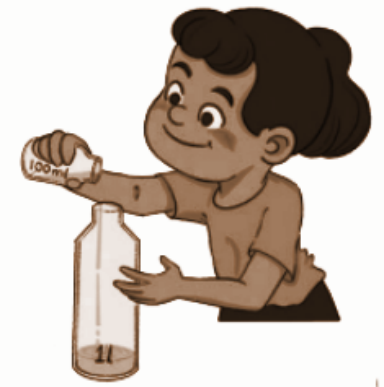
(c) How many 100 ml bottles will fill a 1 l bottle?
Solution:
Since 11= 1000 ml
= 100 ml + 100 mlm + 100 ml + 100 ml + 100 ml + 100 ml + 100 ml + 100 ml + 100 ml + 100 ml
= 10 × 100 ml
Thus, ten 100 ml bottles will fill a 1 l bottle.
(d) How many 100 ml
250 ml in \(\frac{1}{2}\) l = ________
250 ml in 750 ml = ________
100 ml in \(\frac{1}{2}\) l = ________.
100 ml in 800 ml = ________
Solution:
\(\frac{1}{2}\)l = \(\frac{1}{2}\) × 1000 ml = 500 ml
= 250 ml + 250 ml
= 2 × 250 ml
So, there are two 250 ml in \(\frac{1}{2}\) l.
750 ml = 250 ml + 250 ml + 250 ml
= 3 × 250 ml
So, there are three 250 ml in 750 ml.
\(\frac{1}{2}\) l = \(\frac{1}{2}\) × 1000 ml = 500 ml
= 100 ml + 100 ml + 100 ml + 100 ml + 100 ml
= 5 × 100 ml
So, there are five 100 ml in \(\frac{1}{2}\) l.
800 ml = 100 ml + 100 ml + 100 ml + 100 ml + 100 ml + 100 ml + 100 ml + 100 ml
= 8 × 100 ml
So, there are eight 100 ml in 800 ml.
NCERT Textbook Pages 124-125 – Let Us Do
Question 1. Find a dosing cup or a bottle of 10 ml and try to find how many 10 ml will fill a 100 ml bottle.
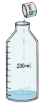
Solution:
100 ml = 10 × 10 ml
So, ten 10 ml cups will fill a 100 ml bottle.
Find how many
(a) 10 ml dosing cups will fill a 250 ml glass?
(b) 10 ml dosing cups will fill a 500 ml vessel?
(c) 10 ml dosing cups will fill a 1 l bottle?
Solution:
(a) 250 ml = 25 × 10 ml
(b) 500 ml = 50 × 10 ml
(c) 1 l = 1000 ml = 100 × 10 ml
Question 2. Take a 1ml dropper and find out
(а) How many 1 ml droppers will fill a 10 ml dosing cup?
Solution:
10 ml – 10 × 1 ml
(b) How many droppers will fill a teaspoon?
Solution:
Students should do it by themselves.
Question 3. Find out how much of these liquids are used at a time.
(a) Eye drops Less than 1 ml at a time.
(b) Honey _______________________
(c) Syrup _______________________
(d) Cooking Oil _______________________
(e) ________ _______________________
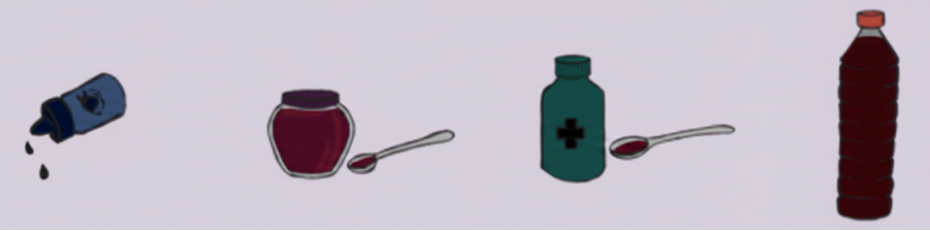
Solution: Students should do it by themselves.
Question 4. Mr Krishna packages perfumed oil in different sized bottles. During a festival, the following customers asked for 1 l perfumed oils but in different sized bottles. Write the number of bottles each of them will get.
(a) Ms Shetty wants bottles of 500 ml each.
(b) Mr Muthukumar wants bottles of 200 ml each.
(c) Ms Naini wants bottles of 100 ml each
(d) Ms Kannan wants bottles of 50 ml each
Solution:
(a) 1 l = 1000 ml = 500 ml + 500 ml
So, Mr. Krishna needs two 500 ml bottles.
(b) 1 l = 1000 ml = 200 ml + 200 ml + 200 ml + 200 ml + 200 ml
So, Mr. Krishna needs five 200 ml bottles.
(c) 1 l = 1000 ml = 10 × 100 ml
So, Mr. Krishna needs ten 100 ml bottles.
(d) 1 l = 1000 ml = 20 × 50 ml
So, Mr. Krishna needs twenty 50 ml bottles.
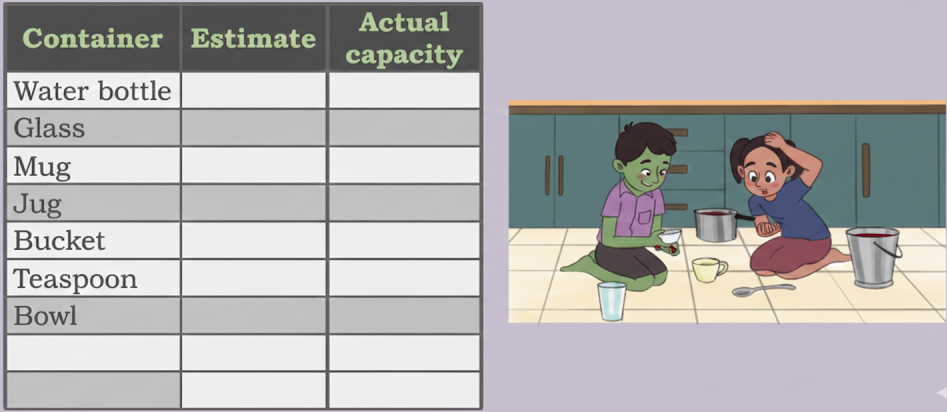
Solution: Students should do it by themselves.
NCERT Textbook Pages 125-126 – Let Us Explore
Visit nearby shops and make a list of different items that are sold in the following quantities.
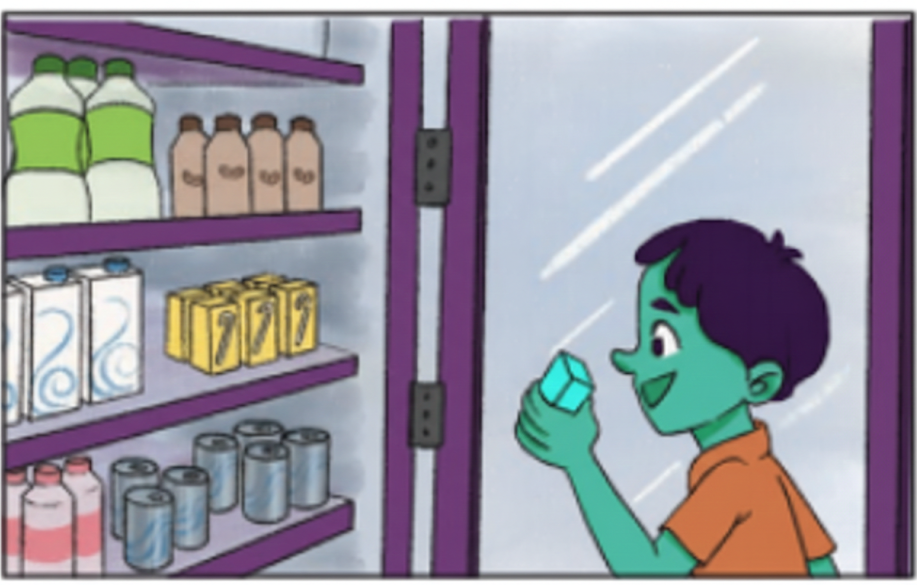
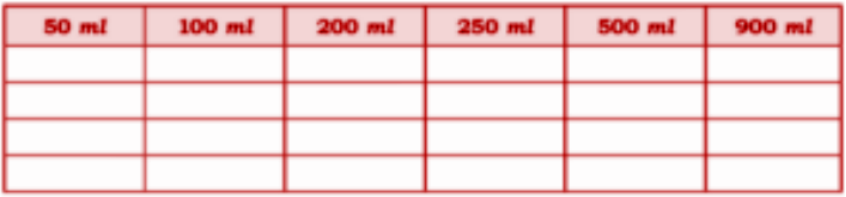
Solution: Students should do it by themselves.
NCERT Textbook Page 126 – Let Us Find
(a) How many litres of water do you drink in a day? How did you find out?
Solution: Students should do it by themselves.
(b) How much water can a crow drink at a time?
Solution: Students should do it by themselves.
(c) How much milk do you drink in one day?
Solution: Students should do it by themselves.
(d) How much water does an elephant drink in a day?
Solution: Students should do it by themselves.
NCERT Textbook Pages 126-127
What do you use the most water for? What do you use the least water for? Compare this with a few others in your grade. In which activities is your water usage the same?
Solution: Students should do it by themselves.
How much water may be used in the following activities?
(a) Water for taking a shower
(b) Watering crops in a field
(c) Watering flowering plants .
(d) Washing clothes
(e) _______________________
(f) _______________________
Solution: Students should do it by themselves.
NCERT Textbook Page 127
Water Conservation in Everydav Life
Have you ever noticed a small drip of water flowing from your tap or water purifier? Have you considered how much water is actually being wasted?
Take a container and put it under the leaking tap or water purifier for an hour. How much water is lost in an hour from just a slow drip? Did it surprise you?
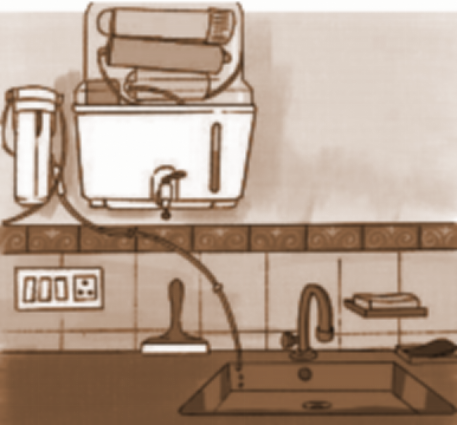
How much water is lost in a day?
How much do you think is lost in a week?
How would this wastage of water affect us?
Solution: Students should do it by themselves.
NCERT Solutions Class 4 Maths Chapter 8 Weigh It Pour It (2026-27)
In this chapter, you revise **measuring weight and capacity** using fun stories, markets, and home activities. The NCERT Solutions for **Class 4 Maths Chapter 8 Weigh It Pour It** help you relate kilograms, grams, litres and millilitres to real life objects.
By regularly practicing questions on **kg–g and l–ml conversions**, students build strong estimation skills. These NCERT Solutions Class 4 Maths Chapter 8 (2026-27) make it easy to compare weights, read containers and understand **fractional packets** like 1/2 kg or 1/4 litre.
Use these explanations as a quick revision guide before tests. Try to solve every exercise on your own, then check with the **step-by-step answers**. This habit improves accuracy, boosts confidence and strengthens your basics in **measurement word problems** for higher classes.
FAQs on NCERT Solutions For Class 4 Maths Chapter 8 Weigh It Pour It - 2026-27 Free PDF Download (Sign-in Required)
1. What is included in NCERT Solutions for Class 4 Maths Chapter 8 'Weigh It Pour It'?
NCERT Solutions for Class 4 Maths Chapter 8 include stepwise answers for all textbook exercises, helping students master weights and measurements.
Key features:
- Exercise-wise solutions with detailed explanations
- Important diagrams and examples
- Exam-ready definitions and formulae
- Focus on CBSE 2026–27 marking schemes
- Tips to score full marks and improve conceptual clarity
2. How can I download the free PDF of NCERT Solutions for Class 4 Maths Chapter 8?
You can download the free PDF of Class 4 Maths Chapter 8 'Weigh It Pour It' solutions for offline study.
Steps:
- Visit the NCERT Solutions Class 4 Maths Chapter 8 page on trusted platforms
- Look for the 'Free PDF Download' button or link
- Click to get the chapter-wise solutions for practice anytime
3. How to write stepwise NCERT answers to score full marks in Class 4 Maths Chapter 8?
To score full marks in Chapter 8, write stepwise answers by:
- Starting with a clear statement of what is to be solved
- Showing each calculation or reasoning step in order
- Including any required units (grams, kilograms, litres, millilitres)
- Drawing neat diagrams where asked
- Writing final answers clearly, underlined if possible
- Using keywords from definitions and textbook terminology
4. Are diagrams and definitions compulsory in NCERT Maths answers for Chapter 8 'Weigh It Pour It'?
Yes, in Class 4 Maths Chapter 8, diagrams and definitions are essential to:
- Accurately represent weighing and measuring instruments
- Clarify answers and boost marks
- Demonstrate understanding of weight and capacity concepts
Always draw neat, labelled diagrams and write exam-ready definitions in your answers.
5. What are the most important topics and questions in Class 4 Maths Chapter 8 for CBSE exams?
The most important topics in Chapter 8 'Weigh It Pour It' are:
- Units of measurement (kg, g, L, mL)
- Converting between units (e.g., grams to kilograms, millilitres to litres)
- Reading scales on balances and containers
- Solving real-life word problems involving weights and capacity
Practice sample questions on conversion and practical measurement for best results.
6. Where can I find exercise-wise solutions for Intext and Back Exercises of Class 4 Maths Chapter 8?
You can find exercise-wise NCERT Solutions for both Intext and Back Exercises of Chapter 8 on dedicated educational portals.
- Each exercise is solved step-by-step
- Solutions match the latest CBSE syllabus (2026–27)
- Both practice problems and word problems are covered
- Answers follow the CBSE marking scheme format
7. What definitions and formulae should I revise for NCERT Class 4 Maths Chapter 8?
Revise key definitions and formulae for Chapter 8 such as:
- Unit of mass: Kilogram (kg), Gram (g)
- Unit of capacity: Litre (L), Millilitre (mL)
- Conversion formulae:
- 1 kg = 1000 g
- 1 L = 1000 mL
- Measuring instruments: balance, measuring cup, jug, glass
Learning these will help in quizzes and exams.
8. How should long answers be structured for CBSE marking in Chapter 8?
To structure long answers for full CBSE marks in Chapter 8, follow these steps:
- Begin with an introduction or definition of the concept
- Break down your answer into bullet points or numbered steps
- Use diagram/labelled illustration where required
- Support your working with examples or calculations
- End with a clear, concise conclusion
9. Do examiners give partial marks for correct steps even if the final answer is wrong in CBSE Class 4 Maths?
Yes, CBSE marking scheme often awards step marks for showing the correct method:
- Each correct intermediate step gets partial marks
- Final answer must be correct for full marks
- Neat presentation and proper units add value
- Always show your working to maximise scores, even if unsure of the final answer
10. How can I quickly revise Class 4 Maths Chapter 8 before exams?
To revise Chapter 8 'Weigh It Pour It' efficiently:
- Go through key definitions and conversion formulae
- Practice exercise-wise important questions
- Review labelled diagrams (balance, containers)
- Solve a sample paper or mock test for time management
- Use flash notes and 1-day revision planners if available
