



Exercise-wise NCERT Solutions for Class 4 Maths Chapter 3: Key Answers and Revision Tips
NCERT Textbook Page 34 – Let Us Count
Gundappa has some land with tall coconut trees.
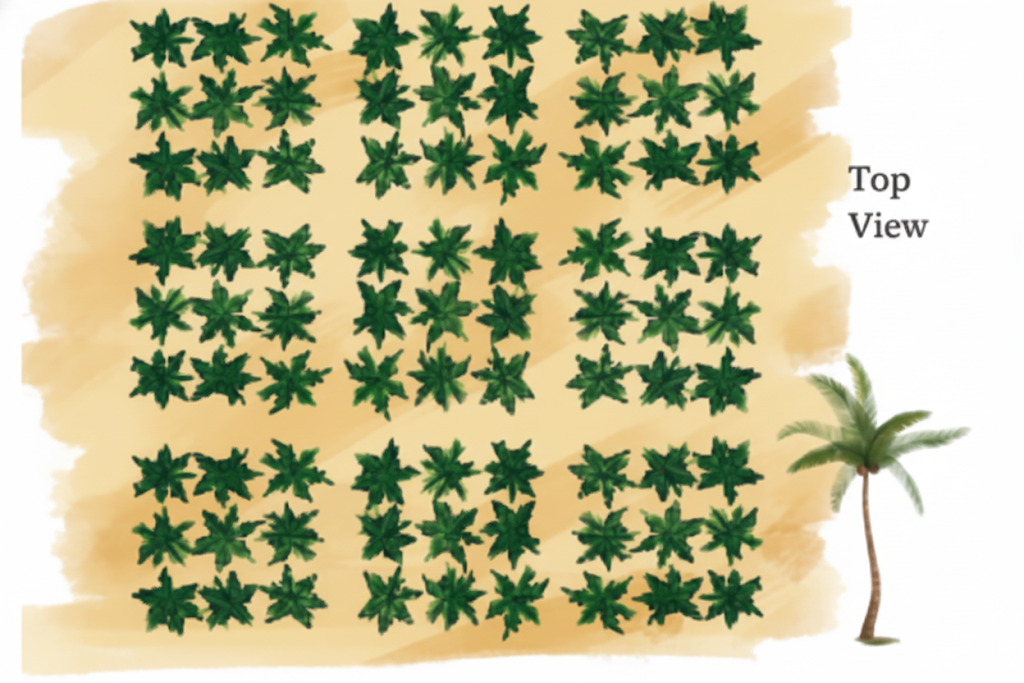
How many coconut trees does Gundappa have? How do you knOw?
Solution:
Gundappa has a total of 81 coconut trees.
From the land diagram, there are 9 sections, and each section has 9 trees.
To find the total number of trees, we multiply the number of trees in one section by the number of sections.
So, (9 x 9 = 81) trees.
Gundappa has plucked 5 coconuts from each tree. How many coconuts has he plucked?
Solution: There are 81 coconut trees, and Gundappa has collected 5 coconuts from each one.
Therefore, the total number of coconuts picked is (5 x 81 = 405).
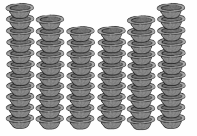
Muniamma makes plates and cups. Number of cups = __________
Solution:
In the first stack, from top to bottom, there are 11 cups. Similarly, in the second, third, fourth, fifth and sixth stacks, there are 10, 9, 9, 10 and 11 cups, respectively.
So, the total cups are:
11 + 10 + 9 + 9 + 10 + 11 = 60 cups
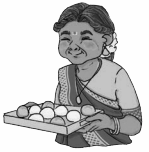
How many coconut laddoos are there in the trays?
Solution:
There are 3 trays in all, and each tray contains 13 coconut laddoos.
So, the total number of coconut laddoos is (3 x 13 = 39).
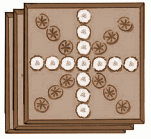
How many milk pedas are there in the trays?
Solution:
Each tray contains 12 milk pedas.
Therefore, the total number of milk pedas is (3 x 12 = 36).
NCERT Textbook Pages 35-36 – Patterns with Money
Shirley and Shiv arranged their play money in some nice patterns as shown below.
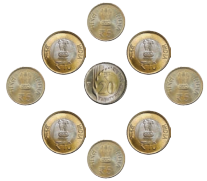
How much money? ________
Solution:
₹ 80
How did you count them? Discuss in class.
Solution:
Students should do it by themselves.
Arrange play money of amounts 1, 2, 5, and 10 to show ₹ 36, ₹ 125, and ₹ 183. Ask your peers to tell how much it is.
Solution:
Students should do it by themselves.
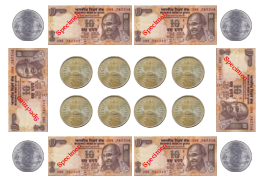
How much money? ________
Solution:
₹ 108
Do you think all numbers in times-2 table are even?
Solution: Yes, all the numbers in the 2 times table (multiples of 2) are even, and they can be grouped into pairs.
Two Ways
Shirley and Shiv arranged their coins in the following ways. Write the number of coins in the triangles.
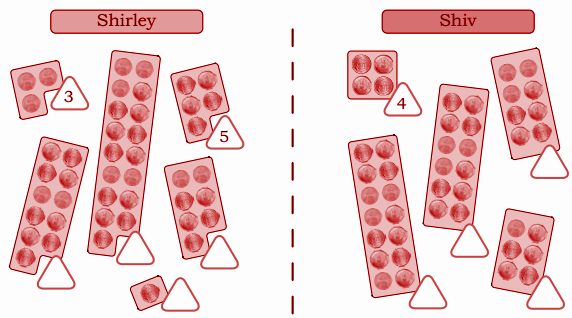
Describe Shiv’s arrangement and write his numbers.
Solution:
Shiv has grouped his coins into even numbers: 4, 6, 8, 12, and 14.
Describe Shirley’s arrangement and write her numbers.
Solution: Shirley has arranged her coins in odd numbers: 1, 3, 5, 7, 11, and 17.
Identify numbers between 1 and 20 as even or odd. You may draw the pairing arrangement of the numbers.
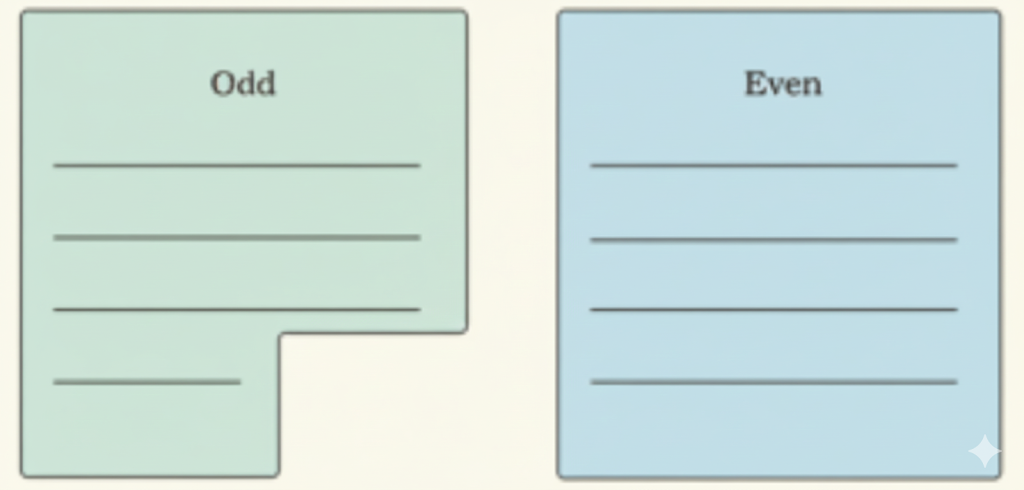
Do you think all numbers in times-2 table are even?
Solution:
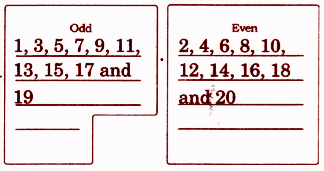
Yes, every number in the 2 times table (multiples of 2) is even, and each can be paired.
NCERT Textbook Pages 37-38 – Crayons Arrangement
Circle the odd numbers and put a square around each even number. Use the crayons arrangement, if needed.
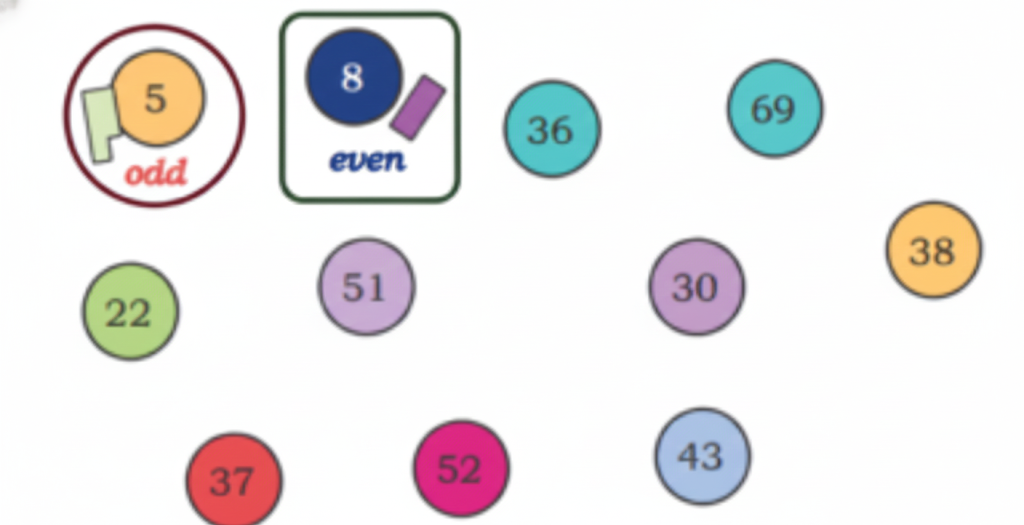
Which numbers are even and which are odd? Discuss.
Solution:
Even numbers: 8, 36, 22, 30, 38 and 52.
Odd numbers: 5, 69, 51, 37 and 43.
Explore your textbook and find out what Shirley has seen. Draw a square on the even numbers. Put a circle on the odd numbers.
Solution:
Students should do it by themselves.
Identify which of the following numbers are even and which are odd. Explain your reasoning.

Solution:
Odd numbers: 67, 99, and 415
Even numbers: 30, 46, 78, 154, and 300
Even numbers always end with 0,2,4, 6, or 8.
Odd numbers always end with 1, 3, 5, 7, or 9.
Make two 2-digit numbers using the digits 1 and 6 without repetition.
Solution:
The numbers that can be formed using the digits 1 and 6 without repeating them are 16 and 61.
Identify the numbers as even or odd. Now choose any two digits and make 2-digit numbers in such a way that the numbers are even.
Solution: 16 is an even number, while 61 is an odd number.
If we use the digits 2 and 8, we can make two even numbers: 28 and 82.
(Answers may vary.)
Are there more even or odd numbers between 1 and 100?
Solution: Yes, the even numbers between 1 and 100 are 2, 4, 6, 8, …, 96, 98.
The odd numbers between 1 and 100 are 3, 5, 7, 9, …, 97, 99.
There are the same number of even and odd numbers between 1 and 100.
It is also observed that the numbers immediately before and after any odd number are even.
Shiv wonders if both the numbers, before and after an even number, will be odd. What do you think? Check and discuss.
Solution:
Students should do it by themselves.
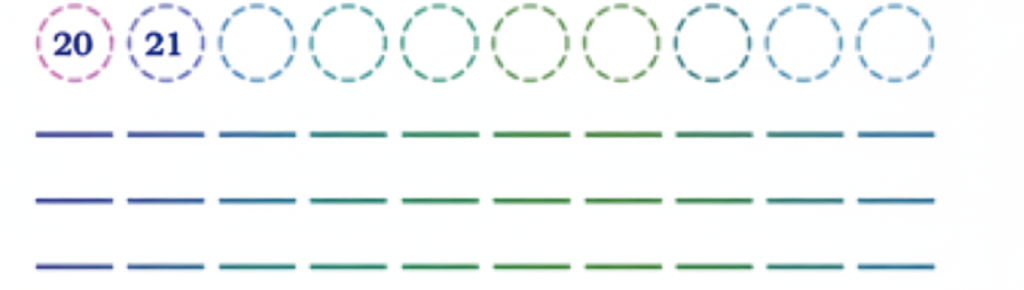
Choose any 10 numbers in an order, without skipping any consecutive numbers. Write whether they are even or odd below each number. What do you notice? Discuss.
Solution:

Each even number is followed by an odd number, and each odd number is followed by an even number, because numbers go up by one each time.
NCERT Solutions for Class 4 Maths Chapter 3 Pattern Around Us
In NCERT Solutions Class 4 Maths Chapter 3 Pattern Around Us, children explore patterns using money, coins, and page numbers. Understanding even and odd numbers through fun activities makes counting easier and builds a strong base for higher classes.
These NCERT Solutions Class 4 Maths Chapter 3 (2026-27) help students see patterns in daily life, like pairing objects or arranging play money. Regular practice improves number sense, mental maths, and confidence in solving pattern-based questions in exams.
While studying this chapter, try to notice patterns around you—in calendars, tiles, and numbers. Revising all exercise questions from NCERT Class 4 Maths Chapter 3 Pattern Around Us will strengthen your basics and help you score better in school tests.
FAQs on NCERT Solutions For Class 4 Maths Chapter 3 Pattern Around Us - 2026-27 Free PDF Download (Sign-in Required)
1. What are NCERT Solutions for Class 4 Maths Chapter 3 Pattern Around Us?
NCERT Solutions for Class 4 Maths Chapter 3 Pattern Around Us are detailed, stepwise answers to all textbook questions, covering exercises, intext, and back exercises.
These solutions help students:
- Understand key pattern concepts with easy explanations
- Score full marks by following the CBSE marking scheme
- Revise important definitions and diagrams
- Practice for exams using expert-verified answers
2. How to write stepwise NCERT answers to score full marks in Class 4 Maths Chapter 3?
To score full marks in Class 4 Maths Chapter 3, write NCERT answers in a stepwise manner as follows:
- Begin with a clear definition or introduction of the pattern
- Show each step of the solution—especially for patterns and sequences
- Use neat diagrams wherever needed, as marks are awarded for correct labelling
- Highlight all important keywords (e.g., sequence, repetition, pattern rule)
- End with a final statement or answer box
3. Which questions are likely to be asked from Class 4 Maths Chapter 3 in school exams?
Exams commonly include:
- Pattern completion (draw the next shape or number)
- Identifying pattern rules
- Drawing and labelling pattern diagrams
- Short definition-based or application questions (e.g., What is a pattern?)
- Questions from intext and back exercises in the NCERT textbook
4. Is it mandatory to include diagrams or definitions while answering questions from Pattern Around Us?
Yes, including diagrams for pattern-based questions and definitions for key terms is highly recommended:
- Most marks are awarded for correct, neat diagrams with labels
- Definitions must be as per CBSE/NCERT standards for full marks
5. How should long answers be structured in Class 4 Maths Chapter 3 to get better marks?
Structure long answers for Class 4 Maths Chapter 3 as follows:
- Start with a brief introduction or definition
- Explain each step using clear points/bullets
- Add relevant diagrams with neat labelling
- Conclude with the main answer or summary
6. How can I download the free PDF of Class 4 Maths Chapter 3 Pattern Around Us solutions?
You can download the free PDF of NCERT Solutions for Class 4 Maths Chapter 3 from trusted educational websites.
- Look for the "Download PDF" button on the solutions page
- Ensure you choose the correct chapter and academic year (2026–27)
- Check for exercise-wise, step-by-step answers in the PDF
7. What are the key definitions and formulae to remember from this chapter?
Key definitions and formulae for Chapter 3 include:
- Pattern: A repeated or regular order in objects, shapes, or numbers
- Sequence: Numbers or objects arranged in a particular order
- Rule: The logic that decides what comes next in a pattern
8. How do stepwise NCERT Solutions help in exam preparation for Class 4 Maths?
Stepwise NCERT Solutions make exam preparation easier by:
- Showing clearly how to solve each type of question
- Following the CBSE marking scheme for step marks
- Helping avoid common mistakes through detailed steps and correct diagrams
- Assisting in quick revision and boosting confidence for exams
9. What are common mistakes students make in Class 4 Maths Chapter 3 Pattern Around Us?
Common mistakes include:
- Missing steps in pattern completion
- Forgetting to draw or label diagrams
- Writing unclear or incorrect definitions
- Not following the exact NCERT sequence or language
- Overlooking instructions and marks for neatness
10. Are NCERT Solutions enough for Class 4 Maths exams?
NCERT Solutions for Class 4 Maths are generally sufficient for school exams as they cover:
- All textbook exercises and intext questions
- Step-by-step explanations following the CBSE pattern
- Important definitions, diagrams, and solved examples
11. How do I present long answers to match the CBSE marking scheme?
To match the CBSE marking scheme for long answers:
- Break the answer into clear, logical steps
- Use bullet points or numbers for each step
- Draw diagrams where needed and label them properly
- Highlight important keywords and ensure the final answer is boxed or underlined
12. Where can I get chapterwise solutions PDF for offline study?
You can get chapterwise solutions PDFs for Class 4 Maths from educational platforms and NCERT-specific resources.
- Search for the required chapter (e.g., Pattern Around Us) plus 'PDF download'
- Ensure the PDF includes all exercises and the marking scheme
13. How to learn diagrams or map questions for Class 4 Maths Chapter 3?
To master diagram and pattern map questions in Chapter 3:
- Practice drawing each type of pattern (shapes, numbers, colour patterns)
- Use accurate, clean shapes and proper colouring
- Label all parts as shown in the NCERT Solutions
- Revise using quick notes and solved examples from PDFs
14. What are the most important topics from Class 4 Maths Chapter 3?
The most important topics include:
- Identifying and continuing patterns in numbers and shapes
- Understanding pattern rules
- Creating new patterns and sequences
- Drawing and labelling patterns as per textbook questions
