









List of Maths Terms That Start With S With Meanings and Simple Explanations
What is the first thing that crosses your mind when you think of Maths? Is it a number? Is it a date? Or is it some long calculation? Well, even though the word ‘Maths’ brings in a cloud of calculations and random numbers, there is definitely something more interesting and less tedious than the long calculations to it. There is a long list of special Maths words knowing which you can ace the concepts and theorems of Maths easily. The below-given Maths words that start with S will equip you with an upper hand at Maths.
List of Maths Words That Begin with S
Sum: When we add two or more quantities, the result obtained is called the sum. For example, 2+5=7. Here, 7 is the sum.
Subtract: It is a Mathematical operation that involves taking away a definite quantity or number from a given quantity or number. For example, subtracting 10 from 25, we obtain 25-10 =15.
Scale: It is a conventional ratio of the length or distance in a model or map to the real length or distance. For example, if we depict a distance of 10 kilometres on the ground as a distance of 1 kilometre on a map, then we take a scale of 1:10.
Square: It is a 2D plane figure, enclosed by 4 straight sides. All the sides of this shape are equal in length and each interior angle measures 900. As it has 4 sides, a square is called a quadrilateral.
Segment: A straight line that connects two points in space is called a segment.
Symmetry: When an object can be split into two equal halves, about an imaginary axis, such that each half is a mirror image of the other, this correspondence is called symmetry.
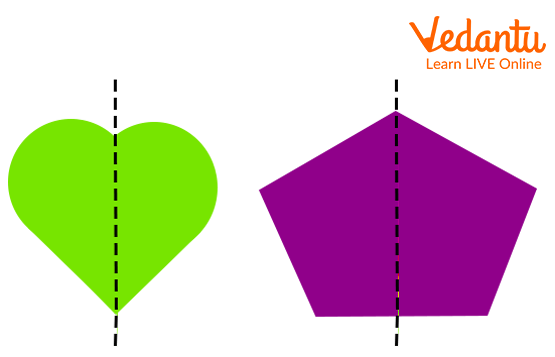
Image of examples of symmetry
Symbol: A pattern, sign, character, or image that is used to represent a word or operation in Maths is called a symbol. For example, ‘%’ is the symbol for percentage.
Semi-Circle: When a circle is divided into two equal parts by its diameter, each part is called a semi-circle. The radius of a semicircle is the same as that of the circle. The circumference, area, and perimeter of the semi-circle are obtained by dividing the circumference, area, and perimeter of the circle by 2.
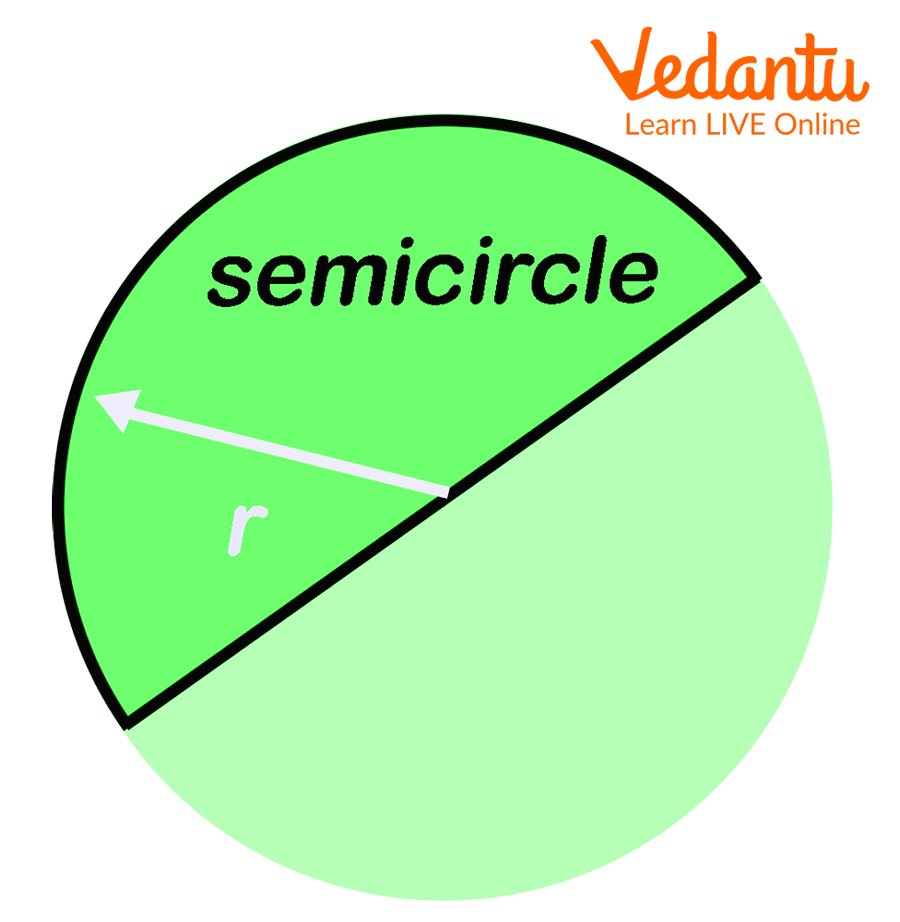
Image of a semicircle
Sphere: It is a 3D geometric figure that resembles a ball. Every point on a sphere is at the same distance from its centre.
Speed: Speed is the measure of how fast an object moves. It is calculated by dividing the distance covered by an object by the time taken to cover the distance. Therefore, speed is defined as the distance covered by an object in unit time. The units used to measure this quantity are metre/second and kilometre/hour.
Surface Area: The total area covered by all the surfaces of a 3D object is called its surface area. For example, the surface area of a cuboid is calculated by adding up the surface area of each of its surfaces.
Sector: A sector is the part of a circle formed when two of its radii connect at the centre. It looks like a pie slice or slice of a pizza.
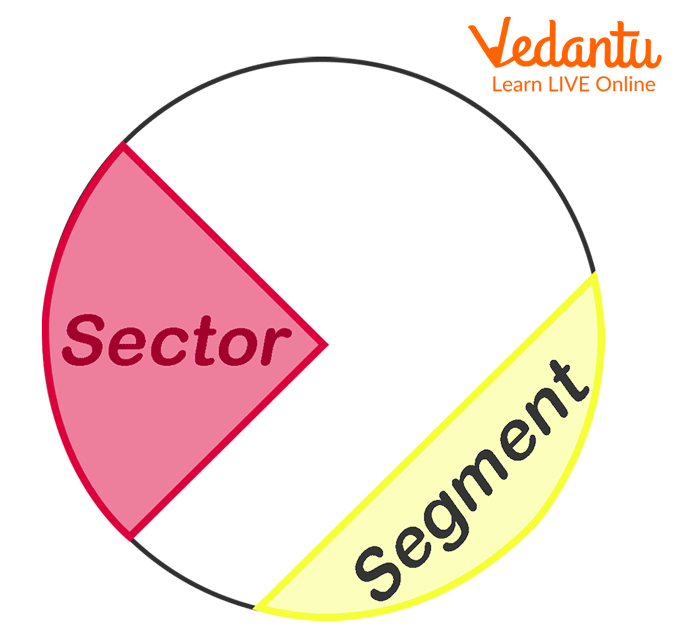
Image of a circle showing its sector and segment
Square Root: The square root of a given number refers to the value which when multiplied by itself yields the original number. For example, 25= 5 x 5.
Sine: The sine of an angle in a right-angled triangle is given as the ratio of the length of the side opposite to the angle to the hypotenuse of the triangle. It is abbreviated as ‘sin’.
Sin θ = perpendicular ÷ hypotenuse
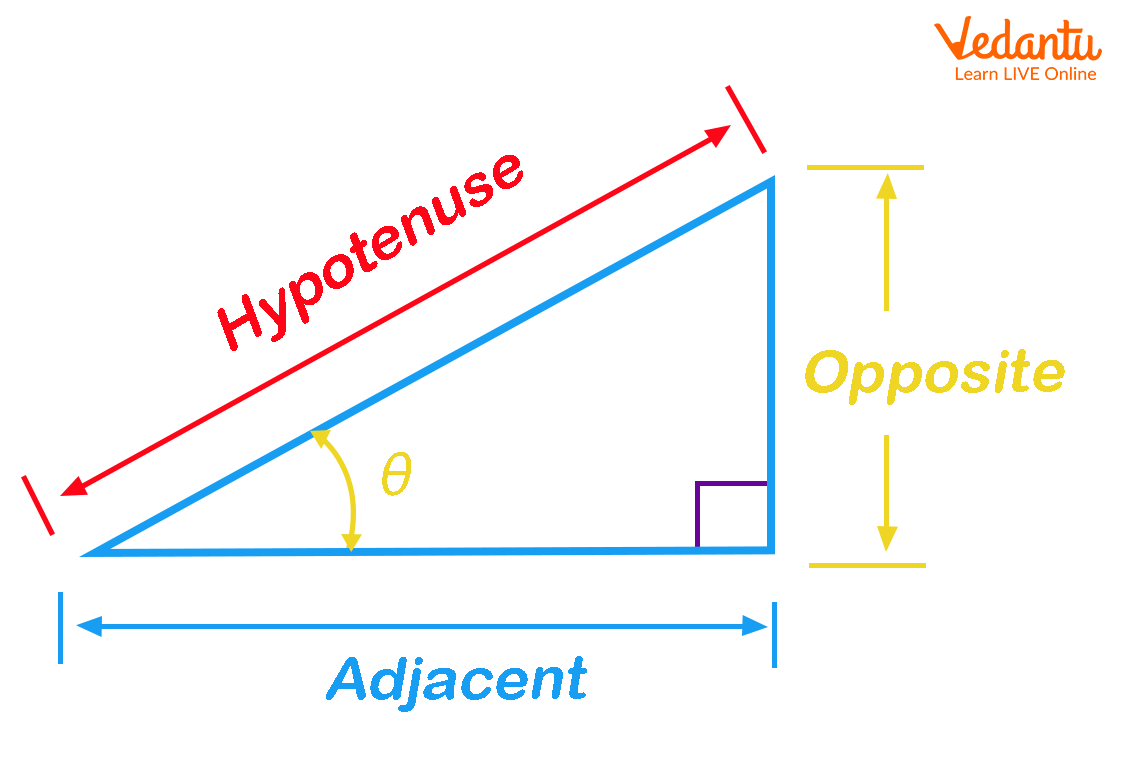
Image of a right-angled triangle
Simple Interest: It is the interest calculated on the principal amount by multiplying the principal amount, percent or rate of interest, and time. It is abbreviated as S.I. and expressed as S.I.= P x R x T/100
Standard Deviation: It is a measure of how distributed or spread out the values of a data set are. It is calculated by taking a square root of Variance.
(Variance is calculated as the average of squared differences of the values from the Mean.)
Surd: When a number contains square roots or cube roots that cannot be adjusted and removed to simplify the number, it is called a surd. For example, the $\sqrt{3}$ is a surd whereas $\sqrt{9}$ is not a surd.
Slant Length: For a cone, the length of its slanting sides is called the slant length. It is abbreviated as ‘s’. Refer to the image given below to find that the slant length of a cone can be calculated as s = $\sqrt{(h^{2}+r^{2})}$. Slant length is also observed in pyramids.
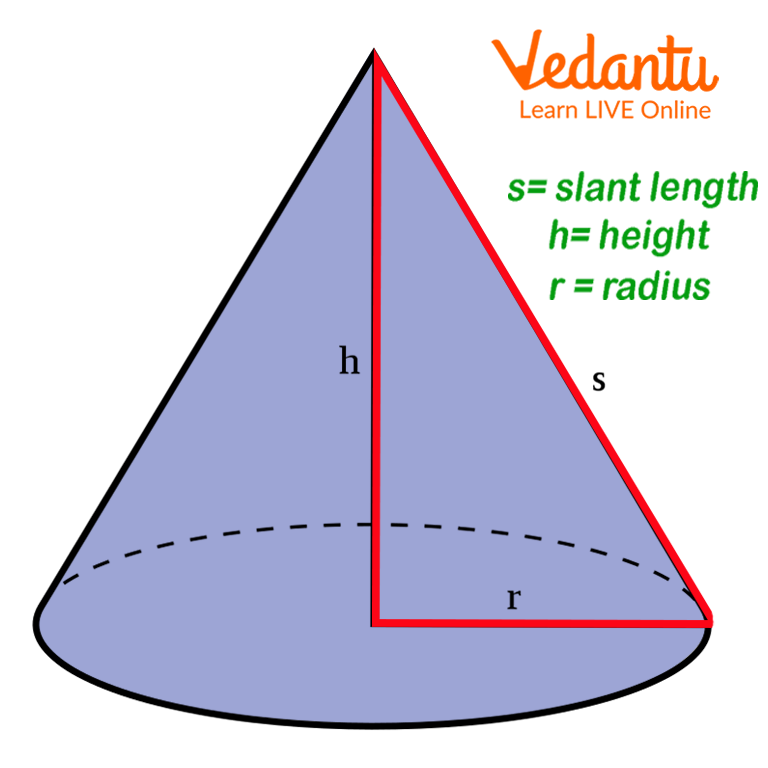
Image of a cone
Set: A finite or infinite collection of unique numbers, quantities, objects, or things is called a set. Each member of a set is called its element and the elements of a set are enclosed within the curly brackets. For example, {2, 4, 6, 8, 10} is a set of even numbers from 1 to 10.
Sample Space: It is the set of all outcomes possible when an event occurs. For example, if a coin is flipped in the air, the sample space will have only two possible outcomes. The sample space with all the possible outcomes of this event will be:
S={H, T}.
Superset: When a set comprises all the elements of other smaller sets, it is referred to as the superset of the smaller sets. For example:
Set A = {1, 2, 3, 4, 5, 6, 7, 8, 9, 10, 11, 12, 13, 14, 15, 16, 17, 18, 19, 20}
Set B = {2, 4, 6, 8, 10, 12, 14, 16, 18, 20}
Set C = {5, 10, 15, 20}
Here, Set A is the superset of Set B and Set C.
Every set is a super set of the empty set.
Subset: If there are two sets Set A and Set B such that Set A comprises all the elements of Set B, then Set B is referred to as the subset of Set A.
Example:
Set A ={ 10, 20, 30, 40, 50, 60, 70, 80, 90, 100}
Set B = {20, 40, 60, 80, 100}
Here, Set B is the subset of Set A.
Scalene Triangle: When each of the three sides of a triangle has a unique length, it is called a scalene triangle. In this type of triangle, all angles are also not equal.
Supplementary Angles: When the sum of two angles measures up to 180 degrees, the angles are called supplementary angles. A pair of supplementary angles may or may not be on a straight line. For example, 110° + 70 ° = 180°, therefore, 110 ° and 70° are supplementary angles
Sales Tax: Sales tax is an additional sum of money charged on the selling price of goods/commodities, or services. In general, it is paid to the national government of our country. For example, if you buy a tshirt for 400 INR, and the sales tax charged on it 5%, you pay 20 INR as the sales tax.
Conclusion
There are many more Maths words that start with S apart from the above list of words. However, the list of words discussed above are some of the most used Maths words and students will surely come across them in their Maths chapters. To ease out the learning process for them, these simple Maths words that start with S can be taught with the help of pictorial representations. Also check out the common Maths words that start with other alphabets like V, G, E, P, etc. on Vedantu and help your kids with approaching the theories of Mathematics in a unique yet effective way.
FAQs on 25 Important Maths Words That Start With S With Definitions and Examples
1. What are some important maths words that start with S?
Some important maths words that start with S include terms commonly used in algebra, geometry, statistics, and arithmetic.
- Sum – result of addition
- Square – a number multiplied by itself
- Square root – a number that produces a given value when squared
- Scale – ratio used to enlarge or reduce figures
- Slope – measure of steepness of a line
- Symmetry – balanced arrangement of parts
- Sequence – ordered list of numbers
- Set – well-defined collection of objects
- Standard form – scientific notation
- Statistics – study of data
2. What is the meaning of sum in mathematics?
The sum is the result obtained when two or more numbers are added together.
- Example: 7 + 5 = 12
- Here, 12 is the sum of 7 and 5.
- The symbol used for addition is +.
3. What is a square number in maths?
A square number is a number obtained by multiplying a number by itself.
- Formula: n × n = n²
- Example: 6 × 6 = 36
- So, 36 is a square number.
4. What is the square root of a number?
The square root of a number is a value that, when multiplied by itself, gives the original number.
- Symbol: √
- Example: √49 = 7
- Because 7 × 7 = 49
5. What does slope mean in mathematics?
The slope of a line measures its steepness and direction.
- Formula: slope (m) = (y₂ − y₁) / (x₂ − x₁)
- Positive slope → line rises from left to right
- Negative slope → line falls from left to right
6. What is symmetry in geometry?
Symmetry means a shape can be divided into two identical halves that mirror each other.
- Line symmetry – divided by a line into equal halves
- Rotational symmetry – looks the same after rotation
- Example: A square has 4 lines of symmetry.
7. What is a sequence in maths?
A sequence is an ordered list of numbers that follow a specific pattern or rule.
- Example: 2, 4, 6, 8, …
- This is an arithmetic sequence with common difference 2.
- General form: a, a + d, a + 2d, …
8. What is a set in mathematics?
A set is a well-defined collection of distinct objects called elements.
- Example: A = {2, 4, 6, 8}
- Sets are written using curly brackets { }.
- Common operations include union (∪) and intersection (∩).
9. What is standard form in maths?
Standard form (scientific notation) expresses very large or small numbers as a × 10ⁿ, where 1 ≤ a < 10.
- Example: 5,000 = 5 × 10³
- Example: 0.004 = 4 × 10⁻³
10. What is statistics in mathematics?
Statistics is the branch of mathematics that deals with collecting, organizing, analyzing, and interpreting data.
- Measures include mean, median, and mode.
- Data can be shown using graphs like bar charts and histograms.
- Used in research, business, and probability.
