




Which of these is correct in regards to a magnet?
A) \[\text{Geometric length = 0}\text{.8 times the magnetic length}\]
B) \[\text{Magnetic length = 0}\text{.8 times the geometric length}\]
C) \[\text{Magnetic length = Geometric length}\]
D) \[\text{Geometric length = 10/9 of magnetic length}\]
Answer
 Verified
265.8k+ views
Hint: A bar magnet consists of two equal and opposite magnetic poles separated by a small distance. Poles are not exactly at the ends. The smallest distance between two poles is known as the effective length and is less than the geometric length. The distance between two magnetic poles is called magnetic length whereas the Geometric length is a measure of the total length of the magnet. Since the magnetic poles are not exactly at the ends, the magnetic length is slightly less than the geometrical length.
Complete step by step solution:
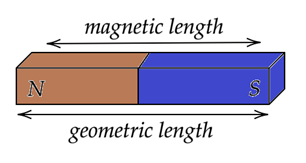
Due to end effects, the poles of a bar magnet are assumed to be slightly inside the ends of the magnet. The distance between the two poles (north and south) gives the magnetic length of the magnet. The actual size of the magnet gives us its geometric length. The magnetic length of a bar magnet is nearly \[\text{0}\text{.8}\] times that of the geometric length, which looks quite valid if you refer to the figure given above.
Hence we can say that \[\text{Magnetic length = 0}\text{.8 times the geometric length}\] or option (C) is the correct answer.
Note: This ratio of the magnetic length to the geometric length remains constant in all situations. It is due to this constant property that when a magnet is cut transversely, the magnetic strength remains constant. The effective length of the magnet is the inter-polar distance of the magnet and is always less than the geometric length of the magnet. Although the actual relationship between them depends on the shape of the magnet.
Complete step by step solution:
Due to end effects, the poles of a bar magnet are assumed to be slightly inside the ends of the magnet. The distance between the two poles (north and south) gives the magnetic length of the magnet. The actual size of the magnet gives us its geometric length. The magnetic length of a bar magnet is nearly \[\text{0}\text{.8}\] times that of the geometric length, which looks quite valid if you refer to the figure given above.
Hence we can say that \[\text{Magnetic length = 0}\text{.8 times the geometric length}\] or option (C) is the correct answer.
Note: This ratio of the magnetic length to the geometric length remains constant in all situations. It is due to this constant property that when a magnet is cut transversely, the magnetic strength remains constant. The effective length of the magnet is the inter-polar distance of the magnet and is always less than the geometric length of the magnet. Although the actual relationship between them depends on the shape of the magnet.
Recently Updated Pages
JEE Main 2025-26 Experimental Skills Mock Test – Free Practice

JEE Main 2025-26 Electronic Devices Mock Test: Free Practice Online
JEE Main 2025-26 Mock Tests: Free Practice Papers & Solutions
JEE Main 2025-26: Magnetic Effects of Current & Magnetism Mock Test
JEE Main 2025-26 Atoms and Nuclei Mock Test – Free Practice Online
JEE Main Mock Test 2025-26: Experimental Skills Chapter Online Practice
Trending doubts
JEE Main 2026: Exam Dates, Session 2 Updates, City Slip, Admit Card & Latest News
JEE Main Participating Colleges 2026 - A Complete List of Top Colleges
Kinematics Mock Test for JEE Main 2025-26: Practice & Ace the Exam
Kinematics Mock Test for JEE Main 2025-26: Comprehensive Practice
Hybridisation in Chemistry – Concept, Types & Applications
Understanding the Electric Field of a Uniformly Charged Ring
Other Pages
CBSE Class 12 Physics Question Paper 2026: Download SET-wise PDF with Answer Key & Analysis
JEE Advanced 2026 Notification Out with Exam Date, Registration (Extended), Syllabus and More
JEE Advanced Percentile vs Marks 2026: JEE Main Cutoff, AIR & IIT Admission Guide
JEE Advanced 2026 Marks vs Rank: Estimate IIT Rank from Your Score
JEE Advanced Weightage Chapter Wise 2026 for Physics, Chemistry, and Mathematics
Derivation of Equation of Trajectory Explained for Students