




Which of the following radiations has the highest penetrating power?
A) $\alpha - rays$
B) $\beta - rays$
C) $\gamma - rays$
D) $X - rays$
Answer
 Verified
271.8k+ views
Hint: The "rays" emitted by radioactive elements were named in order of their power to penetrate various materials, using the first three letters of the Greek alphabet: alpha rays as the least penetrating, followed by beta rays, followed by gamma rays as the most penetrating.
Complete step by step solution:
There are typically four types of radioactive radiation namely alpha radiation, beta radiation, gamma radiation, and x radiation. Neutron radiation is also encountered in nuclear power plants and high-altitude flight and emitted from some industrial radioactive sources.
Penetrating power refers to the energy with which the radiation particles are ejected from the atom. The higher the energy, the more the particles or light produced by radioactive decay will penetrate a substance.
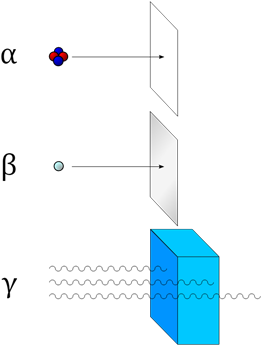
Penetration of the modes of decay Alpha particles can be completely stopped by a sheet of paper. Beta particles can be stopped by aluminum shielding. Gamma rays can only be reduced by much more substantial mass, such as a very thick layer of lead.
X-rays are highly penetrating and interact with matter through ionization via three processes, photoelectric effect, Compton scattering or pair production. Their high penetration power the impact of X-rays can occur throughout a body, they are however less ionizing than alpha particles.
Hence the correct order of penetrating power of the given radiation is:
$\gamma > \beta > \alpha > X - rays$
Therefore the correct option of the given question is option (C).
Note: Gamma ray is the ray with the smallest wavelength but consists of the highest energy than any wave in the electromagnetic spectrum. Gamma rays are capable of emitting tons of energy in a split second than our sun in its entire billion year lifetime.
Complete step by step solution:
There are typically four types of radioactive radiation namely alpha radiation, beta radiation, gamma radiation, and x radiation. Neutron radiation is also encountered in nuclear power plants and high-altitude flight and emitted from some industrial radioactive sources.
Penetrating power refers to the energy with which the radiation particles are ejected from the atom. The higher the energy, the more the particles or light produced by radioactive decay will penetrate a substance.
Penetration of the modes of decay Alpha particles can be completely stopped by a sheet of paper. Beta particles can be stopped by aluminum shielding. Gamma rays can only be reduced by much more substantial mass, such as a very thick layer of lead.
X-rays are highly penetrating and interact with matter through ionization via three processes, photoelectric effect, Compton scattering or pair production. Their high penetration power the impact of X-rays can occur throughout a body, they are however less ionizing than alpha particles.
Hence the correct order of penetrating power of the given radiation is:
$\gamma > \beta > \alpha > X - rays$
Therefore the correct option of the given question is option (C).
Note: Gamma ray is the ray with the smallest wavelength but consists of the highest energy than any wave in the electromagnetic spectrum. Gamma rays are capable of emitting tons of energy in a split second than our sun in its entire billion year lifetime.
Recently Updated Pages
JoSAA Counselling 2026: JoSAA 2026 Mock Seat Allotment LIVE: Round 2 Result Released, Registration, Choice Filling and Ranks

Circuit Switching vs Packet Switching: Key Differences Explained
JEE General Topics in Chemistry Important Concepts and Tips
JEE Extractive Metallurgy Important Concepts and Tips for Exam Preparation
JEE Atomic Structure and Chemical Bonding important Concepts and Tips
JEE Amino Acids and Peptides Important Concepts and Tips for Exam Preparation
Trending doubts
JEE Main 2026: Exam Dates, Session 2 Updates, City Slip, Admit Card & Latest News
JEE Main Participating Colleges 2026 - A Complete List of Top Colleges
Kinematics Mock Test for JEE Main 2025-26: Comprehensive Practice
Understanding the Electric Field of a Uniformly Charged Ring
Understanding Atomic Structure for Beginners
Derivation of Equation of Trajectory Explained for Students
Other Pages
CBSE Class 12 Physics Question Paper 2026: Download SET-wise PDF with Answer Key & Analysis
JEE Advanced 2026 Notification Out with Exam Date, Registration (Extended), Syllabus and More
JEE Advanced Percentile vs Marks 2026: JEE Main Cutoff, AIR & IIT Admission Guide
JEE Advanced Weightage Chapter Wise 2026 for Physics, Chemistry, and Mathematics
Kinematics Mock Test for JEE Main 2025-26: Practice & Ace the Exam
How to Convert a Galvanometer into an Ammeter or Voltmeter