




Which of the following is not a natural polymer?
(A) Proteins
(B) Polysaccharides
(C) Cotton
(D) Phenol-formaldehyde
Answer
 Verified
273.9k+ views
Hint: - The alpha amino acids are considered to be the building blocks of proteins.
- Polysaccharides are carbohydrates which upon hydrolysis give a large number of monosaccharides.
- Bakelite is a phenol-formaldehyde polymer.
Complete step by step answer:
Amino acids are those organic compounds which contain amino groups and carboxyl groups as functional groups. Depending upon the relative position of the amino group with respect to the carboxyl group, the amino acids are classified as alpha-, beta-, gamma-, delta- etc. amino acids.
The hydrolysis of proteins gives only the alpha amino acids. The term ‘amino acid’ is used to refer specifically to these alpha amino acids.
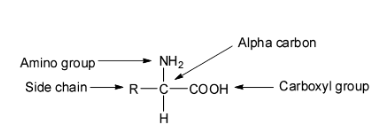
Thus, the proteins are biopolymers formed by the condensation of a large number of alpha amino acids joined together by peptide bonds having 3D structures. So, option A is wrong.
Polysaccharides are biopolymers formed by joining together the monosaccharides by glycosidic linkages. For example, cellulose is a polysaccharide.
Cellulose is a linear polymer of $\beta$ -D-glucose in which ${{\text{C}}_{\text{1}}}$ of one glucose unit is linked to ${{\text{C}}_4}$ of the other glucose unit through a $\beta$-glycosidic linkage. Hence, option B is not correct.
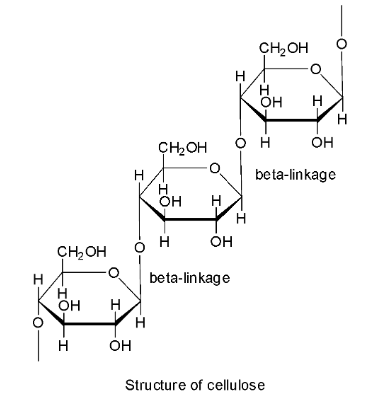
The chief component of cotton is cellulose. Cotton consists of about 95 percent cellulose and the rest are fats and waxes. Thus, cotton is also a natural polymer and so option C is wrong.
Bakelite is a synthetic polymer obtained by the condensation of phenol with formaldehyde in presence of an acid or a base catalyst. The initially formed ortho or para hydroxyl derivatives further react with phenol to give novolac which on further heating with formaldehyde gives bakelite by cross linking.
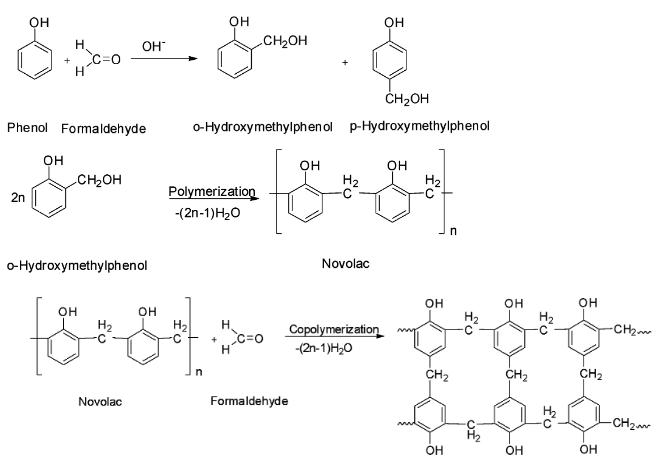
Thus, Bakelite is a synthetic polymer and hence option D is correct.
Note:
Bakelite is used in the manufacture of combs, fountain pen barrels and also used for making electrical goods.
The polysaccharide cellulose is considered as the chief structural material of cell walls of all plants. Due to its linear structure, cellulose is easily converted into fibres.
Cotton is most commonly used to make a number of textile products.
- Polysaccharides are carbohydrates which upon hydrolysis give a large number of monosaccharides.
- Bakelite is a phenol-formaldehyde polymer.
Complete step by step answer:
Amino acids are those organic compounds which contain amino groups and carboxyl groups as functional groups. Depending upon the relative position of the amino group with respect to the carboxyl group, the amino acids are classified as alpha-, beta-, gamma-, delta- etc. amino acids.
The hydrolysis of proteins gives only the alpha amino acids. The term ‘amino acid’ is used to refer specifically to these alpha amino acids.
Thus, the proteins are biopolymers formed by the condensation of a large number of alpha amino acids joined together by peptide bonds having 3D structures. So, option A is wrong.
Polysaccharides are biopolymers formed by joining together the monosaccharides by glycosidic linkages. For example, cellulose is a polysaccharide.
Cellulose is a linear polymer of $\beta$ -D-glucose in which ${{\text{C}}_{\text{1}}}$ of one glucose unit is linked to ${{\text{C}}_4}$ of the other glucose unit through a $\beta$-glycosidic linkage. Hence, option B is not correct.
The chief component of cotton is cellulose. Cotton consists of about 95 percent cellulose and the rest are fats and waxes. Thus, cotton is also a natural polymer and so option C is wrong.
Bakelite is a synthetic polymer obtained by the condensation of phenol with formaldehyde in presence of an acid or a base catalyst. The initially formed ortho or para hydroxyl derivatives further react with phenol to give novolac which on further heating with formaldehyde gives bakelite by cross linking.
Thus, Bakelite is a synthetic polymer and hence option D is correct.
Note:
Bakelite is used in the manufacture of combs, fountain pen barrels and also used for making electrical goods.
The polysaccharide cellulose is considered as the chief structural material of cell walls of all plants. Due to its linear structure, cellulose is easily converted into fibres.
Cotton is most commonly used to make a number of textile products.
Recently Updated Pages
Classification of Drugs in Chemistry: Types, Examples & Exam Guide

Difference Between Alcohol and Phenol: Structure, Tests & Uses
Wheatstone Bridge – Principle, Formula, Diagram & Applications
Mass vs Weight: Key Differences Explained for Students
Area vs Volume: Key Differences Explained for Students
Mutually Exclusive vs Independent Events: Key Differences Explained
Trending doubts
JEE Main Participating Colleges 2026 - A Complete List of Top Colleges
Understanding Atomic Structure for Beginners
Understanding the Different Types of Solutions in Chemistry
Which polymer is used in nonstick cooking vessels A class 12 chemistry JEE_Main
Electron Gain Enthalpy and Electron Affinity Explained
Understanding Electromagnetic Waves and Their Importance
Other Pages
Degree of Dissociation: Meaning, Formula, Calculation & Uses
Understanding the Angle of Deviation in a Prism
CBSE Notes Class 12 Chemistry Chapter 7 - Alcohol Phenol and Ether - 2026-27
Electrochemistry JEE Advanced 2026 Notes
Class 12 Chemistry Mock Test Series – Practice Online for JEE Main & Boards
CBSE Notes Class 12 Chemistry Chapter 8 - Aldehyde Ketone and Carboxylic Acid - 2026-27