




Which of the following is laboratory preparation of dihydrogen?
A. \[3Fe + 4{H_2}{O_{(steam)}} \to F{e_3}{O_4} + 4{H_2}\]
B. \[2Na + 2{H_2}O \to NaOH + 2{H_2}\]
C. \[Ca{H_2} + 2{H_2}O \to Ca{(OH)_2} + 2{H_2}\]
D. \[Zn + {H_2}S{O_{4(dil.)}} \to ZnS{o_4} + {H_2}\]
Answer
 Verified
283.5k+ views
Hint: Zinc granules are widely preferred for laboratory preparation of hydrogen gas because these granules usually have a small quantity of Cu, which has the ability to act as a catalyst in the given process.
Complete Step-by-Step Answer:
Dihydrogen or just Hydrogen is one of the most widely found gases. Various reactions release hydrogen gas as either a major product or as a by – product. But in most of these cases, the hydrogen gas formed is directly released into the atmosphere. It is very difficult to trap and collect the hydrogen formed because of its light weight and low density.
To collect this hydrogen, a very efficient laboratory method has been developed. The details about this process are as follows:
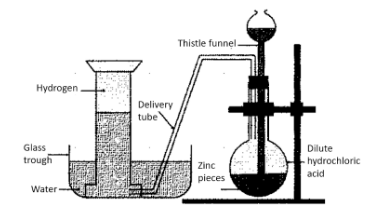
This process involves 4 major steps:
1. First of all, a certain amount of zinc granules is placed in a flask
2. After this, hydrochloric acid needs to be added to these zinc granules. This is done with the help of a thistle funnel. A replacement for hydrochloric acid could be sulphuric acid.
3. The reaction between the acid and the zinc granules would release hydrogen gas. The gas thus produced is transferred to a vessel filled with water, via a delivery tube.
4. The transferred hydrogen is now collected via a method known as downward displacement of water.
The chemical reaction for this process can be given as:
\[Zn + {H_2}S{O_{4(dil.)}} \to ZnS{o_4} + {H_2}\]
Hence, Option D is the correct option.
Note: Before collecting the hydrogen gas with the help of the apparatus, precautions must be taken in order to ensure that all the air inside the apparatus has been displaced. This is because hydrogen gas reacts explosively with air.
Complete Step-by-Step Answer:
Dihydrogen or just Hydrogen is one of the most widely found gases. Various reactions release hydrogen gas as either a major product or as a by – product. But in most of these cases, the hydrogen gas formed is directly released into the atmosphere. It is very difficult to trap and collect the hydrogen formed because of its light weight and low density.
To collect this hydrogen, a very efficient laboratory method has been developed. The details about this process are as follows:
This process involves 4 major steps:
1. First of all, a certain amount of zinc granules is placed in a flask
2. After this, hydrochloric acid needs to be added to these zinc granules. This is done with the help of a thistle funnel. A replacement for hydrochloric acid could be sulphuric acid.
3. The reaction between the acid and the zinc granules would release hydrogen gas. The gas thus produced is transferred to a vessel filled with water, via a delivery tube.
4. The transferred hydrogen is now collected via a method known as downward displacement of water.
The chemical reaction for this process can be given as:
\[Zn + {H_2}S{O_{4(dil.)}} \to ZnS{o_4} + {H_2}\]
Hence, Option D is the correct option.
Note: Before collecting the hydrogen gas with the help of the apparatus, precautions must be taken in order to ensure that all the air inside the apparatus has been displaced. This is because hydrogen gas reacts explosively with air.
Recently Updated Pages
Disproportionation Reaction: Definition, Example & JEE Guide

JEE Main 2025-26 Mock Test: Binomial Theorem & Quick Practice
Properties of Solids and Liquids Mock Test 2025
JEE Main Mock Test 2025-26: Principles Related To Practical
JEE Main Mock Test 2025-26: Dual Nature of Matter & Radiation
JEE Main 2025-26 Work, Energy and Power Mock Test – Free Practice Online
Trending doubts
JEE Main 2026: Exam Dates, Session 2 Updates, City Slip, Admit Card & Latest News
Understanding the Electric Field of a Uniformly Charged Ring
Understanding Atomic Structure for Beginners
Derivation of Equation of Trajectory Explained for Students
Electron Gain Enthalpy and Electron Affinity Explained
How to Convert a Galvanometer into an Ammeter or Voltmeter
Other Pages
JEE Advanced Percentile vs Marks 2026: JEE Main Cutoff, AIR & IIT Admission Guide
JEE Advanced 2026 Notification Out with Exam Date, Registration (Extended), Syllabus and More
NCERT Solutions For Class 11 Chemistry In Hindi Chapter 1 Some Basic Concepts Of Chemistry - 2026-27
Understanding Electromagnetic Waves and Their Importance
Understanding Instantaneous Velocity
NCERT Solutions For Class 11 Chemistry Chapter 8 Organic Chemistry - Some Basic Principles And Techniques - 2026-27