




Which of the following has the highest dipole moment?
(A) \[C{H_3}Cl\]
(B) \[C{H_3}F\]
(C) \[C{H_3}Br\]
(D) \[C{H_3}I\]
Answer
 Verified
268.8k+ views
Hint: Polar chemicals have a dipole moment other than zero, while non-polar compounds have a dipole moment of zero. The net dipole moment in a molecule will be 0 if the identical atoms are linearly present in front of one another, linked to the centre atom, and have the same magnitude but opposite direction of the dipole.
Complete Step by Step Solution:
We must first comprehend the idea of a dipole moment before we can compare the dipole moments of the supplied molecules.
When there is a charge separation, a phenomenon known as the dipole moment develops. Dipole moments are brought into play by the differences in electronegativity and can be seen between two different ions connected by ionic connections or it can be seen between atoms connected by covalent bonds. The dipole moment also rises as the difference in electronegativity widens. The dipole moment's magnitude is also influenced by the distance between the positive and negative charge separations. The magnitude of the dipole moment serves as a gauge for the polarity that a molecule possesses.
Now, in order to comprehend the dipole moments, we will examine each answer choice and sketch corresponding Lewis dot structures. The Lewis dot structure of chloromethane is displayed below if we take the first choice, which says either chloromethane or methyl chloride:
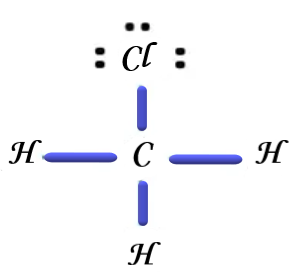
(Self made)
Now if we consider the second option, \[C{H_3}F\] is a non-toxic and liquefiable gas also known as Fluor-methane or methyl fluoride. It is a colourless and flammable gas. The Lewis dot structure of Fluor-methane is drawn below,
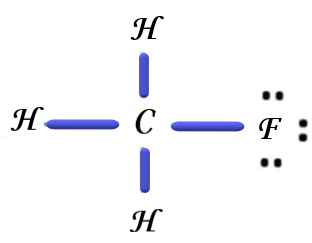
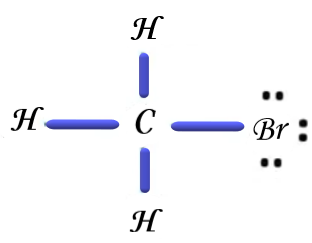
Now if we consider the third option, the Lewis dot structure of Bromomethane is drawn below,
Similarly, if we consider the last option, the Lewis dot structure of Iodomethane, that is also called methyl iodide,
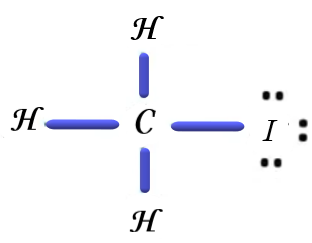
So, after comparing the four structures, we can see that the dipole moment of methyl chloride is maximum among the four.
The correct order of dipole moments is \[C{H_3}Cl > C{H_3}F > C{H_3}Br > C{H_3}I\].
Therefore, the correct option is: (A) \[C{H_3}Cl\]
Note: Among fluor-methane, bromomethane, and iodomethane, methyl chloride has the highest dipole moment because its bond length is larger while having lower charges, and its product of charges and bond length is more than that of methyl fluoride.
Complete Step by Step Solution:
We must first comprehend the idea of a dipole moment before we can compare the dipole moments of the supplied molecules.
When there is a charge separation, a phenomenon known as the dipole moment develops. Dipole moments are brought into play by the differences in electronegativity and can be seen between two different ions connected by ionic connections or it can be seen between atoms connected by covalent bonds. The dipole moment also rises as the difference in electronegativity widens. The dipole moment's magnitude is also influenced by the distance between the positive and negative charge separations. The magnitude of the dipole moment serves as a gauge for the polarity that a molecule possesses.
Now, in order to comprehend the dipole moments, we will examine each answer choice and sketch corresponding Lewis dot structures. The Lewis dot structure of chloromethane is displayed below if we take the first choice, which says either chloromethane or methyl chloride:
(Self made)
Now if we consider the second option, \[C{H_3}F\] is a non-toxic and liquefiable gas also known as Fluor-methane or methyl fluoride. It is a colourless and flammable gas. The Lewis dot structure of Fluor-methane is drawn below,
Now if we consider the third option, the Lewis dot structure of Bromomethane is drawn below,
Similarly, if we consider the last option, the Lewis dot structure of Iodomethane, that is also called methyl iodide,
So, after comparing the four structures, we can see that the dipole moment of methyl chloride is maximum among the four.
The correct order of dipole moments is \[C{H_3}Cl > C{H_3}F > C{H_3}Br > C{H_3}I\].
Therefore, the correct option is: (A) \[C{H_3}Cl\]
Note: Among fluor-methane, bromomethane, and iodomethane, methyl chloride has the highest dipole moment because its bond length is larger while having lower charges, and its product of charges and bond length is more than that of methyl fluoride.
Recently Updated Pages
Algebra Made Easy: Step-by-Step Guide for Students

JEE Isolation, Preparation and Properties of Non-metals Important Concepts and Tips for Exam Preparation
JEE Energetics Important Concepts and Tips for Exam Preparation
Chemical Properties of Hydrogen - Important Concepts for JEE Exam Preparation
JEE General Topics in Chemistry Important Concepts and Tips
JEE Amino Acids and Peptides Important Concepts and Tips for Exam Preparation
Trending doubts
JEE Main 2026: Exam Dates, Session 2 Updates, City Slip, Admit Card & Latest News
JEE Main Participating Colleges 2026 - A Complete List of Top Colleges
Understanding the Electric Field of a Uniformly Charged Ring
Derivation of Equation of Trajectory Explained for Students
Understanding Atomic Structure for Beginners
JEE Main Marking Scheme 2026- Paper-Wise Marks Distribution and Negative Marking Details
Other Pages
JEE Advanced 2026 Notification Out with Exam Date, Registration (Extended), Syllabus and More
JEE Advanced Percentile vs Marks 2026: JEE Main Cutoff, AIR & IIT Admission Guide
JEE Advanced 2026 Marks vs Rank: Estimate IIT Rank from Your Score
JEE Advanced Weightage Chapter Wise 2026 for Physics, Chemistry, and Mathematics
Understanding the Different Types of Solutions in Chemistry
NCERT Solutions For Class 11 Chemistry In Hindi Chapter 1 Some Basic Concepts Of Chemistry - 2025-26