




Which of the following groups is sharp ortho and para directive?
A) $ - {{\text{C}}_6}{{\text{H}}_5}$
B) $ - {\text{OH}}$
C) $ - {\text{C}}{{\text{H}}_3}$
D) $ - {\text{Cl}}$
Answer
 Verified
249.9k+ views
Hint: Here, all the groups are ortho and para directing as they are all electron donating groups .The $ - {\text{OH}}$ is the sharp ortho and para directing group as the lone pair present on oxygen group increase electron density at ortho and para positions.
Step-by-Step Explanation:
When mono-substituted benzene reacts with an electrophile, the electrophile can get attached to ortho, para or meta position on benzene. The electrophile if gets attached to the ortho or para position, it is called the ortho and para directing group. If it gets attached to the meta position it is called a meta directing group. The ortho and para directing groups are electron donating groups. Here, given all options are ortho and para directing. But $ - {\text{OH}}$ group is sharp ortho and para directing as the lone pair electron present in the Oxygen atom of the group increases electron density at ortho and para position so that the electrophile can easily get attached at these positions. The resonance structure of phenol is as follows-
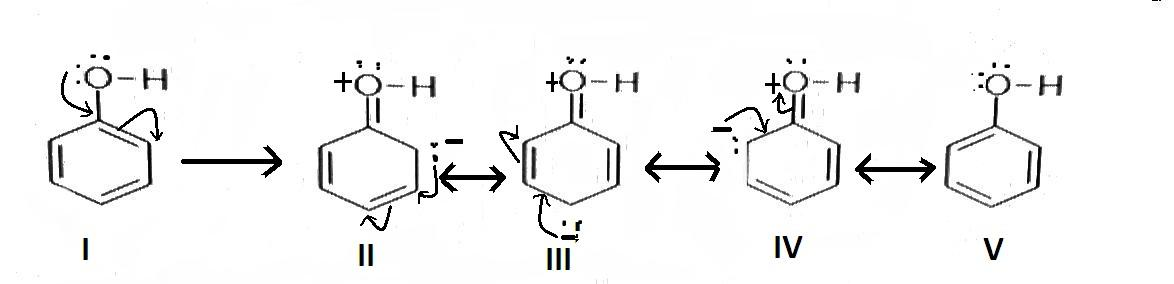
Hence correct answer is ‘B’.
Note: While ortho and para directing groups are electron donating groups, the meta directing groups are electron withdrawing groups. Halides are the exception of this rule because even when they are electron withdrawing groups they are still ortho and para directing.
Step-by-Step Explanation:
When mono-substituted benzene reacts with an electrophile, the electrophile can get attached to ortho, para or meta position on benzene. The electrophile if gets attached to the ortho or para position, it is called the ortho and para directing group. If it gets attached to the meta position it is called a meta directing group. The ortho and para directing groups are electron donating groups. Here, given all options are ortho and para directing. But $ - {\text{OH}}$ group is sharp ortho and para directing as the lone pair electron present in the Oxygen atom of the group increases electron density at ortho and para position so that the electrophile can easily get attached at these positions. The resonance structure of phenol is as follows-
Hence correct answer is ‘B’.
Note: While ortho and para directing groups are electron donating groups, the meta directing groups are electron withdrawing groups. Halides are the exception of this rule because even when they are electron withdrawing groups they are still ortho and para directing.
Recently Updated Pages
JEE Isolation, Preparation and Properties of Non-metals Important Concepts and Tips for Exam Preparation

Isoelectronic Definition in Chemistry: Meaning, Examples & Trends
Ionisation Energy and Ionisation Potential Explained
Iodoform Reactions - Important Concepts and Tips for JEE
Introduction to Dimensions: Understanding the Basics
Instantaneous Velocity Explained: Formula, Examples & Graphs
Trending doubts
JEE Main 2026: Exam Dates, Session 2 Updates, City Slip, Admit Card & Latest News
Hybridisation in Chemistry – Concept, Types & Applications
JEE Main 2026 Application Login: Direct Link, Registration, Form Fill, and Steps
Understanding the Electric Field of a Uniformly Charged Ring
Derivation of Equation of Trajectory Explained for Students
JEE Main Marking Scheme 2026- Paper-Wise Marks Distribution and Negative Marking Details
Other Pages
JEE Advanced Marks vs Ranks 2025: Understanding Category-wise Qualifying Marks and Previous Year Cut-offs
JEE Advanced 2026 - Exam Date (Released), Syllabus, Registration, Eligibility, Preparation, and More
CBSE Notes Class 11 Chemistry Chapter 9 - Hydrocarbons - 2025-26
CBSE Notes Class 11 Chemistry Chapter 5 - Thermodynamics - 2025-26
CBSE Notes Class 11 Chemistry Chapter 8 - Organic Chemistry Some Basic Principles And Techniques - 2025-26
JEE Advanced Weightage 2025 Chapter-Wise for Physics, Maths and Chemistry