




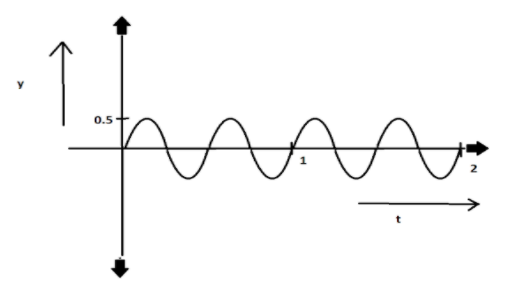
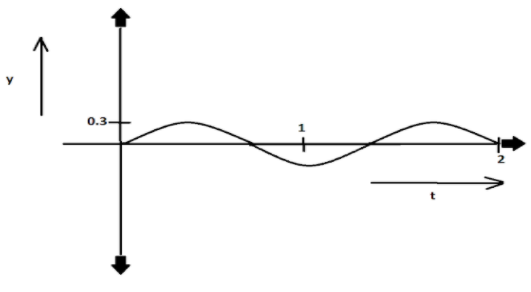
Which of the following figures represents a loud sound of low pitch?
Where $y = $ displacement $\left( m \right)$, $t = $ time $\left( s \right)$.
A)

B)

C)
D)
Answer
 Verified
244.5k+ views
Hint: While solving any question related to loudness, we should remember that loudness is determined by the amplitude of the sound wave, and pitch is determined by the frequency of the sound wave. Also, the higher is the amplitude, the louder will be the sound and the lower is the frequency, the lower will be the pitch and vice versa.
Complete step by step solution:
Before answering the above question, we should know what is loudness and pitch of a sound.
PITCH: The pitch is the frequency of sound waves that the ear understands. A higher frequency sound has a higher pitch and a lower frequency sound has a lower pitch.
LOUDNESS: The loudness or volume of sound is determined by the amplitude of sound waves. The loudness of sound is directly proportional to the square of the amplitude. Hence, a louder sound will have a higher amplitude as compared to a softer sound.
Among option (A), option (B), option (C), and option (D), the graph in option (A) shows the highest amplitude and hence we can say it is the loudest among all, and option (D) shows the lowest amplitude and hence we can say it is the softest or the most silent among all.
Among option (A), option (B), option (C), and option (D) the graph in option (A) shows the least frequency, and hence we can say it has the least pitch among all, and option (C) shows the most frequency and hence we can say it has the highest pitch among all.
So we can clearly conclude option (A) satisfies our requirement of high loudness and low pitch.
Therefore, option (A) is the correct option.
Note: Keep in mind that the loudness of sound is dependent on the energy received by the ear per unit time. It is independent of the change in frequency. On the other hand, the pitch of the sound is independent of the energy received by the ear per unit of time. But, it is dependent on the frequency of sound, as with the increase in the frequency of sound shrillness of sound also increases.
Complete step by step solution:
Before answering the above question, we should know what is loudness and pitch of a sound.
PITCH: The pitch is the frequency of sound waves that the ear understands. A higher frequency sound has a higher pitch and a lower frequency sound has a lower pitch.
LOUDNESS: The loudness or volume of sound is determined by the amplitude of sound waves. The loudness of sound is directly proportional to the square of the amplitude. Hence, a louder sound will have a higher amplitude as compared to a softer sound.
Among option (A), option (B), option (C), and option (D), the graph in option (A) shows the highest amplitude and hence we can say it is the loudest among all, and option (D) shows the lowest amplitude and hence we can say it is the softest or the most silent among all.
Among option (A), option (B), option (C), and option (D) the graph in option (A) shows the least frequency, and hence we can say it has the least pitch among all, and option (C) shows the most frequency and hence we can say it has the highest pitch among all.
So we can clearly conclude option (A) satisfies our requirement of high loudness and low pitch.
Therefore, option (A) is the correct option.
Note: Keep in mind that the loudness of sound is dependent on the energy received by the ear per unit time. It is independent of the change in frequency. On the other hand, the pitch of the sound is independent of the energy received by the ear per unit of time. But, it is dependent on the frequency of sound, as with the increase in the frequency of sound shrillness of sound also increases.
Recently Updated Pages
JEE Main 2026 Admit Card OUT LIVE Soon| Session 2 Direct Download Link

JEE Main 2026 Session 2 City Intimation Slip Expected Soon: Check How to Download
JEE Main 2026 Session 2 Application Form: Reopened Registration, Dates & Fees
JEE Main 2026 Session 2 Registration (Reopened): Last Date, Fees, Link & Process
WBJEE 2026 Registration Started: Important Dates Eligibility Syllabus Exam Pattern
Dimensions of Charge: Dimensional Formula, Derivation, SI Units & Examples
Trending doubts
JEE Main 2026: Exam Dates, Session 2 Updates, City Slip, Admit Card & Latest News
Ideal and Non-Ideal Solutions Explained for Class 12 Chemistry
Understanding the Angle of Deviation in a Prism
Understanding Differential Equations: A Complete Guide
Hybridisation in Chemistry – Concept, Types & Applications
Understanding the Electric Field of a Uniformly Charged Ring
Other Pages
JEE Advanced Marks vs Ranks 2025: Understanding Category-wise Qualifying Marks and Previous Year Cut-offs
JEE Advanced 2026 - Exam Date (Released), Syllabus, Registration, Eligibility, Preparation, and More
CBSE Notes Class 11 Physics Chapter 1 - Units And Measurements - 2025-26
Important Questions For Class 11 Physics Chapter 1 Units and Measurement - 2025-26
CBSE Notes Class 11 Physics Chapter 4 - Laws of Motion - 2025-26
CBSE Notes Class 11 Physics Chapter 14 - Waves - 2025-26