




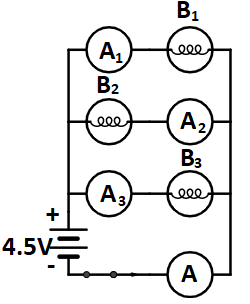
Three identical bulbs $B_1$, $B_2$ and $B_3$ are connected as shown in figure. When all three bulbs glow, a current of 3 A is recorded by the Ammeter A.
How much power is dissipated in the circuit when all three bulbs glow together?
Answer
 Verified
264.6k+ views
Hint: By the series and parallel combination concept find the current in each bulb thenUse the formula ${{P = VI}}$, Where P = power, I = current and V = potential difference and then substitute the given values of potential difference and current in the formula then evaluate power dissipation in the given circuit diagram.
Complete step by step solution:
Given: Bulbs B1, B2 and B3 are three identical
Current, I = 3 A
Potential difference, V = 4.5 V
To find: Power dissipation in the circuit when all three identical bulbs glows together
The rate at which electric energy is consumed is called power. It is denoted by P. SI unit of power is Watt.
From the given circuit diagram, it is clear that bulbs B1, B2 and B3 are connected in parallel combination.
Formula for power dissipation is given as ${{P = VI}}$
Where P = Power dissipated in the circuit
I = Current in the circuit
V = Potential drop across electric components (here bulbs)
On substituting the given values in above formula, we get
$\Rightarrow {{P = 4}}{{.5 \times 3 = 13}}{{.5 Watt}}$
Therefore, power of 13.5 W is dissipated in the circuit when all three bulbs glow together.
Note: Other formulae for power dissipation are ${{P = VI = }}{{{I}}^{{2}}}{{R = }}\dfrac{{{{{V}}^{{2}}}}}{{{R}}}$. On the basis of given quantities in the question, we can use different formulae. According to the question, values of voltage (V) and current (I) are given. So, we use formula P = VI. If in question, only the value of current and resistance is asked then we can use the formula ${{P = }}{{{I}}^{{2}}}{{R}}$. If in the question, only the value of voltage and resistance are given then we can use formula, ${{P = }}\dfrac{{{{{V}}^{{2}}}}}{{{R}}}$.
A watt hour and kilowatt hour are practical units of electric energy. The commercial unit of electric energy is kilowatt hour (kWh), where ${{1kWh = 1000Wh = 3}}{{.6 \times 1}}{{{0}}^{{6}}}{{J}}.$ Electric power is the rate at which electric energy is consumed. SI unit of electric power is Watt.
Complete step by step solution:
Given: Bulbs B1, B2 and B3 are three identical
Current, I = 3 A
Potential difference, V = 4.5 V
To find: Power dissipation in the circuit when all three identical bulbs glows together
The rate at which electric energy is consumed is called power. It is denoted by P. SI unit of power is Watt.
From the given circuit diagram, it is clear that bulbs B1, B2 and B3 are connected in parallel combination.
Formula for power dissipation is given as ${{P = VI}}$
Where P = Power dissipated in the circuit
I = Current in the circuit
V = Potential drop across electric components (here bulbs)
On substituting the given values in above formula, we get
$\Rightarrow {{P = 4}}{{.5 \times 3 = 13}}{{.5 Watt}}$
Therefore, power of 13.5 W is dissipated in the circuit when all three bulbs glow together.
Note: Other formulae for power dissipation are ${{P = VI = }}{{{I}}^{{2}}}{{R = }}\dfrac{{{{{V}}^{{2}}}}}{{{R}}}$. On the basis of given quantities in the question, we can use different formulae. According to the question, values of voltage (V) and current (I) are given. So, we use formula P = VI. If in question, only the value of current and resistance is asked then we can use the formula ${{P = }}{{{I}}^{{2}}}{{R}}$. If in the question, only the value of voltage and resistance are given then we can use formula, ${{P = }}\dfrac{{{{{V}}^{{2}}}}}{{{R}}}$.
A watt hour and kilowatt hour are practical units of electric energy. The commercial unit of electric energy is kilowatt hour (kWh), where ${{1kWh = 1000Wh = 3}}{{.6 \times 1}}{{{0}}^{{6}}}{{J}}.$ Electric power is the rate at which electric energy is consumed. SI unit of electric power is Watt.
Recently Updated Pages
JEE Main 2025-26 Experimental Skills Mock Test – Free Practice

JEE Main 2025-26 Electronic Devices Mock Test: Free Practice Online
JEE Main 2025-26 Mock Tests: Free Practice Papers & Solutions
JEE Main 2025-26: Magnetic Effects of Current & Magnetism Mock Test
JEE Main 2025-26 Atoms and Nuclei Mock Test – Free Practice Online
JEE Main Mock Test 2025-26: Experimental Skills Chapter Online Practice
Trending doubts
JEE Main 2026: Exam Dates, Session 2 Updates, City Slip, Admit Card & Latest News
JEE Main Participating Colleges 2026 - A Complete List of Top Colleges
Kinematics Mock Test for JEE Main 2025-26: Practice & Ace the Exam
Kinematics Mock Test for JEE Main 2025-26: Comprehensive Practice
Hybridisation in Chemistry – Concept, Types & Applications
Understanding the Electric Field of a Uniformly Charged Ring
Other Pages
CBSE Class 12 Physics Question Paper 2026: Download SET-wise PDF with Answer Key & Analysis
JEE Advanced 2026 Notification Out with Exam Date, Registration (Extended), Syllabus and More
JEE Advanced Percentile vs Marks 2026: JEE Main Cutoff, AIR & IIT Admission Guide
JEE Advanced Weightage Chapter Wise 2026 for Physics, Chemistry, and Mathematics
JEE Advanced Marks vs Rank 2025 - Predict Your IIT Rank Based on Score
Derivation of Equation of Trajectory Explained for Students