




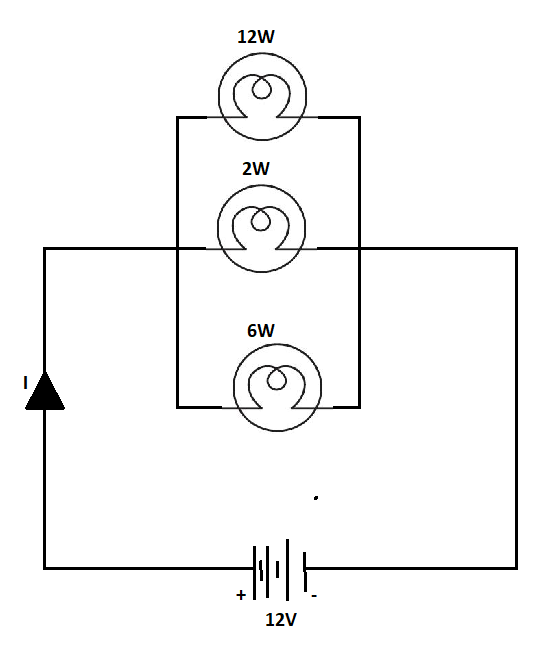
Three bulbs with individual power ratings of 12 W,2 W, and 6 W respectively are connected as per the circuit diagram. Find the amount of heat dissipated by each in 10 seconds.
\[
A) 12W - 144J,2W - 20J,6W - 60J \\
B) 12W - 120J,2W - 24J,6W - 60J \\
C) 12W - 120J,2W - 20J,6W - 72J \\
D) 12W - 120J,2W - 20J,6W - 60J \\
\]
Answer
 Verified
253.5k+ views
Hint: Heat dissipated by the bulb is the power consumed by it over time. The power rating of the bulb means the amount of energy it consumes per unit of time. A bulb has a filament of tungsten and tungsten offers resistance to the flow of current during this process it gets heated up and dissipates heat energy.
Complete step by step solution:
As we can see in this diagram the three bulbs of different power ratings are connected in parallel.
In a parallel connection, the current gets divided into the branches but the voltage across each branch remains the same
Here all three bulbs are connected in parallel connection to a 12V supply
So the voltage available to each bulb will be the same
Now the power rating of each bulb is given
Bulb 1:
Power = 12W
Voltage available is =12V
As we know heat dissipated is the product of the power consumed by the bulb and time
$H = Pt$
Where,
$H$ is the heat dissipated
$P$ is the power consumed
$t$ is the time taken
$H = 12 \times 10$
$\Rightarrow H = 120J $
Bulb 2:
Power = 2W
Voltage available is = 12V
As we know heat dissipated is the product of the power consumed by the bulb and time
$ \because H = Pt $
$\therefore H = 2 \times 10$
$\Rightarrow H = 20J $
Bulb 3:
Power = 6W
Voltage available is =12V
As we know heat dissipated is the product of the power consumed by the bulb and time
$\because H = Pt$
$\therefore H = 6 \times 10 $
$\Rightarrow H = 60J $
Final answer is \[D:12W - 120J,2W - 20J,6W - 60J\].
Note: Heat dissipated by is the amount of power it consumes in the given time. When an electric current flows through a conductor it experiences resistance and due to this resistance to flow the material through which the current is flowing gets heated up and dissipates the energy. It may be said that in the above process the electric energy is being converted into electrical energy.
Complete step by step solution:
As we can see in this diagram the three bulbs of different power ratings are connected in parallel.
In a parallel connection, the current gets divided into the branches but the voltage across each branch remains the same
Here all three bulbs are connected in parallel connection to a 12V supply
So the voltage available to each bulb will be the same
Now the power rating of each bulb is given
Bulb 1:
Power = 12W
Voltage available is =12V
As we know heat dissipated is the product of the power consumed by the bulb and time
$H = Pt$
Where,
$H$ is the heat dissipated
$P$ is the power consumed
$t$ is the time taken
$H = 12 \times 10$
$\Rightarrow H = 120J $
Bulb 2:
Power = 2W
Voltage available is = 12V
As we know heat dissipated is the product of the power consumed by the bulb and time
$ \because H = Pt $
$\therefore H = 2 \times 10$
$\Rightarrow H = 20J $
Bulb 3:
Power = 6W
Voltage available is =12V
As we know heat dissipated is the product of the power consumed by the bulb and time
$\because H = Pt$
$\therefore H = 6 \times 10 $
$\Rightarrow H = 60J $
Final answer is \[D:12W - 120J,2W - 20J,6W - 60J\].
Note: Heat dissipated by is the amount of power it consumes in the given time. When an electric current flows through a conductor it experiences resistance and due to this resistance to flow the material through which the current is flowing gets heated up and dissipates the energy. It may be said that in the above process the electric energy is being converted into electrical energy.
Recently Updated Pages
States of Matter Chapter For JEE Main Chemistry

Young’s Double Slit Experiment Derivation Explained
JEE Main Participating Colleges 2026 - A Complete List of Top Colleges
Wheatstone Bridge – Principle, Formula, Diagram & Applications
Circuit Switching vs Packet Switching: Key Differences Explained
Mass vs Weight: Key Differences Explained for Students
Trending doubts
JEE Main 2026: Exam Dates, Session 2 Updates, City Slip, Admit Card & Latest News
JEE Main Marking Scheme 2026- Paper-Wise Marks Distribution and Negative Marking Details
JEE Main 2026 Application Login: Direct Link, Registration, Form Fill, and Steps
Hybridisation in Chemistry – Concept, Types & Applications
Understanding the Electric Field of a Uniformly Charged Ring
Derivation of Equation of Trajectory Explained for Students
Other Pages
CBSE Class 12 Physics Question Paper 2026: Download SET-wise PDF with Answer Key & Analysis
JEE Advanced 2026 - Exam Date (Released), Syllabus, Registration, Eligibility, Preparation, and More
JEE Advanced Marks vs Ranks 2025: Understanding Category-wise Qualifying Marks and Previous Year Cut-offs
JEE Advanced Weightage 2025 Chapter-Wise for Physics, Maths and Chemistry
Ideal and Non-Ideal Solutions Explained for Class 12 Chemistry
JEE Advanced Marks vs Rank 2025 - Predict Your IIT Rank Based on Score