




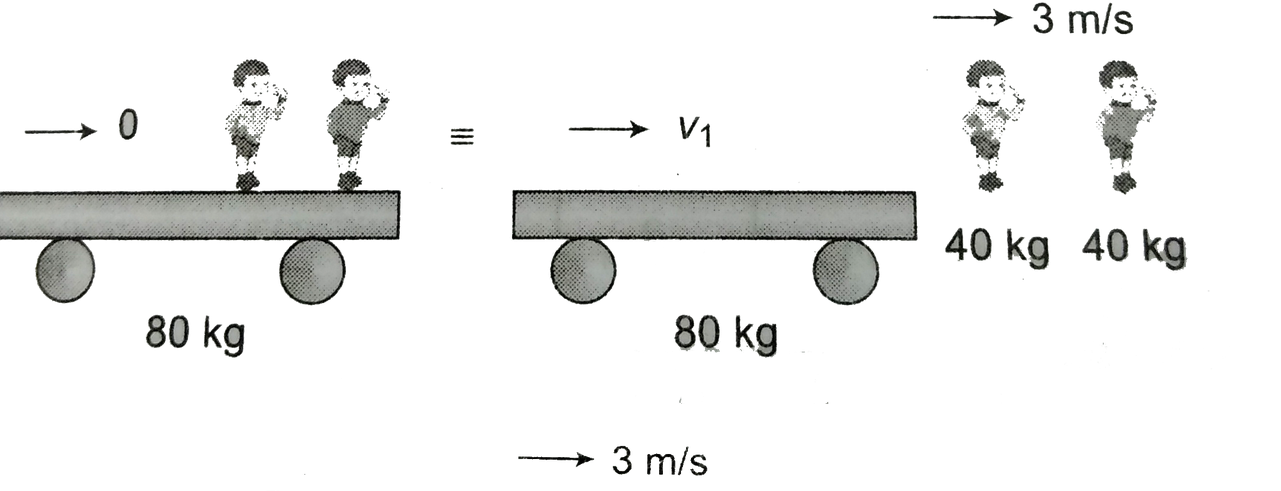
The speed of the trolley when the man jumps of the trolley is:
(A) 2
(B) 4
(C) 8
(D) 16
Answer
 Verified
274.8k+ views
Hint To answer this question we have to form the equation which develops the relation between the mass and the velocities of the man and the trolley with the equation of conservation of momentum. Once we develop the equation we have to put the values in the quantities and evaluate the expression. This will give us the answer to the required question.
Complete step by step answer
We should know that the mass of the trolley let be m = 40 kg
Mass of the mass is denoted by M = 80kg
As we know that there is no external force that is acting in the horizontal direction, the conservation of momentum along the direction is reserved.
Hence we can write that:
$(M + m){v_0} = M{v_{man}} + m{v_{trolley}}$
Now we have to put the values in the above expression that is formed. So the expression becomes:
$
\Rightarrow (80v + 40)2 = 80( - 1) + (40{v_{trolley}}) \\
\Rightarrow {v_{trolley}} = 8m/s \\
$
Hence we can see that the value of speed of the trolley when the man jumps off the trolley is 8m/s.
So the correct answer is option C.
Note We should know that momentum is defined as the physical quantity which signifies to the quantity of the motion of an object. Any object which is in motion will always have a momentum. The formula of momentum is given as mass multiplied by the velocity.
In this answer we have also come across the law of momentum. For better understanding we should be knowing the statement of the law. So here are they:
In case of collision that occurs between 2 objects, let them be object 1 and object 2, in an isolated system, then the total momentum of the two objects before the collision will always be equal to that of the total momentum of the 2 objects after the collision.
Complete step by step answer
We should know that the mass of the trolley let be m = 40 kg
Mass of the mass is denoted by M = 80kg
As we know that there is no external force that is acting in the horizontal direction, the conservation of momentum along the direction is reserved.
Hence we can write that:
$(M + m){v_0} = M{v_{man}} + m{v_{trolley}}$
Now we have to put the values in the above expression that is formed. So the expression becomes:
$
\Rightarrow (80v + 40)2 = 80( - 1) + (40{v_{trolley}}) \\
\Rightarrow {v_{trolley}} = 8m/s \\
$
Hence we can see that the value of speed of the trolley when the man jumps off the trolley is 8m/s.
So the correct answer is option C.
Note We should know that momentum is defined as the physical quantity which signifies to the quantity of the motion of an object. Any object which is in motion will always have a momentum. The formula of momentum is given as mass multiplied by the velocity.
In this answer we have also come across the law of momentum. For better understanding we should be knowing the statement of the law. So here are they:
In case of collision that occurs between 2 objects, let them be object 1 and object 2, in an isolated system, then the total momentum of the two objects before the collision will always be equal to that of the total momentum of the 2 objects after the collision.
Recently Updated Pages
Mass vs Weight: Key Differences Explained for Students

Circuit Switching vs Packet Switching: Key Differences Explained
Uniform Acceleration Explained: Formula, Examples & Graphs
Length vs. Height: Key Differences Explained for Students
Rows vs Columns: Key Differences Explained Simply
Place Value vs Face Value: Key Differences Explained for Students
Trending doubts
JEE Main 2026: Exam Dates, Session 2 Updates, City Slip, Admit Card & Latest News
Understanding the Electric Field of a Uniformly Charged Ring
Understanding Atomic Structure for Beginners
Derivation of Equation of Trajectory Explained for Students
Electron Gain Enthalpy and Electron Affinity Explained
How to Convert a Galvanometer into an Ammeter or Voltmeter
Other Pages
JEE Advanced 2026 Notification Out with Exam Date, Registration (Extended), Syllabus and More
JEE Advanced Percentile vs Marks 2026: JEE Main Cutoff, AIR & IIT Admission Guide
CBSE Notes Class 11 Physics Chapter 1 - Units And Measurements - 2026-27
NCERT Solutions For Class 11 Physics Chapter 1 Units And Measurements - 2026-27
Important Questions For Class 11 Physics Chapter 1 Units and Measurement - 2026-27
JEE Advanced Weightage Chapter Wise 2026 for Physics, Chemistry, and Mathematics