




The shape of $Cl{O_3}^ - $ according to VSEPR model is-
(A) Planar triangle
(B) Pyramidal
(C) Tetrahedral
(D) Square planar
Answer
 Verified
284.1k+ views
Hint: This question belongs to the chapter Chemical Bonding and Molecular Structure. This question demands us to find the shape of compound $Cl{O_3}^ - $, to state the structure we need to place the formula of hybridization. By placing all the required values, we can find our answer.
Complete step by step answer:
> Chlorate is a white crystalline, inorganic in nature. It is water-soluble. The material itself is noncombustible, but can form a very flammable combination with materials which are combustible, which can be explosive if the combustible material is very finely divided. Friction can ignite the mixture. Strong sulfuric acid contact may lead to fires or explosions. Spontaneous decomposition and ignition can result when mixed with ammonium salts. Long exposure to heat or fire can lead to an explosion.
The compound is $Cl{O_3}^ - $.
By placing hybridization formula, we get
$ \Rightarrow \dfrac{1}{2}$ (Number of valence electron on center atom + number of monovalent atom)
$ \Rightarrow \dfrac{1}{2}\left( {7 + 0 + 1} \right)k$ { here, 7 is the valence electron on chlorine, oxygen is divalent so monovalent 0, 1 is the charge gained}
$ \Rightarrow \dfrac{1}{2}\left( 8 \right) = 4$, so we get $s{p^3}$ hybridization.
4 bonds would have been made but it will be 3 bond pair and 1 lone pair
Figure –
So, the shape of the compound $Cl{O_3}^ - $ would be pyramidal.
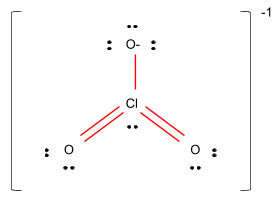
Hence, it is clear that option B is the correct option.
Note: Chlorate is a monovalent anion derived from chloric acid deprotonation. It's a mere inorganic anion and oxoanion chlorine. It is a chloric acid conjugate base.
Complete step by step answer:
> Chlorate is a white crystalline, inorganic in nature. It is water-soluble. The material itself is noncombustible, but can form a very flammable combination with materials which are combustible, which can be explosive if the combustible material is very finely divided. Friction can ignite the mixture. Strong sulfuric acid contact may lead to fires or explosions. Spontaneous decomposition and ignition can result when mixed with ammonium salts. Long exposure to heat or fire can lead to an explosion.
The compound is $Cl{O_3}^ - $.
By placing hybridization formula, we get
$ \Rightarrow \dfrac{1}{2}$ (Number of valence electron on center atom + number of monovalent atom)
$ \Rightarrow \dfrac{1}{2}\left( {7 + 0 + 1} \right)k$ { here, 7 is the valence electron on chlorine, oxygen is divalent so monovalent 0, 1 is the charge gained}
$ \Rightarrow \dfrac{1}{2}\left( 8 \right) = 4$, so we get $s{p^3}$ hybridization.
4 bonds would have been made but it will be 3 bond pair and 1 lone pair
Figure –
So, the shape of the compound $Cl{O_3}^ - $ would be pyramidal.
Hence, it is clear that option B is the correct option.
Note: Chlorate is a monovalent anion derived from chloric acid deprotonation. It's a mere inorganic anion and oxoanion chlorine. It is a chloric acid conjugate base.
Recently Updated Pages
Disproportionation Reaction: Definition, Example & JEE Guide

JEE Main 2025-26 Mock Test: Binomial Theorem & Quick Practice
Properties of Solids and Liquids Mock Test 2025
JEE Main Mock Test 2025-26: Principles Related To Practical
JEE Main Mock Test 2025-26: Dual Nature of Matter & Radiation
JEE Main 2025-26 Work, Energy and Power Mock Test – Free Practice Online
Trending doubts
JEE Main 2026: Exam Dates, Session 2 Updates, City Slip, Admit Card & Latest News
Understanding the Electric Field of a Uniformly Charged Ring
Understanding Atomic Structure for Beginners
Derivation of Equation of Trajectory Explained for Students
Electron Gain Enthalpy and Electron Affinity Explained
How to Convert a Galvanometer into an Ammeter or Voltmeter
Other Pages
JEE Advanced Percentile vs Marks 2026: JEE Main Cutoff, AIR & IIT Admission Guide
JEE Advanced 2026 Notification Out with Exam Date, Registration (Extended), Syllabus and More
NCERT Solutions For Class 11 Chemistry In Hindi Chapter 1 Some Basic Concepts Of Chemistry - 2026-27
Understanding Electromagnetic Waves and Their Importance
Understanding Instantaneous Velocity
JEE Advanced Weightage Chapter Wise 2026 for Physics, Chemistry, and Mathematics