




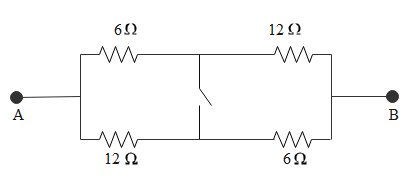
The ratio of equivalent resistance across A and B when switch is open to that when switch is closed is:
(A) $\dfrac{3}{8}$
(B) $\dfrac{5}{8}$
(C) $\dfrac{7}{8}$
(D) $\dfrac{9}{8}$
Answer
 Verified
233.1k+ views
Hint: We know that resistance is a measure of the opposition to current flow in an electrical circuit. Resistance is measured in ohms, symbolized by the Greek letter omega. Resistance is an electrical quantity that measures how the device or material reduces the electric current flow through it. The resistance is measured in units of ohms (Ω). If we make an analogy to water flow in pipes, the resistance is bigger when the pipe is thinner, so the water flow is decreased. Based on this concept we have to solve this question.
Complete step-by-step answer:
When the switch is open, $6\Omega $and $12\Omega $are connected in series. $12\Omega $ and $6\Omega $ are also connected in series and both are in parallel connection.
So, ${{R}_{AB}}=\left( 6+12 \right)||\left( 12+6 \right)$
$\Rightarrow {{R}_{AB}}=18||18=9\Omega $
When the switch is closed, $6\Omega $and $12\Omega $are connected in parallel. $12\Omega $ and $6\Omega $ are also connected in parallel and both are in series connection.
So, ${{{R}'}_{AB}}=\left[ 6||12 \right]+\left[ 12||6 \right]$
Or, $6||12$=$\dfrac{6\times 12}{6+12}=4\Omega $
Or, ${{{R}'}_{AB}}=4+4=8\Omega $
Ratio $\dfrac{{{{{R}'}}_{AB}}}{{{{{R}'}}_{AB}}}=\dfrac{9}{8}$
Hence, the correct answer is Option D.
Note: We know that components connected in parallel are connected along multiple paths so that the current can split up. The same voltage is applied to each component. A circuit composed solely of components connected in series is known as a series circuit; likewise, one connected completely in parallel is known as a parallel circuit. The parallel circuit is the standard electrical circuit found in most homes and devices. Because it provides more than one way for a current to flow through to a device, it creates a much more stable and efficient power system than would otherwise be possible.
It should be known to us that components connected in series are connected along a single conductive path, so the same current flows through all of the components but voltage is dropped (lost) across each of the resistances. In a series circuit, the sum of the voltages consumed by each individual resistance is equal to the source voltage.
Complete step-by-step answer:
When the switch is open, $6\Omega $and $12\Omega $are connected in series. $12\Omega $ and $6\Omega $ are also connected in series and both are in parallel connection.
So, ${{R}_{AB}}=\left( 6+12 \right)||\left( 12+6 \right)$
$\Rightarrow {{R}_{AB}}=18||18=9\Omega $
When the switch is closed, $6\Omega $and $12\Omega $are connected in parallel. $12\Omega $ and $6\Omega $ are also connected in parallel and both are in series connection.
So, ${{{R}'}_{AB}}=\left[ 6||12 \right]+\left[ 12||6 \right]$
Or, $6||12$=$\dfrac{6\times 12}{6+12}=4\Omega $
Or, ${{{R}'}_{AB}}=4+4=8\Omega $
Ratio $\dfrac{{{{{R}'}}_{AB}}}{{{{{R}'}}_{AB}}}=\dfrac{9}{8}$
Hence, the correct answer is Option D.
Note: We know that components connected in parallel are connected along multiple paths so that the current can split up. The same voltage is applied to each component. A circuit composed solely of components connected in series is known as a series circuit; likewise, one connected completely in parallel is known as a parallel circuit. The parallel circuit is the standard electrical circuit found in most homes and devices. Because it provides more than one way for a current to flow through to a device, it creates a much more stable and efficient power system than would otherwise be possible.
It should be known to us that components connected in series are connected along a single conductive path, so the same current flows through all of the components but voltage is dropped (lost) across each of the resistances. In a series circuit, the sum of the voltages consumed by each individual resistance is equal to the source voltage.
Recently Updated Pages
JEE Main 2023 April 6 Shift 1 Question Paper with Answer Key

JEE Main 2023 April 6 Shift 2 Question Paper with Answer Key
JEE Main 2023 (January 31 Evening Shift) Question Paper with Solutions [PDF]
JEE Main 2023 January 30 Shift 2 Question Paper with Answer Key
JEE Main 2023 January 25 Shift 1 Question Paper with Answer Key
JEE Main 2023 January 24 Shift 2 Question Paper with Answer Key
Trending doubts
JEE Main 2026: Session 2 Registration Open, City Intimation Slip, Exam Dates, Syllabus & Eligibility
JEE Main 2026 Application Login: Direct Link, Registration, Form Fill, and Steps
Understanding the Angle of Deviation in a Prism
Hybridisation in Chemistry – Concept, Types & Applications
How to Convert a Galvanometer into an Ammeter or Voltmeter
Understanding Uniform Acceleration in Physics
Other Pages
JEE Advanced Marks vs Ranks 2025: Understanding Category-wise Qualifying Marks and Previous Year Cut-offs
Dual Nature of Radiation and Matter Class 12 Physics Chapter 11 CBSE Notes - 2025-26
Understanding the Electric Field of a Uniformly Charged Ring
JEE Advanced Weightage 2025 Chapter-Wise for Physics, Maths and Chemistry
Derivation of Equation of Trajectory Explained for Students
Understanding Electromagnetic Waves and Their Importance