




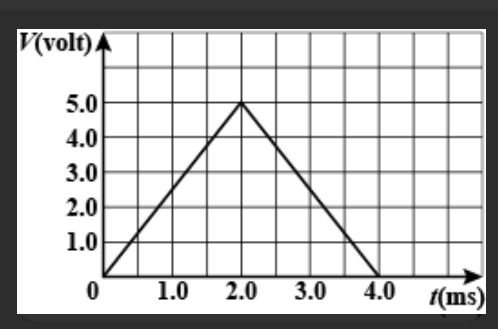
The potential difference across a $150 \mathrm{mH}$ inductor as a function of time is shown in figure. Assume that the initial value of the current in the inductor is zero. What is the current when $t=4.0 \mathrm{ms} ?$
(A) $2.67 \times 10^{-4} \mathrm{A}$
(B) $3.67 \times 10^{-2} \mathrm{A}$
(C) $6.67 \times 10^{-2} \mathrm{A}$
(D) $9.67 \times 10^{-4} \mathrm{A}$
Answer
 Verified
264.9k+ views
Hint: The electric potential difference between points A and B, VB−VA, is defined to be the change in potential energy of a charge q moved from A to B, divided by the charge. Units of potential difference are joules per coulomb, given the name volt (V) after Alessandro Volta. When a voltage is connected across a wire, an electric field is produced in the wire. Metal wire is a conductor. Some electrons around the metal atoms are free to move from atom to atom. This causes a difference in energy across the component, which is known as an electrical potential difference.
Complete step by step answer
If the electric potential difference between two locations is 1 volt, then one Coulomb of charge will gain 1 joule of potential energy when moved between those two locations. Because electric potential difference is expressed in units of volts, it is sometimes referred to as the voltage.
$\mathrm{V}_{\mathrm{L}}=\mathrm{L} \dfrac{\mathrm{d}}{\mathrm{dt}}$
$\therefore \quad \mathrm{di}=\dfrac{1}{\mathrm{L}}\left(\mathrm{V}_{\mathrm{L}} \mathrm{dt}\right)$
$\therefore \quad \int \mathrm{di}=\mathrm{i}=\dfrac{1}{\mathrm{L}} \int \mathrm{V}_{\mathrm{L}} \mathrm{dt} \quad$ or $\quad \mathrm{i}=\dfrac{1}{\mathrm{L}}$
At $\mathrm{t}=4 \mathrm{ms}$
$\mathrm{i}=\left(150 \times 10^{-3}\right)^{-1}\left(\dfrac{1}{2} \times 4 \times 10^{-3} \times 5\right)=6.67 \times 10^{-2} \mathrm{A}$
So the correct answer is option C.
Note: One volt is defined as the difference in electric potential between two points of a conducting wire when an electric current of one ampere dissipates one watt of power between those points. Voltage, also sometimes called potential difference or electromotive force (EMF), refers to the amount of potential energy the electrons have in an object or circuit. In some ways, you can think of this as the amount of "push" the electrons are making to try to get towards a positive charge. This process defines the electric potential of a point-like charge. Therefore, a system consisting of a negative and a positive point-like charge has a negative potential energy.
Complete step by step answer
If the electric potential difference between two locations is 1 volt, then one Coulomb of charge will gain 1 joule of potential energy when moved between those two locations. Because electric potential difference is expressed in units of volts, it is sometimes referred to as the voltage.
$\mathrm{V}_{\mathrm{L}}=\mathrm{L} \dfrac{\mathrm{d}}{\mathrm{dt}}$
$\therefore \quad \mathrm{di}=\dfrac{1}{\mathrm{L}}\left(\mathrm{V}_{\mathrm{L}} \mathrm{dt}\right)$
$\therefore \quad \int \mathrm{di}=\mathrm{i}=\dfrac{1}{\mathrm{L}} \int \mathrm{V}_{\mathrm{L}} \mathrm{dt} \quad$ or $\quad \mathrm{i}=\dfrac{1}{\mathrm{L}}$
At $\mathrm{t}=4 \mathrm{ms}$
$\mathrm{i}=\left(150 \times 10^{-3}\right)^{-1}\left(\dfrac{1}{2} \times 4 \times 10^{-3} \times 5\right)=6.67 \times 10^{-2} \mathrm{A}$
So the correct answer is option C.
Note: One volt is defined as the difference in electric potential between two points of a conducting wire when an electric current of one ampere dissipates one watt of power between those points. Voltage, also sometimes called potential difference or electromotive force (EMF), refers to the amount of potential energy the electrons have in an object or circuit. In some ways, you can think of this as the amount of "push" the electrons are making to try to get towards a positive charge. This process defines the electric potential of a point-like charge. Therefore, a system consisting of a negative and a positive point-like charge has a negative potential energy.
Recently Updated Pages
JEE Main 2025-26 Experimental Skills Mock Test – Free Practice

JEE Main 2025-26 Electronic Devices Mock Test: Free Practice Online
JEE Main 2025-26 Mock Tests: Free Practice Papers & Solutions
JEE Main 2025-26: Magnetic Effects of Current & Magnetism Mock Test
JEE Main 2025-26 Atoms and Nuclei Mock Test – Free Practice Online
JEE Main Mock Test 2025-26: Experimental Skills Chapter Online Practice
Trending doubts
JEE Main 2026: Exam Dates, Session 2 Updates, City Slip, Admit Card & Latest News
JEE Main Participating Colleges 2026 - A Complete List of Top Colleges
Kinematics Mock Test for JEE Main 2025-26: Practice & Ace the Exam
Kinematics Mock Test for JEE Main 2025-26: Comprehensive Practice
Hybridisation in Chemistry – Concept, Types & Applications
Understanding the Electric Field of a Uniformly Charged Ring
Other Pages
CBSE Class 12 Physics Question Paper 2026: Download SET-wise PDF with Answer Key & Analysis
JEE Advanced 2026 Notification Out with Exam Date, Registration (Extended), Syllabus and More
JEE Advanced Percentile vs Marks 2026: JEE Main Cutoff, AIR & IIT Admission Guide
JEE Advanced Weightage Chapter Wise 2026 for Physics, Chemistry, and Mathematics
JEE Advanced Marks vs Rank 2025 - Predict Your IIT Rank Based on Score
Derivation of Equation of Trajectory Explained for Students