




The nitride ion in lithium nitride is composed of:
A. 7 protons and 7 electrons
B. 10 protons and 7 electrons
C. 7 protons and 10 electrons
D. 10 protons and 10 electrons
Answer
 Verified
267.6k+ views
Hint: Lithium nitride is a compound with chemical formula $L{i_3}N$. It is the only stable alkali metal nitride. It reacts with water to make lithium hydroxide and ammonia. Further, electrons are a type of subatomic particle with a negative charge and protons are a type of subatomic particle with a positive charge.
Complete step by step answer:
Lithium nitride is a solid which has a reddish-pink color and a high melting point. Its chemical formula is $L{i_3}N$. Its structure is as shown:
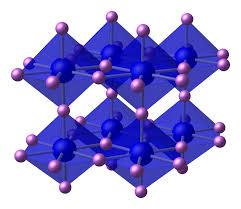
The nitride ion in this compound is ${N^{3 - }}$ which has a charge of – 3. Since, the atomic number of nitrogen is 7, so the number of protons is also 7 because the number of protons in the nucleus of the atom is equal to the atomic number (Z).
Now, the number of electrons will be 10 because the number of protons were 7 and further, 3 more electrons were added. (Because there is a charge of – 3 on the nitride ion).
So, there were 7+3=10 electrons.
Hence, option C is correct.
Note:
The nitrides of boron, vanadium, silicon, titanium and tantalum are very refractory, resistant to chemical attack, and hard and thus are useful as abrasives and in making crucibles. Lithium nitride is used to store hydrogen and is also used as a source of the nitride ion. Moreover, nitride compounds are also used as insulators
Complete step by step answer:
Lithium nitride is a solid which has a reddish-pink color and a high melting point. Its chemical formula is $L{i_3}N$. Its structure is as shown:
The nitride ion in this compound is ${N^{3 - }}$ which has a charge of – 3. Since, the atomic number of nitrogen is 7, so the number of protons is also 7 because the number of protons in the nucleus of the atom is equal to the atomic number (Z).
Now, the number of electrons will be 10 because the number of protons were 7 and further, 3 more electrons were added. (Because there is a charge of – 3 on the nitride ion).
So, there were 7+3=10 electrons.
Hence, option C is correct.
Note:
The nitrides of boron, vanadium, silicon, titanium and tantalum are very refractory, resistant to chemical attack, and hard and thus are useful as abrasives and in making crucibles. Lithium nitride is used to store hydrogen and is also used as a source of the nitride ion. Moreover, nitride compounds are also used as insulators
Recently Updated Pages
Disproportionation Reaction: Definition, Example & JEE Guide

Hess Law of Constant Heat Summation: Definition, Formula & Applications
Algebra Made Easy: Step-by-Step Guide for Students
JEE Isolation, Preparation and Properties of Non-metals Important Concepts and Tips for Exam Preparation
JEE Energetics Important Concepts and Tips for Exam Preparation
Chemical Properties of Hydrogen - Important Concepts for JEE Exam Preparation
Trending doubts
JEE Main 2026: Exam Dates, Session 2 Updates, City Slip, Admit Card & Latest News
JEE Main Participating Colleges 2026 - A Complete List of Top Colleges
Understanding the Electric Field of a Uniformly Charged Ring
Derivation of Equation of Trajectory Explained for Students
Understanding Atomic Structure for Beginners
How to Convert a Galvanometer into an Ammeter or Voltmeter
Other Pages
JEE Advanced 2026 Notification Out with Exam Date, Registration (Extended), Syllabus and More
JEE Advanced Percentile vs Marks 2026: JEE Main Cutoff, AIR & IIT Admission Guide
JEE Advanced 2026 Marks vs Rank: Estimate IIT Rank from Your Score
JEE Advanced Weightage Chapter Wise 2026 for Physics, Chemistry, and Mathematics
NCERT Solutions For Class 11 Chemistry In Hindi Chapter 1 Some Basic Concepts Of Chemistry - 2025-26
Understanding Electromagnetic Waves and Their Importance