




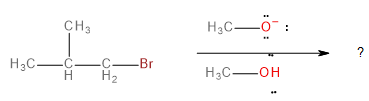
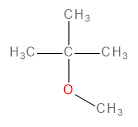
The major product formed in the following reaction is
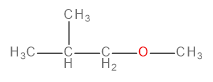
A.
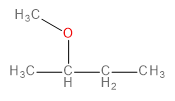
B.
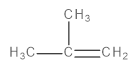
C.
D.
Answer
 Verified
267.3k+ views
Hint: Here we have an alkyl halide reacting with methoxide ion (\[C{H_3}{O^ - }\] ) in the presence of methanol (\[C{H_3}OH\]). The alkyl halide undergoes an elimination reaction called dehydrohalogenation.
Complete Step by Step Solution:
In this question, we have to predict the product that will be formed when 1-bromo-2-methylpropane reacts with a methoxide ion (\[C{H_3}{O^ - }\] ) in the presence of methanol (\[C{H_3}OH\]).
The methoxide ion is an electron-rich species having lone pairs on the oxygen atom. The carbon-bromine (\[C - Br\] ) bond in 1-bromo-2-methylpropane is polarised towards bromine because of its higher electronegativity. This makes the carbon atom a bit deficient in electrons. Therefore, one might think that the methoxide ion would substitute the bromine in a nucleophilic substitution reaction to form an ether as the final product.
However, this does not happen because the methoxide ion does not act as a nucleophile. Instead, it prefers to attack a hydrogen atom on 1-bromo-2-methylpropane and abstracts it as a proton (\[{H^ + }\]). Thus, the methoxide ion acts as a base.
When the methoxide ion acts as a base, it initiates an elimination reaction instead of a substitution reaction.
Although elimination reactions can occur via multiple mechanisms, in this case, the mechanism followed is a “bimolecular” elimination mechanism, also known as the E2 mechanism.
This is a single-step mechanism involving the abstraction of a beta-hydrogen as a proton and the elimination of bromine as a bromide ion (\[B{r^ - }\]) to form an alkene as the final, major product.
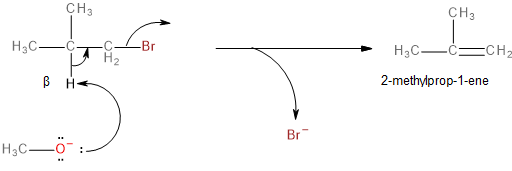
Image: Elimination reaction of 1-bromo-2-methylpropane to form 2-methylprop-1-ene
Thus, option C is correct.
Note: Nucleophilicity and basicity are not the same. Nucleophilicity refers to the ability of an electron-rich species to donate its lone pairs of electrons to electron-deficient species. Therefore, all nucleophiles are Lewis bases. But basicity refers to the ability of an electron-rich species to accept a proton. When an electron-rich species acts as an electron donor (i.e., a nucleophile), it causes substitution. When an electron-rich species acts as a proton acceptor (i.e., a base), it causes elimination. It is highly advised that students learn about the extent of nucleophilicities and basicities of different electron-rich species.
Complete Step by Step Solution:
In this question, we have to predict the product that will be formed when 1-bromo-2-methylpropane reacts with a methoxide ion (\[C{H_3}{O^ - }\] ) in the presence of methanol (\[C{H_3}OH\]).
The methoxide ion is an electron-rich species having lone pairs on the oxygen atom. The carbon-bromine (\[C - Br\] ) bond in 1-bromo-2-methylpropane is polarised towards bromine because of its higher electronegativity. This makes the carbon atom a bit deficient in electrons. Therefore, one might think that the methoxide ion would substitute the bromine in a nucleophilic substitution reaction to form an ether as the final product.
However, this does not happen because the methoxide ion does not act as a nucleophile. Instead, it prefers to attack a hydrogen atom on 1-bromo-2-methylpropane and abstracts it as a proton (\[{H^ + }\]). Thus, the methoxide ion acts as a base.
When the methoxide ion acts as a base, it initiates an elimination reaction instead of a substitution reaction.
Although elimination reactions can occur via multiple mechanisms, in this case, the mechanism followed is a “bimolecular” elimination mechanism, also known as the E2 mechanism.
This is a single-step mechanism involving the abstraction of a beta-hydrogen as a proton and the elimination of bromine as a bromide ion (\[B{r^ - }\]) to form an alkene as the final, major product.
Image: Elimination reaction of 1-bromo-2-methylpropane to form 2-methylprop-1-ene
Thus, option C is correct.
Note: Nucleophilicity and basicity are not the same. Nucleophilicity refers to the ability of an electron-rich species to donate its lone pairs of electrons to electron-deficient species. Therefore, all nucleophiles are Lewis bases. But basicity refers to the ability of an electron-rich species to accept a proton. When an electron-rich species acts as an electron donor (i.e., a nucleophile), it causes substitution. When an electron-rich species acts as a proton acceptor (i.e., a base), it causes elimination. It is highly advised that students learn about the extent of nucleophilicities and basicities of different electron-rich species.
Recently Updated Pages
States of Matter Chapter For JEE Main Chemistry

Classification of Drugs in Chemistry: Types, Examples & Exam Guide
Types of Solutions in Chemistry: Explained Simply
Difference Between Alcohol and Phenol: Structure, Tests & Uses
[Awaiting the three content sources: Ask AI Response, Competitor 1 Content, and Competitor 2 Content. Please provide those to continue with the analysis and optimization.]
Sign up for JEE Main 2026 Live Classes - Vedantu
Trending doubts
JEE Main 2026: Exam Dates, Session 2 Updates, City Slip, Admit Card & Latest News
JEE Main Participating Colleges 2026 - A Complete List of Top Colleges
Understanding the Electric Field of a Uniformly Charged Ring
Derivation of Equation of Trajectory Explained for Students
Understanding Atomic Structure for Beginners
How to Convert a Galvanometer into an Ammeter or Voltmeter
Other Pages
JEE Advanced 2026 Notification Out with Exam Date, Registration (Extended), Syllabus and More
JEE Advanced Percentile vs Marks 2026: JEE Main Cutoff, AIR & IIT Admission Guide
CBSE Class 12 Chemistry Question Paper 2026 PDF Download (All Sets) with Answer Key
NCERT Solutions For Class 12 Chemistry Chapter 2 Electrochemistry - 2025-26
NCERT Solutions For Class 12 Chemistry Chapter 1 Solutions - 2025-26
NCERT Solutions For Class 12 Chemistry Chapter 3 Chemical Kinetics - 2025-26