




The IUPAC name of the following compound is:
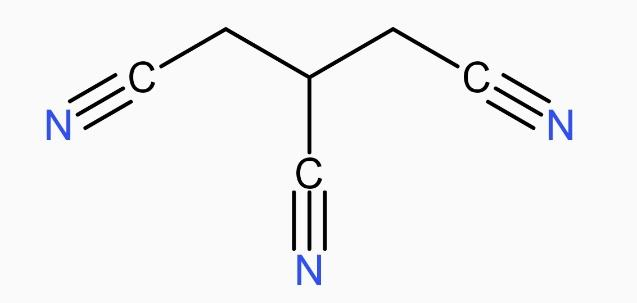
(A) Propane-1,2,3-tricarbonitrile
(B) 3-Cyanopetane-1,5-dinitrile
(C) Pentane-1,3,5-trinitrile
(D) All
Answer
 Verified
289.8k+ views
Hint: Steps to write the IUPAC name of a compound:
1. Identify the functional group (it can be alcohol, aldehyde, ether etc.).
2. Find the longest carbon chain.
3. Number of carbon atoms present in the longest chain.
4. If there is any branched group, identify their position and name them.
5. Combine the elements' names in a single word.
Complete step by step solution:
* -CN group is named as carbonitrile when they are supposed to yield carboxylic acid on hydrolysis in an aliphatic chain,
* The longest carbon chain here is propane that means 3 carbon, and with each carbon there is one -CN group attached.
* So, the branched CN groups are on the position 1,2,3 and they are three in number. So, we will write ‘tri’ before carbonitrile.
* As we know, the compounds are named in an alphabetical order, thus, propane will be written first.
* Therefore, the IUPAC name of the following compound propane-1,2,3-tricarbonitrile. Its molecular formula is \[{{C}_{6}}{{H}_{5}}{{N}_{3}}\], also the condensed formula is \[CNC{{H}_{2}}CHCNC{{H}_{2}}CN\].
So, the correct option is (a).
Note: Carbon atoms of the terminal groups are not counted in the principal chain. If any one of the terminal groups is not directly attached to the parent chain and forms the part of the side chain, then the longest chain is selected containing two such similar groups at its two ends. The groups present in the side chain are treated as substituents and are indicated by suitable prefixes.
1. Identify the functional group (it can be alcohol, aldehyde, ether etc.).
2. Find the longest carbon chain.
3. Number of carbon atoms present in the longest chain.
4. If there is any branched group, identify their position and name them.
5. Combine the elements' names in a single word.
Complete step by step solution:
* -CN group is named as carbonitrile when they are supposed to yield carboxylic acid on hydrolysis in an aliphatic chain,
* The longest carbon chain here is propane that means 3 carbon, and with each carbon there is one -CN group attached.
* So, the branched CN groups are on the position 1,2,3 and they are three in number. So, we will write ‘tri’ before carbonitrile.
* As we know, the compounds are named in an alphabetical order, thus, propane will be written first.
* Therefore, the IUPAC name of the following compound propane-1,2,3-tricarbonitrile. Its molecular formula is \[{{C}_{6}}{{H}_{5}}{{N}_{3}}\], also the condensed formula is \[CNC{{H}_{2}}CHCNC{{H}_{2}}CN\].
So, the correct option is (a).
Note: Carbon atoms of the terminal groups are not counted in the principal chain. If any one of the terminal groups is not directly attached to the parent chain and forms the part of the side chain, then the longest chain is selected containing two such similar groups at its two ends. The groups present in the side chain are treated as substituents and are indicated by suitable prefixes.
Recently Updated Pages
Environmental Chemistry Chapter for JEE Main Chemistry

Chemical Bonding and Molecular Structure Chapter for JEE Main Chemistry
Chelating Ligand, Ambidentate Ligand, and Flexidentate Ligand for JEE Exam
JEE Main 2023 (February 1st Shift 2) Physics Question Paper with Answer Key
JEE Main 2023 (February 1st Shift 1) Maths Question Paper with Answer Key
JEE Main 2023 (February 1st Shift 2) Chemistry Question Paper with Answer Key
Trending doubts
JEE Main 2026: Exam Dates, Session 2 Updates, City Slip, Admit Card & Latest News
Understanding the Electric Field of a Uniformly Charged Ring
Electron Gain Enthalpy and Electron Affinity Explained
Derivation of Equation of Trajectory Explained for Students
Understanding Atomic Structure for Beginners
How to Convert a Galvanometer into an Ammeter or Voltmeter
Other Pages
NCERT Solutions For Class 12 Chemistry Chapter 2 Electrochemistry - 2026-27 Free PDF Download (Sign-in Required)
NCERT Solutions For Class 12 Chemistry Chapter 1 Solutions - 2026-27 Free PDF Download (Sign-in Required)
NCERT Solutions For Class 12 Chemistry Chapter 3 Chemical Kinetics - 2026-27 Free PDF Download (Login Required)
CBSE Notes Class 12 Chemistry Chapter 1 - Solutions - 2026-27 PDF Download (Login Required)
NCERT Solutions for Class 12 Chemistry Chapter 6 Haloalkanes and Haloarenes - 2026-27 Free PDF Download (Sign-In Required)
NCERT Solutions For Class 12 Chemistry Chapter 7 Alcohol Phenol And Ether - 2026-27 Free PDF Download (Login Required)
NCERT Solutions For Class 12 Chemistry Chapter 2 Electrochemistry - 2026-27 Free PDF Download (Sign-in Required)
NCERT Solutions For Class 12 Chemistry Chapter 1 Solutions - 2026-27 Free PDF Download (Sign-in Required)
NCERT Solutions For Class 12 Chemistry Chapter 3 Chemical Kinetics - 2026-27 Free PDF Download (Login Required)