




The ionospheric layer acts as a reflector for the frequency range:
A) $1\,KHz$ to $10\,KHz$
B) $3$ to $30\,MHz$
C) $100\,KHz$ to $1\,MHz$
D) $3\,GHz$ to $30\,GHz$
Answer
 Verified
258.3k+ views
Hint: The atmospheric layer of the earth is divided into many layers depending on its nature. They include the troposphere, stratosphere, mesosphere, thermosphere, ionosphere and the exosphere. All these layers together are called the atmosphere.
Complete step by step solution:
The ionosphere is the layer of the earth that is the ionized part starting from the distance of the $48\,Km$ from the earth surface and extends up to the $965\,Km$. The ionosphere layer is of three types as $D$ layer, $E$ layer and the $F$ layer based on the wavelength of the absorbed solar radiation. Out of which the $D$ ionospheric layer located at the bottom, $E$ ionospheric layer at the middle and both interfere with the thermosphere and the mesosphere.
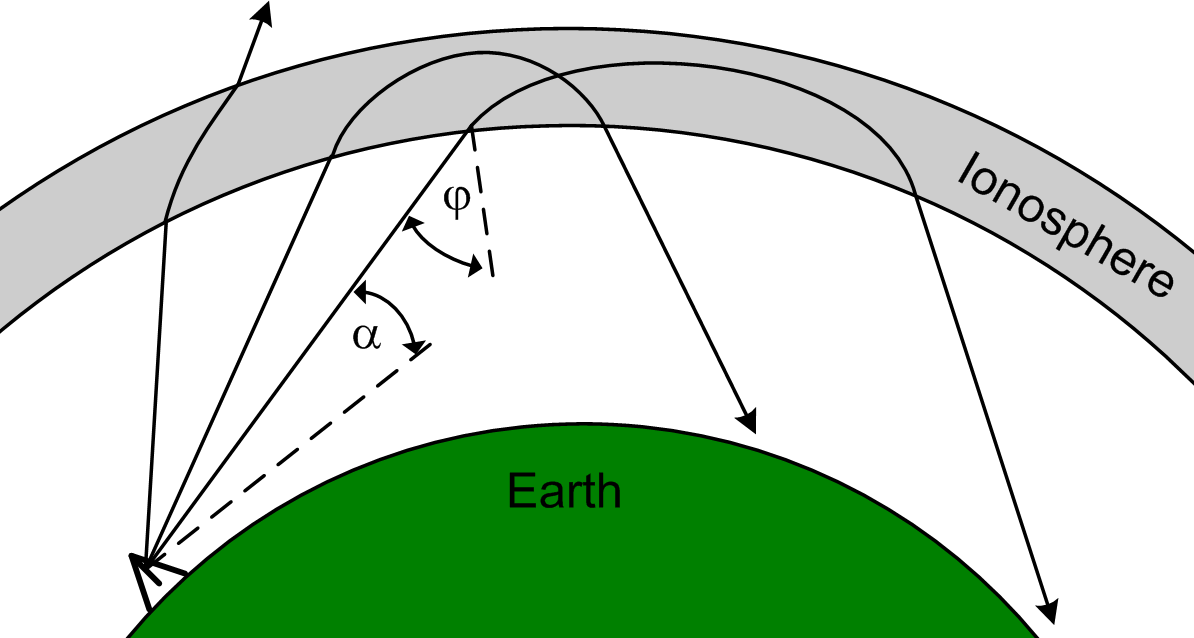
The $F$ ionospheric layer at the top. This layer is provided with the abundant number of the electrons along with the ionized molecules and the atoms. This layer of ionosphere reflects the light waves that are within the frequency range of $3$ to $30\,MHz$ . Above or below this range, may pass through it.
Thus the option (B) is correct.
Note: The atoms and the molecules present in the ionosphere get ionized by the solar radiations from the sun. Hence they conduct the electricity. Due to the process of ionization, this layer of the atmosphere is with a higher temperature.
Complete step by step solution:
The ionosphere is the layer of the earth that is the ionized part starting from the distance of the $48\,Km$ from the earth surface and extends up to the $965\,Km$. The ionosphere layer is of three types as $D$ layer, $E$ layer and the $F$ layer based on the wavelength of the absorbed solar radiation. Out of which the $D$ ionospheric layer located at the bottom, $E$ ionospheric layer at the middle and both interfere with the thermosphere and the mesosphere.
The $F$ ionospheric layer at the top. This layer is provided with the abundant number of the electrons along with the ionized molecules and the atoms. This layer of ionosphere reflects the light waves that are within the frequency range of $3$ to $30\,MHz$ . Above or below this range, may pass through it.
Thus the option (B) is correct.
Note: The atoms and the molecules present in the ionosphere get ionized by the solar radiations from the sun. Hence they conduct the electricity. Due to the process of ionization, this layer of the atmosphere is with a higher temperature.
Recently Updated Pages
JEE Main Mock Test 2025-26: Electromagnetic Induction & Alternating Currents

JEE Main Mock Test 2025-26: Optics Chapter Practice Online
JEE Main 2025-26 Mock Test: Properties of Solids and Liquids
JEE Main Mock Test 2025-26: Dual Nature of Matter & Radiation
JEE Main 2025-26 Electromagnetic Waves Mock Test with Solutions
JEE Main 2025-26 Mock Test: Electronic Devices Chapter Practice
Trending doubts
JEE Main 2026: Exam Dates, Session 2 Updates, City Slip, Admit Card & Latest News
JEE Main Participating Colleges 2026 - A Complete List of Top Colleges
JEE Main Marking Scheme 2026- Paper-Wise Marks Distribution and Negative Marking Details
Hybridisation in Chemistry – Concept, Types & Applications
Understanding the Electric Field of a Uniformly Charged Ring
Derivation of Equation of Trajectory Explained for Students
Other Pages
CBSE Class 12 Physics Question Paper 2026: Download SET-wise PDF with Answer Key & Analysis
JEE Advanced 2026 - Exam Date (Released), Syllabus, Registration, Eligibility, Preparation, and More
JEE Advanced Marks vs Ranks 2025: Understanding Category-wise Qualifying Marks and Previous Year Cut-offs
JEE Advanced Weightage 2025 Chapter-Wise for Physics, Maths and Chemistry
Understanding Atomic Structure for Beginners
Understanding Electromagnetic Waves and Their Importance