




The hybridisation in $I{F_7}$ molecule is :
A. $s{p^3}$
B. $s{p^3}{d^2}$
C. $s{p^3}d$
D. $s{p^3}{d^3}$
Answer
 Verified
269.4k+ views
Hint: In the process of hybridization two or more than two atomic orbital goes in inter-mixing of the atomic orbital and gives hybridized orbital which remains same in the number and energy.
Complete step by step solution:
> The given compound is known as iodine heptafluoride. It has seven bond pairs and one lone pair. In the following diagram pentagonal bipyramidal geometry of molecules is shown . > There are two fluorine atoms above and below the plane which make two pyramids with the plane while five fluorine atoms are arranged in a pentagon in the plane. The geometry of molecules used to predict with VSEPR theory (valence shell electron repulsion theory).In this theory the number of electron pairs are used to predict the geometry of molecules.
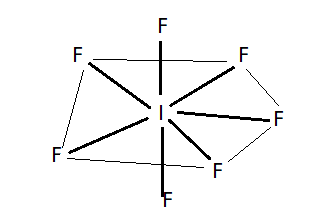
> In $I{F_7}$ molecule ,central metal atom is $I$. The electronic configuration of iodine atom is given below ;
${I_{53}} = 1{s^2},2{s^2},2{p^6},3{s^2},3{p^6},4{s^2},3{d^{10}},4{p^6},5{s^2},4{d^{10}},5{p^5}$ so here is seven atomic orbital that is one s orbitals, three p orbitals and three d orbitals which hybridizes to form seven hybrid orbitals. The geometry of $I{F_7}$ is pentagonal bipyramidal. Seven hybrid $s{p^3}{d^3}$ orbitals are directed towards the corners of a pentagonal bipyramid. Five of the hybrid orbitals are directed towards the corners of a regular pentagon whereas the remaining two are directed above and below the plane. So here option D is correct.
Note : We know that the number of valence electron in central metal atom Iodine is seven and in fluorine it is also seven so total number of valence electron in molecule is $7 + 7 \times 7 = 56$.Hence it need seven atomic orbital so possess $s{p^3}{d^3}$ hybridization. The bond angle is ${72^0}$ and ${90^0}$.
Complete step by step solution:
> The given compound is known as iodine heptafluoride. It has seven bond pairs and one lone pair. In the following diagram pentagonal bipyramidal geometry of molecules is shown . > There are two fluorine atoms above and below the plane which make two pyramids with the plane while five fluorine atoms are arranged in a pentagon in the plane. The geometry of molecules used to predict with VSEPR theory (valence shell electron repulsion theory).In this theory the number of electron pairs are used to predict the geometry of molecules.
> In $I{F_7}$ molecule ,central metal atom is $I$. The electronic configuration of iodine atom is given below ;
${I_{53}} = 1{s^2},2{s^2},2{p^6},3{s^2},3{p^6},4{s^2},3{d^{10}},4{p^6},5{s^2},4{d^{10}},5{p^5}$ so here is seven atomic orbital that is one s orbitals, three p orbitals and three d orbitals which hybridizes to form seven hybrid orbitals. The geometry of $I{F_7}$ is pentagonal bipyramidal. Seven hybrid $s{p^3}{d^3}$ orbitals are directed towards the corners of a pentagonal bipyramid. Five of the hybrid orbitals are directed towards the corners of a regular pentagon whereas the remaining two are directed above and below the plane. So here option D is correct.
Note : We know that the number of valence electron in central metal atom Iodine is seven and in fluorine it is also seven so total number of valence electron in molecule is $7 + 7 \times 7 = 56$.Hence it need seven atomic orbital so possess $s{p^3}{d^3}$ hybridization. The bond angle is ${72^0}$ and ${90^0}$.
Recently Updated Pages
Disproportionation Reaction: Definition, Example & JEE Guide

Hess Law of Constant Heat Summation: Definition, Formula & Applications
JEE General Topics in Chemistry Important Concepts and Tips
JEE Extractive Metallurgy Important Concepts and Tips for Exam Preparation
JEE Atomic Structure and Chemical Bonding important Concepts and Tips
JEE Amino Acids and Peptides Important Concepts and Tips for Exam Preparation
Trending doubts
JEE Main 2026: Exam Dates, Session 2 Updates, City Slip, Admit Card & Latest News
JEE Main Participating Colleges 2026 - A Complete List of Top Colleges
Understanding the Electric Field of a Uniformly Charged Ring
Understanding Atomic Structure for Beginners
Derivation of Equation of Trajectory Explained for Students
JEE Main Marking Scheme 2026- Paper-Wise Marks Distribution and Negative Marking Details
Other Pages
JEE Advanced 2026 Notification Out with Exam Date, Registration (Extended), Syllabus and More
JEE Advanced Percentile vs Marks 2026: JEE Main Cutoff, AIR & IIT Admission Guide
JEE Advanced 2026 Marks vs Rank: Estimate IIT Rank from Your Score
JEE Advanced Weightage Chapter Wise 2026 for Physics, Chemistry, and Mathematics
Understanding the Different Types of Solutions in Chemistry
NCERT Solutions For Class 11 Chemistry In Hindi Chapter 1 Some Basic Concepts Of Chemistry - 2025-26