




The group having triangular planar structures is:
A.${ NCl }_{ 3 },{ BCl }_{ 3 }{ ,SO }_{ 3 }$
B.${ CO }_{ 3 }^{ 2- }{ ,NO }_{ 3 }^{ - }{ ,SO }_{ 3 }$
C.${ BF }_{ 3 }{ ,NF }_{ 3 }{ ,CO }_{ 3 }^{ 2- }$
D.${ NH }_{ 3 } {, SO }_{ 3 }{ ,CO }_{ 3 }^{ 2- }$
Answer
 Verified
258.9k+ views
Hint: In the trigonal planar arrangement, there is a central atom, bonded to three other atoms. These three other atoms are arranged like a triangle around the central atom, with a bond angle measuring ${ 120 }^{ \circ }{ C }$.
Complete step-by-step answer:
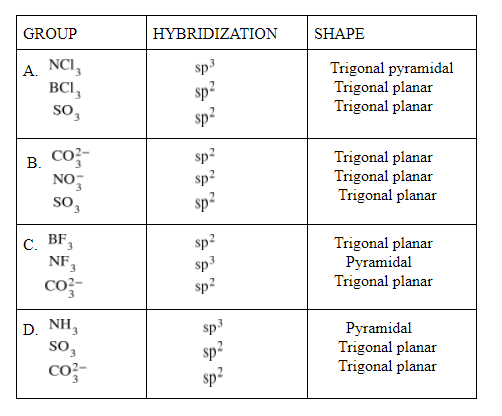
As we can see here that ${ CO }_{ 3 }^{ 2- }{ ,NO }_{ 3 }^{ - }{ ,SO }_{ 3 }$
has ${ sp }^{ 2 }$ and trigonal planar structure, so the correct option is B.
Additional Information:
-Hybridization is a process of mixing two or more atomic orbitals of an atom having comparable energy to form orbitals of equal energy known as hybrid orbitals.
-One s and three p orbitals of carbon mix/hybridize to give four ${ sp }^{ 3 }$ hybrid orbitals. The ${ sp }^{ 3 }$ hybrid orbitals are used by 4 hydrogen atoms for sigma bond formation.
-Trigonal planar is a subatomic geometry model with one molecule at the middle and three particles at the sides of a symmetrical triangle, called peripheral atoms, all in one plane.
- In an ideal trigonal planar species, every one of the three ligands are indistinguishable and all bond angles are ${ 120 }^{ \circ }{ C }$.
-When ${ sp }^{ 3 }$ orbitals are formed, they arrange themselves with the goal that they are as far separated as could be expected under the circumstances. That is a tetrahedral arrangement, with a point of ${ 109.5 }^{ \circ }{ C }$.
Note: The possibility to make a mistake is that you may choose option A. But in that ${ NCl }_{ 3 }$ is trigonal pyramidal, not trigonal planar due to the presence of lone pairs of electrons on nitrogen atoms.
Complete step-by-step answer:
As we can see here that ${ CO }_{ 3 }^{ 2- }{ ,NO }_{ 3 }^{ - }{ ,SO }_{ 3 }$
has ${ sp }^{ 2 }$ and trigonal planar structure, so the correct option is B.
Additional Information:
-Hybridization is a process of mixing two or more atomic orbitals of an atom having comparable energy to form orbitals of equal energy known as hybrid orbitals.
-One s and three p orbitals of carbon mix/hybridize to give four ${ sp }^{ 3 }$ hybrid orbitals. The ${ sp }^{ 3 }$ hybrid orbitals are used by 4 hydrogen atoms for sigma bond formation.
-Trigonal planar is a subatomic geometry model with one molecule at the middle and three particles at the sides of a symmetrical triangle, called peripheral atoms, all in one plane.
- In an ideal trigonal planar species, every one of the three ligands are indistinguishable and all bond angles are ${ 120 }^{ \circ }{ C }$.
-When ${ sp }^{ 3 }$ orbitals are formed, they arrange themselves with the goal that they are as far separated as could be expected under the circumstances. That is a tetrahedral arrangement, with a point of ${ 109.5 }^{ \circ }{ C }$.
Note: The possibility to make a mistake is that you may choose option A. But in that ${ NCl }_{ 3 }$ is trigonal pyramidal, not trigonal planar due to the presence of lone pairs of electrons on nitrogen atoms.
Recently Updated Pages
Disproportionation Reaction: Definition, Example & JEE Guide

Hess Law of Constant Heat Summation: Definition, Formula & Applications
JEE General Topics in Chemistry Important Concepts and Tips
JEE Extractive Metallurgy Important Concepts and Tips for Exam Preparation
JEE Atomic Structure and Chemical Bonding important Concepts and Tips
JEE Amino Acids and Peptides Important Concepts and Tips for Exam Preparation
Trending doubts
JEE Main 2026: Exam Dates, Session 2 Updates, City Slip, Admit Card & Latest News
JEE Main Participating Colleges 2026 - A Complete List of Top Colleges
JEE Main Marking Scheme 2026- Paper-Wise Marks Distribution and Negative Marking Details
Hybridisation in Chemistry – Concept, Types & Applications
Understanding the Electric Field of a Uniformly Charged Ring
Understanding the Different Types of Solutions in Chemistry
Other Pages
JEE Advanced 2026 - Exam Date (Released), Syllabus, Registration, Eligibility, Preparation, and More
JEE Advanced Marks vs Ranks 2025: Understanding Category-wise Qualifying Marks and Previous Year Cut-offs
CBSE Notes Class 11 Chemistry Chapter 5 - Thermodynamics - 2025-26
JEE Advanced Weightage 2025 Chapter-Wise for Physics, Maths and Chemistry
Derivation of Equation of Trajectory Explained for Students
Understanding Atomic Structure for Beginners