




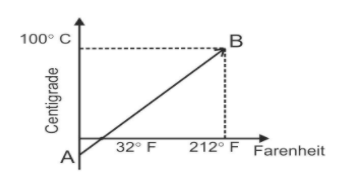
The graph $AB$ shown in figure is a plot of temperature of a body in degree Celsius and degree Fahrenheit. Then
A. Slope of line $AB$ is $\dfrac{9}{5}$
B. Slope of line$AB$ is $\dfrac{5}{9}$
C. Slope of line $AB$ is $\dfrac{1}{9}$
D. Slope of line $AB$ is $\dfrac{3}{9}$
Answer
 Verified
249.6k+ views
Hint: In this question, the concept of the slope of the straight line is used. As we know that one of the methods for calculating the slope of the straight we need two coordinate points on the linear line from which we can calculate the slope.
Complete step by step answer:
In this question, we have given a plot of temperature of a body in degree Celsius and degree Fahrenheit. We need to find the slope of the given graph.
As we know that the slope of the straight line can be calculated by using the expression,
$m = \dfrac{{{y_2} - {y_1}}}{{{x_2} - {x_1}}}......\left( 1 \right)$
Where, the coordinates of the linear line are $\left( {{x_1},{y_1}} \right)$ and $\left( {{x_2},{y_2}} \right)$.
Let us consider the given graph of the temperature of a body in degree Celsius and degree Fahrenheit as,
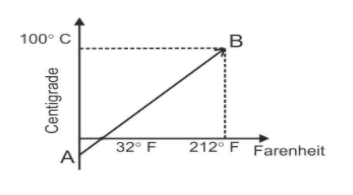
Now, in the given graph of the Celsius and the Fahrenheit scale, the coordinates are $\left( {32,0} \right)$ and $\left( {212,100} \right)$.
Now, we compare the coordinates that is $\left( {{x_1},{y_1}} \right)$ is equal to $\left( {32,0} \right)$ and $\left( {{x_2},{y_2}} \right)$ is equal to $\left( {212,100} \right)$.
Now, we substitute these coordinates in equation (1) as,
$ \Rightarrow m = \dfrac{{100 - 0}}{{212 - 32}}......\left( 1 \right)$
Now, we simplify the above calculation and get,
$ \Rightarrow m = \dfrac{{100}}{{180}}$
After simplification we get,
$\therefore m = \dfrac{5}{9}$
Therefore, the correct option is B.
Note: As we know that the boiling point temperature of the water in Fahrenheit scale is $212^\circ {\text{F}}$ and in the Celsius scale it is $100^\circ {\text{C}}$ while the freezing point temperature of the water in Fahrenheit scale is $32^\circ {\text{F}}$ and in the Celsius scale it is $0^\circ {\text{C}}$. The conversion of the Celsius scale to Fahrenheit scale can be done by the equation of relation between Celsius and Fahrenheit scale of temperature as,
$ \Rightarrow \dfrac{C}{5} = \dfrac{{F - 32}}{9}$
Complete step by step answer:
In this question, we have given a plot of temperature of a body in degree Celsius and degree Fahrenheit. We need to find the slope of the given graph.
As we know that the slope of the straight line can be calculated by using the expression,
$m = \dfrac{{{y_2} - {y_1}}}{{{x_2} - {x_1}}}......\left( 1 \right)$
Where, the coordinates of the linear line are $\left( {{x_1},{y_1}} \right)$ and $\left( {{x_2},{y_2}} \right)$.
Let us consider the given graph of the temperature of a body in degree Celsius and degree Fahrenheit as,
Now, in the given graph of the Celsius and the Fahrenheit scale, the coordinates are $\left( {32,0} \right)$ and $\left( {212,100} \right)$.
Now, we compare the coordinates that is $\left( {{x_1},{y_1}} \right)$ is equal to $\left( {32,0} \right)$ and $\left( {{x_2},{y_2}} \right)$ is equal to $\left( {212,100} \right)$.
Now, we substitute these coordinates in equation (1) as,
$ \Rightarrow m = \dfrac{{100 - 0}}{{212 - 32}}......\left( 1 \right)$
Now, we simplify the above calculation and get,
$ \Rightarrow m = \dfrac{{100}}{{180}}$
After simplification we get,
$\therefore m = \dfrac{5}{9}$
Therefore, the correct option is B.
Note: As we know that the boiling point temperature of the water in Fahrenheit scale is $212^\circ {\text{F}}$ and in the Celsius scale it is $100^\circ {\text{C}}$ while the freezing point temperature of the water in Fahrenheit scale is $32^\circ {\text{F}}$ and in the Celsius scale it is $0^\circ {\text{C}}$. The conversion of the Celsius scale to Fahrenheit scale can be done by the equation of relation between Celsius and Fahrenheit scale of temperature as,
$ \Rightarrow \dfrac{C}{5} = \dfrac{{F - 32}}{9}$
Recently Updated Pages
JEE Isolation, Preparation and Properties of Non-metals Important Concepts and Tips for Exam Preparation

Isoelectronic Definition in Chemistry: Meaning, Examples & Trends
Ionisation Energy and Ionisation Potential Explained
Iodoform Reactions - Important Concepts and Tips for JEE
Introduction to Dimensions: Understanding the Basics
Instantaneous Velocity Explained: Formula, Examples & Graphs
Trending doubts
JEE Main 2026: Exam Dates, Session 2 Updates, City Slip, Admit Card & Latest News
Hybridisation in Chemistry – Concept, Types & Applications
JEE Main 2026 Application Login: Direct Link, Registration, Form Fill, and Steps
Understanding the Electric Field of a Uniformly Charged Ring
Derivation of Equation of Trajectory Explained for Students
JEE Main Marking Scheme 2026- Paper-Wise Marks Distribution and Negative Marking Details
Other Pages
JEE Advanced Marks vs Ranks 2025: Understanding Category-wise Qualifying Marks and Previous Year Cut-offs
JEE Advanced 2026 - Exam Date (Released), Syllabus, Registration, Eligibility, Preparation, and More
CBSE Notes Class 11 Physics Chapter 1 - Units And Measurements - 2025-26
Important Questions For Class 11 Physics Chapter 1 Units and Measurement - 2025-26
NCERT Solutions For Class 11 Physics Chapter 1 Units And Measurements - 2025-26
CBSE Notes Class 11 Physics Chapter 4 - Laws of Motion - 2025-26