




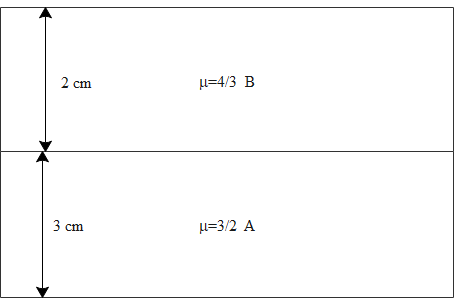
The figure shows an arrangement of two transparent slabs A and B with their respective thickness and refractive indices as shown. Find the vertical shift of the image of a point object placed at the bottom of a due to both the slabs. Also find the effective refractive index of the compound slab.
Answer
 Verified
259.8k+ views
Hint: We know that in physics, refraction is the change in direction of a wave passing from one medium to another or from a gradual change in the medium. Refraction of light is the most commonly observed phenomenon, but other waves such as sound waves and water waves also experience refraction. Refraction is an effect that occurs when a light wave, incident at an angle away from the normal, passes a boundary from one medium into another in which there is a change in velocity of the light. The wavelength decreases as the light enters the medium and the light wave changes direction.
Complete step by step answer
To solve this question, we need to use the concept that is:
$\mathrm{D}_{\mathrm{a}}=\mathrm{D}_{\mathrm{r}} \dfrac{\mathrm{n}_{\text {observer }}}{\mathrm{n}_{\text {object }}}$
Here,
$\mathrm{D}_{\mathrm{a}}$ is a apparent depth
$\mathrm{D}_{\mathrm{r}}$ is real depth
$\mathrm{n}_{\text {observer }}$ is refractive index of media of observer
$\mathrm{n}_{\text {object }}$ is refractive index of media of object
The shift due to both the slabs will be the sum of individual shifts. i.e.,
shift, $\delta=\delta_{1}+\delta_{2}$
and $\delta=\alpha\left(1-\dfrac{1}{\mu}\right)$
For this equation $\mathrm{d}_{1}=2, \mu_{1}=\dfrac{4}{3}$
$\mathrm{d}_{2}=3, \mu_{2}=\dfrac{3}{2}$
So,
$\delta=\delta_{1}+\delta_{2}$
$=2\left(1-\dfrac{1}{\dfrac{4}{3}}\right)+3\left(1-\dfrac{1}{\dfrac{3}{2}}\right)$
$=2\left(1-\dfrac{3}{4}\right)+3\left(1-\dfrac{2}{3}\right)$
$=2\left(\dfrac{1}{4}\right)+3\left(\dfrac{1}{3}\right)$
$\delta=1.5 \mathrm{cm}$
And effective refractive index of compound slab can be $1.5=5\left(1-\dfrac{1}{\mu_{\mathrm{e}}}\right)$
$0.3=1-\dfrac{1}{\mu_{\mathrm{e}}}$
$\mu_{\mathrm{e}}=\dfrac{10}{7}$
Hence the effective refractive index of the compound slab is $\dfrac{10}{7}$.
Note: It is known that the incident ray, reflected ray and the normal, to the interface of any two given mediums; all lie in the same plane. The ratio of the sine of the angle of incidence and sine of the angle of refraction is constant. An object appears to be raised when placed under water. Pool of water appears less deep than it actually is. If a lemon is kept in a glass of water it appears to be bigger when viewed from the sides of the glass. It is due to refraction of light that stars appear to twinkle at night. Refraction of light can be seen in many places in our everyday life. It makes objects under a water surface appear closer than they really are. It is what optical lenses are based on, allowing for instruments such as glasses, cameras, binoculars, microscopes, and the human eye.
Complete step by step answer
To solve this question, we need to use the concept that is:
$\mathrm{D}_{\mathrm{a}}=\mathrm{D}_{\mathrm{r}} \dfrac{\mathrm{n}_{\text {observer }}}{\mathrm{n}_{\text {object }}}$
Here,
$\mathrm{D}_{\mathrm{a}}$ is a apparent depth
$\mathrm{D}_{\mathrm{r}}$ is real depth
$\mathrm{n}_{\text {observer }}$ is refractive index of media of observer
$\mathrm{n}_{\text {object }}$ is refractive index of media of object
The shift due to both the slabs will be the sum of individual shifts. i.e.,
shift, $\delta=\delta_{1}+\delta_{2}$
and $\delta=\alpha\left(1-\dfrac{1}{\mu}\right)$
For this equation $\mathrm{d}_{1}=2, \mu_{1}=\dfrac{4}{3}$
$\mathrm{d}_{2}=3, \mu_{2}=\dfrac{3}{2}$
So,
$\delta=\delta_{1}+\delta_{2}$
$=2\left(1-\dfrac{1}{\dfrac{4}{3}}\right)+3\left(1-\dfrac{1}{\dfrac{3}{2}}\right)$
$=2\left(1-\dfrac{3}{4}\right)+3\left(1-\dfrac{2}{3}\right)$
$=2\left(\dfrac{1}{4}\right)+3\left(\dfrac{1}{3}\right)$
$\delta=1.5 \mathrm{cm}$
And effective refractive index of compound slab can be $1.5=5\left(1-\dfrac{1}{\mu_{\mathrm{e}}}\right)$
$0.3=1-\dfrac{1}{\mu_{\mathrm{e}}}$
$\mu_{\mathrm{e}}=\dfrac{10}{7}$
Hence the effective refractive index of the compound slab is $\dfrac{10}{7}$.
Note: It is known that the incident ray, reflected ray and the normal, to the interface of any two given mediums; all lie in the same plane. The ratio of the sine of the angle of incidence and sine of the angle of refraction is constant. An object appears to be raised when placed under water. Pool of water appears less deep than it actually is. If a lemon is kept in a glass of water it appears to be bigger when viewed from the sides of the glass. It is due to refraction of light that stars appear to twinkle at night. Refraction of light can be seen in many places in our everyday life. It makes objects under a water surface appear closer than they really are. It is what optical lenses are based on, allowing for instruments such as glasses, cameras, binoculars, microscopes, and the human eye.
Recently Updated Pages
JEE Main Mock Test 2025-26: Electromagnetic Induction & Alternating Currents

JEE Main Mock Test 2025-26: Optics Chapter Practice Online
JEE Main 2025-26 Mock Test: Properties of Solids and Liquids
JEE Main Mock Test 2025-26: Dual Nature of Matter & Radiation
JEE Main 2025-26 Electromagnetic Waves Mock Test with Solutions
JEE Main 2025-26 Mock Test: Electronic Devices Chapter Practice
Trending doubts
JEE Main 2026: Exam Dates, Session 2 Updates, City Slip, Admit Card & Latest News
JEE Main Participating Colleges 2026 - A Complete List of Top Colleges
JEE Main Marking Scheme 2026- Paper-Wise Marks Distribution and Negative Marking Details
Hybridisation in Chemistry – Concept, Types & Applications
Understanding the Electric Field of a Uniformly Charged Ring
Derivation of Equation of Trajectory Explained for Students
Other Pages
CBSE Class 12 Physics Question Paper 2026: Download SET-wise PDF with Answer Key & Analysis
JEE Advanced 2026 - Exam Date (Released), Syllabus, Registration, Eligibility, Preparation, and More
JEE Advanced Marks vs Ranks 2025: Understanding Category-wise Qualifying Marks and Previous Year Cut-offs
JEE Advanced Weightage 2025 Chapter-Wise for Physics, Maths and Chemistry
Understanding Atomic Structure for Beginners
Understanding Electromagnetic Waves and Their Importance