




The cyclotron frequency of an electrons gyrating in a magnetic field of $1\,T$ is approximately:
A) $28\,MHz$
B) $280\,MHz$
C) $2.8\,MHz$
D) $28\,GHz$
Answer
 Verified
258.3k+ views
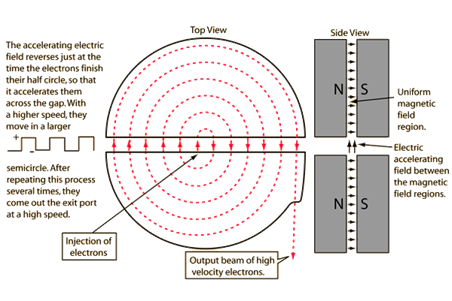
Hint: To find the value of the frequency of the cyclotron of an electron, use the formula below and substitute the value of the magnetic induction, charge and mass of the electron in it , the obtained result provides the answer for the frequency of cyclotron.
Useful formula:
The formula of the frequency of the cyclotron is given by
$\nu = \dfrac{{qB}}{{2\pi m}}$
Where $\nu $ is the frequency of the cyclotron, $q$ is the charge of the electron, $B$ is the magnetic field and $m$ is the mass.
Complete step by step solution:
It is given that the
Magnetic field that is used in the cyclotron, $B = 1T$
Use the formula of the frequency of the cyclotron,
$\nu = \dfrac{{qB}}{{2\pi m}}$
Substitute the values of the charge $q = 1.6 \times {10^{ - 19}}$ , the magnetic induction from the given, $m = 9.1 \times {10^{ - 31}}$ as the mass of the electron in the above used formula.
$\nu = \dfrac{{1.6 \times {{10}^{ - 19}} \times 1}}{{2 \times 3.14 \times 9.1 \times {{10}^{ - 31}}}}$
Simplifying the above equation, we get
$\nu = \dfrac{{0.8 \times {{10}^{12}}}}{{3.14 \times 9.1}}$
By the further simplification of the above step,
$\nu = 28 \times {10^9}\,Hz$
It is known that the $1\,GHz = {10^9}\,Hz$ , substituting this in the above step
$\nu = 28 \times {10^9}\,GHz$
Hence the cyclotron frequency of the electron is obtained as $\nu = 28\,GHz$. It is not $28\,MHz$ since $1\,MHz = {10^6}\,HZ$ .
Thus the option (D) is correct.
Note: The cyclotron frequency mainly depends upon the specific charge and the magnetic induction. The specific charge is calculated by dividing the charge of the particle and the mass of it. The use of the cyclotron is to produce the radioactive isotopes which are used in the process of the imaging procedures.
Useful formula:
The formula of the frequency of the cyclotron is given by
$\nu = \dfrac{{qB}}{{2\pi m}}$
Where $\nu $ is the frequency of the cyclotron, $q$ is the charge of the electron, $B$ is the magnetic field and $m$ is the mass.
Complete step by step solution:
It is given that the
Magnetic field that is used in the cyclotron, $B = 1T$
Use the formula of the frequency of the cyclotron,
$\nu = \dfrac{{qB}}{{2\pi m}}$
Substitute the values of the charge $q = 1.6 \times {10^{ - 19}}$ , the magnetic induction from the given, $m = 9.1 \times {10^{ - 31}}$ as the mass of the electron in the above used formula.
$\nu = \dfrac{{1.6 \times {{10}^{ - 19}} \times 1}}{{2 \times 3.14 \times 9.1 \times {{10}^{ - 31}}}}$
Simplifying the above equation, we get
$\nu = \dfrac{{0.8 \times {{10}^{12}}}}{{3.14 \times 9.1}}$
By the further simplification of the above step,
$\nu = 28 \times {10^9}\,Hz$
It is known that the $1\,GHz = {10^9}\,Hz$ , substituting this in the above step
$\nu = 28 \times {10^9}\,GHz$
Hence the cyclotron frequency of the electron is obtained as $\nu = 28\,GHz$. It is not $28\,MHz$ since $1\,MHz = {10^6}\,HZ$ .
Thus the option (D) is correct.
Note: The cyclotron frequency mainly depends upon the specific charge and the magnetic induction. The specific charge is calculated by dividing the charge of the particle and the mass of it. The use of the cyclotron is to produce the radioactive isotopes which are used in the process of the imaging procedures.
Recently Updated Pages
JEE Main Mock Test 2025-26: Electromagnetic Induction & Alternating Currents

JEE Main Mock Test 2025-26: Optics Chapter Practice Online
JEE Main 2025-26 Mock Test: Properties of Solids and Liquids
JEE Main Mock Test 2025-26: Dual Nature of Matter & Radiation
JEE Main 2025-26 Electromagnetic Waves Mock Test with Solutions
JEE Main 2025-26 Mock Test: Electronic Devices Chapter Practice
Trending doubts
JEE Main 2026: Exam Dates, Session 2 Updates, City Slip, Admit Card & Latest News
JEE Main Participating Colleges 2026 - A Complete List of Top Colleges
JEE Main Colleges 2026: Complete List of Participating Institutes
JEE Main Marking Scheme 2026- Paper-Wise Marks Distribution and Negative Marking Details
Hybridisation in Chemistry – Concept, Types & Applications
Understanding the Electric Field of a Uniformly Charged Ring
Other Pages
CBSE Class 12 Physics Question Paper 2026: Download SET-wise PDF with Answer Key & Analysis
JEE Advanced 2026 - Exam Date (Released), Syllabus, Registration, Eligibility, Preparation, and More
JEE Advanced Marks vs Ranks 2025: Understanding Category-wise Qualifying Marks and Previous Year Cut-offs
JEE Advanced Weightage 2025 Chapter-Wise for Physics, Maths and Chemistry
Derivation of Equation of Trajectory Explained for Students
Understanding Electromagnetic Waves and Their Importance