




The correct statement is :
A. most probable velocity of gas molecules increases with the increase in temperature
B. the fraction of gas molecules having most probable speed decreases with the rise in temperature
B. at given temperature, the rms speed of the gas is maximum while most probable speed is maximum
D. All of the above.
Answer
 Verified
257.4k+ views
Hint : We know that Maxwell’s distribution plot is a plot between the fraction of molecule and speed of molecule at standard temperature. The area under the curve represents the number of molecules. If we heat the gas the peak of the curve will be shifted right because the average speed of the molecule will increase.
Complete step by step solution:
The Maxwell-Boltzmann plot of distribution is given below.
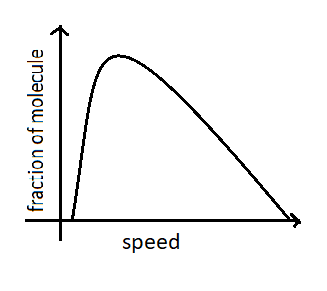
The most probable speed corresponds to the top of the distribution curve because a greater fraction of molecules will have this speed. It is expressed as ${\nu _{mp}} = \sqrt {\dfrac{{2{k_B}T}}{m}} $ where ${k_B}$is Boltzmann constant and $T$ is temperature. We can say that from the equation that the most probable velocity of gas molecules increases with the increase in temperature. At higher temperature, large numbers of molecules will acquire greater amounts of kinetic energy and they move very fast hence their speed increases. The curve also flattens with the increase of temperature. At the same temperature molecules of gas will possess the same kinetic energy. So we can say that when the temperature increases the most probable speed of molecules also increases. Therefore statement A is correct .
Note: We know that we can calculate the most probable speed, the average speed and root mean square speed with the help of Maxwell-Boltzmann equation which gives relation with temperature. Here in the problem we have found out the correct statement with the help of the equation of most probable speed. Second statement is incorrect because it is not possible to decrease the fraction of molecules with the rise of temperature.
Complete step by step solution:
The Maxwell-Boltzmann plot of distribution is given below.
The most probable speed corresponds to the top of the distribution curve because a greater fraction of molecules will have this speed. It is expressed as ${\nu _{mp}} = \sqrt {\dfrac{{2{k_B}T}}{m}} $ where ${k_B}$is Boltzmann constant and $T$ is temperature. We can say that from the equation that the most probable velocity of gas molecules increases with the increase in temperature. At higher temperature, large numbers of molecules will acquire greater amounts of kinetic energy and they move very fast hence their speed increases. The curve also flattens with the increase of temperature. At the same temperature molecules of gas will possess the same kinetic energy. So we can say that when the temperature increases the most probable speed of molecules also increases. Therefore statement A is correct .
Note: We know that we can calculate the most probable speed, the average speed and root mean square speed with the help of Maxwell-Boltzmann equation which gives relation with temperature. Here in the problem we have found out the correct statement with the help of the equation of most probable speed. Second statement is incorrect because it is not possible to decrease the fraction of molecules with the rise of temperature.
Recently Updated Pages
JEE Main Mock Test 2025-26: Principles Related To Practical

JEE Main 2025-26 Mock Test: Organic Compounds Containing Nitrogen
JEE Main Mock Test 2025-26: Purification & Characterisation of Organic Compounds
JEE Main 2025-26 Mock Test: Principles Related To Practical
JEE Main Mock Test 2025-26: Principles & Best Practices
Purification and Characterisation of Organic Compounds JEE Main 2025-26 Mock Test
Trending doubts
JEE Main 2026: Exam Dates, Session 2 Updates, City Slip, Admit Card & Latest News
JEE Main Participating Colleges 2026 - A Complete List of Top Colleges
JEE Main 2026 Application Login: Direct Link, Registration, Form Fill, and Steps
JEE Main Colleges 2026: Complete List of Participating Institutes
JEE Main Marking Scheme 2026- Paper-Wise Marks Distribution and Negative Marking Details
Hybridisation in Chemistry – Concept, Types & Applications
Other Pages
JEE Advanced 2026 - Exam Date (Released), Syllabus, Registration, Eligibility, Preparation, and More
CBSE Class 12 Chemistry Question Paper 2026 PDF Download (All Sets) with Answer Key
NCERT Solutions For Class 12 Chemistry Chapter 10 Biomolecules - 2025-26
JEE Advanced Marks vs Ranks 2025: Understanding Category-wise Qualifying Marks and Previous Year Cut-offs
NCERT Solutions For Class 12 Chemistry Chapter 2 Electrochemistry - 2025-26
NCERT Solutions For Class 12 Chemistry Chapter 1 Solutions - 2025-26