




The chemical formula of tear gas is:
A.$COCl_{ 2 }$
B.$CO_{ 2 }$
C.$Cl_{ 2 }$
D.None of the above
Answer
 Verified
274.2k+ views
Hint: You should use the elimination method to answer this question. Try to identify each compound given in the options one by one. Tear gas chemical formula has one benzene ring.
Complete step by step answer:
Let’s identify each compound one by one -
Option A, $COCl_{ 2 }$, Phosgene is a colorless gas; in low concentrations, its odor resembles freshly cut hay or grass. Phosgene is a valued industrial building block, especially for the production of urethanes and polycarbonate plastics.
Option B, $CO_{ 2 }$, Carbon dioxide is present in the Earth's atmosphere at a low concentration and acts as a greenhouse gas. In its solid-state, it is called dry ice. It is a major component of the carbon cycle.
Option C, $Cl_{ 2 }$, Chlorine gas is pressurized and cooled for easy storage in liquid form. Since chlorine is heavier than air, it accumulates in low-lying areas.
Tear gas or "CS gas" is an aerosol of a volatile solvent with formula is $C_{ 10 }H_{ 5 }ClN_{ 2 }$ compound 2-chlorobenzalmalononitrile (also called o-chlorobenzylidene malononitrile)
It is a cyanocarbon and used as a riot-control agent and causes a burning sensation and tearing of the eyes.
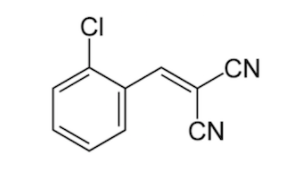
Therefore, we can conclude that the correct answer to this question D.
Note: We should know that there is no specific antidote to common tear gases. Getting clear of gas and into the fresh air is the first line of action.
Immediate removal of contact lenses has also been recommended, as they can retain particles.
Complete step by step answer:
Let’s identify each compound one by one -
Option A, $COCl_{ 2 }$, Phosgene is a colorless gas; in low concentrations, its odor resembles freshly cut hay or grass. Phosgene is a valued industrial building block, especially for the production of urethanes and polycarbonate plastics.
Option B, $CO_{ 2 }$, Carbon dioxide is present in the Earth's atmosphere at a low concentration and acts as a greenhouse gas. In its solid-state, it is called dry ice. It is a major component of the carbon cycle.
Option C, $Cl_{ 2 }$, Chlorine gas is pressurized and cooled for easy storage in liquid form. Since chlorine is heavier than air, it accumulates in low-lying areas.
Tear gas or "CS gas" is an aerosol of a volatile solvent with formula is $C_{ 10 }H_{ 5 }ClN_{ 2 }$ compound 2-chlorobenzalmalononitrile (also called o-chlorobenzylidene malononitrile)
It is a cyanocarbon and used as a riot-control agent and causes a burning sensation and tearing of the eyes.
Therefore, we can conclude that the correct answer to this question D.
Note: We should know that there is no specific antidote to common tear gases. Getting clear of gas and into the fresh air is the first line of action.
Immediate removal of contact lenses has also been recommended, as they can retain particles.
Recently Updated Pages
Wheatstone Bridge – Principle, Formula, Diagram & Applications

Classification of Drugs in Chemistry: Types, Examples & Exam Guide
Mass vs Weight: Key Differences Explained for Students
Area vs Volume: Key Differences Explained for Students
Mutually Exclusive vs Independent Events: Key Differences Explained
Circuit Switching vs Packet Switching: Key Differences Explained
Trending doubts
JEE Main 2026: Exam Dates, Session 2 Updates, City Slip, Admit Card & Latest News
Understanding the Electric Field of a Uniformly Charged Ring
Understanding Atomic Structure for Beginners
Derivation of Equation of Trajectory Explained for Students
Understanding the Different Types of Solutions in Chemistry
Electron Gain Enthalpy and Electron Affinity Explained
Other Pages
JEE Advanced 2026 Notification Out with Exam Date, Registration (Extended), Syllabus and More
JEE Advanced Percentile vs Marks 2026: JEE Main Cutoff, AIR & IIT Admission Guide
JEE Advanced Weightage Chapter Wise 2026 for Physics, Chemistry, and Mathematics
NCERT Solutions For Class 11 Chemistry In Hindi Chapter 1 Some Basic Concepts Of Chemistry - 2025-26
How to Convert a Galvanometer into an Ammeter or Voltmeter
Understanding Electromagnetic Waves and Their Importance