




The C-C bond length of the following molecules is in the order:
\[
{\text{(A)}}{{\text{C}}_{\text{2}}}{{\text{H}}_{\text{6}}}{\text{ > }}{{\text{C}}_{\text{2}}}{{\text{H}}_{\text{4}}}{\text{ > }}{{\text{C}}_{\text{6}}}{{\text{H}}_{\text{6}}}{\text{ > }}{{\text{C}}_{\text{2}}}{{\text{H}}_{\text{2}}} \\
{\text{(B)}}{{\text{C}}_{\text{2}}}{{\text{H}}_{\text{2}}}{\text{ < }}{{\text{C}}_{\text{2}}}{{\text{H}}_{\text{4}}}{\text{ < }}{{\text{C}}_{\text{6}}}{{\text{H}}_{\text{6}}}{\text{ < }}{{\text{C}}_{\text{2}}}{{\text{H}}_{\text{6}}} \\
{\text{(C) }}{{\text{C}}_{\text{2}}}{{\text{H}}_{\text{6}}}{\text{ < }}{{\text{C}}_{\text{2}}}{{\text{H}}_{\text{2}}}{\text{ < }}{{\text{C}}_{\text{6}}}{{\text{H}}_{\text{6}}}{\text{ < }}{{\text{C}}_{\text{2}}}{{\text{H}}_{\text{4}}} \\
{\text{(D) }}{{\text{C}}_{\text{2}}}{{\text{H}}_{\text{4}}}{\text{ < }}{{\text{C}}_{\text{6}}}{{\text{H}}_{\text{6}}}{\text{ < }}{{\text{C}}_{\text{2}}}{{\text{H}}_{\text{2}}}{\text{ < }}{{\text{C}}_{\text{6}}}{{\text{H}}_{\text{6}}} \\
\]
Answer
 Verified
311.7k+ views
Hint: The carbon-carbon bond lengths are dependent upon the type of bonds namely single bond, double bond, or triple bond. The single bond has more bond length compared to double bond which in turn is more than triple bond.
Complete step by step answer:
Bond lengths decrease with increase in s-character. In other words, multiple bonds have a shorter bond length as compared to a single bond.
In the case of single bond only sigma bonds are present whereas in double bond a sigma and a pi bond are present. Sigma bonds are weaker bonds but have high bond length compared to a pi bond. In triple bonds there are two pi bonds which makes it a shorter bond.
A typical carbon-carbon single bond has a length of 154 pm, while a typical double bond and triple bonds are 134 pm and 120 pm, respectively.
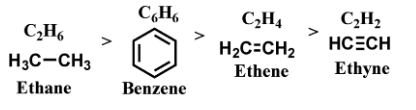
We can see that
Ethane has a single bond between carbon and carbon.
In benzene, the carbon-carbon bond lengths are in resonance due to its aromatic nature, so they have bond length between single bond and double bond as it exhibits partial double bond character.
In ethene, there is a double bond between carbon and carbon.
In ethyne, there is a triple bond between carbon and carbon.
Thus, Single bond > Partial double bond > Double bond > Triple bond.
Therefore, we get the correct following order:
\[{{\text{C}}_{\text{2}}}{{\text{H}}_{\text{2}}}{\text{ < }}{{\text{C}}_{\text{2}}}{{\text{H}}_{\text{4}}}{\text{ < }}{{\text{C}}_{\text{6}}}{{\text{H}}_{\text{6}}}{\text{ < }}{{\text{C}}_{\text{2}}}{{\text{H}}_{\text{6}}}\]
So, the correct option is B.
Note: Partial double bond character is exhibited by molecules having resonance structures where both single bonds and double bonds are exhibited by the molecule. These molecules have bond lengths more than single bonds but less than double bonds.
Complete step by step answer:
Bond lengths decrease with increase in s-character. In other words, multiple bonds have a shorter bond length as compared to a single bond.
In the case of single bond only sigma bonds are present whereas in double bond a sigma and a pi bond are present. Sigma bonds are weaker bonds but have high bond length compared to a pi bond. In triple bonds there are two pi bonds which makes it a shorter bond.
A typical carbon-carbon single bond has a length of 154 pm, while a typical double bond and triple bonds are 134 pm and 120 pm, respectively.
We can see that
Ethane has a single bond between carbon and carbon.
In benzene, the carbon-carbon bond lengths are in resonance due to its aromatic nature, so they have bond length between single bond and double bond as it exhibits partial double bond character.
In ethene, there is a double bond between carbon and carbon.
In ethyne, there is a triple bond between carbon and carbon.
Thus, Single bond > Partial double bond > Double bond > Triple bond.
Therefore, we get the correct following order:
\[{{\text{C}}_{\text{2}}}{{\text{H}}_{\text{2}}}{\text{ < }}{{\text{C}}_{\text{2}}}{{\text{H}}_{\text{4}}}{\text{ < }}{{\text{C}}_{\text{6}}}{{\text{H}}_{\text{6}}}{\text{ < }}{{\text{C}}_{\text{2}}}{{\text{H}}_{\text{6}}}\]
So, the correct option is B.
Note: Partial double bond character is exhibited by molecules having resonance structures where both single bonds and double bonds are exhibited by the molecule. These molecules have bond lengths more than single bonds but less than double bonds.
Recently Updated Pages
JEE Main 2023 (February 1st Shift 2) Physics Question Paper with Answer Key

JEE Main 2023 (February 1st Shift 1) Physics Question Paper with Answer Key
JEE Main 2023 (February 1st Shift 1) Maths Question Paper with Answer Key
Apparent Frequency Explained: Formula, Uses & Examples
JEE Main 2023 (February 1st Shift 2) Chemistry Question Paper with Answer Key
Hydrogen and Its Type Important Concepts and Tips for JEE Exam Preparation
Trending doubts
JEE Main 2026: Exam Dates, Session 2 Updates, City Slip, Admit Card & Latest News
Understanding the Electric Field of a Uniformly Charged Ring
Derivation of Equation of Trajectory Explained for Students
Hybridisation in Chemistry – Concept, Types & Applications
Understanding Atomic Structure for Beginners
Understanding Electromagnetic Waves and Their Importance
Other Pages
NCERT Solutions For Class 11 Chemistry Chapter 7 Redox Reaction - 2026-27 Free PDF Download (Login Required)
CBSE Notes Class 11 Chemistry Chapter 5 - Thermodynamics - 2026-27 PDF Download (Login Required)
NCERT Solutions For Class 11 Chemistry Chapter 5 Thermodynamics - 2026-27 Free PDF Download (Sign-in Required)
JEE Advanced Percentile vs Marks 2026: JEE Main Cutoff, AIR & IIT Admission Guide
JEE Advanced Weightage Chapter Wise 2026 for Physics, Chemistry, and Mathematics
NCERT Solutions For Class 11 Chemistry Chapter 8 Organic Chemistry - Some Basic Principles And Techniques - 2026-27 Free PDF Download (Sign-in Required)
NCERT Solutions For Class 11 Chemistry Chapter 7 Redox Reaction - 2026-27 Free PDF Download (Login Required)
CBSE Notes Class 11 Chemistry Chapter 5 - Thermodynamics - 2026-27 PDF Download (Login Required)
NCERT Solutions For Class 11 Chemistry Chapter 5 Thermodynamics - 2026-27 Free PDF Download (Sign-in Required)