




The bond angle in carbon tetrachloride is approximately
(a) \[{90^o}\]
(b) \[109^\circ \]
(c) \[120^\circ \]
(d) \[180^\circ \]
Answer
 Verified
267.9k+ views
Hint: The carbon tetrachloride (\[CC{l_4}\]) has a structure similar to methane (\[C{H_4}\]). All the bonds (\[C - Cl\]) of \[CC{l_4}\] are covalent. Both \[CC{l_4}\]and \[C{H_4}\]have an identical bond angle. The \[CC{l_4}\]is a non-polar molecule due to its symmetric structure.
Complete step by step solution:The IUPAC name of carbon tetrachloride is tetrachloromethane.
Carbon tetrachloride is an organic compound having \[CC{l_4}\]molecular formula.
The carbon tetrachloride is also known as a polyhalogenated compound because it contains more than one halogen group.
In the structure of carbon tetrachloride, the carbon atom occupies the central position and is linked with four chlorine atoms in a tetrahedral shape.
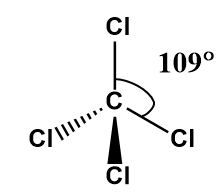
Image: Structure of carbon tetrachloride.
The hybridization of carbon tetrachloride can be predicted in following way:
(1) By using the following equation:
\[Hybridization(H) = \frac{{V + M - C + A}}{2}\] (Eq.1)
Whereas V=number of valence electrons on the central atom
M= a number of monovalent atoms
C= charge on the cation
A=charge on anion
Therefore,
\[Hybridization(H) = \frac{{4 + 4 - 0 + 0}}{2} = 4\]
The value of 4 will be equal to \[s{p^3}\] hybridization.
(2) By counting the sigma bonds:
If the sum of the sigma bond is two, the hybridization will be \[s{p^{}}\].
If the sum of the sigma bond is three, the hybridization will be \[s{p^2}\].
If the sum of the sigma bond is four, the hybridization will be \[s{p^3}\].
If the sum of the sigma bond is five, the hybridization will be \[s{p^3}d\].
If the sum of the sigma bond is six, then hybridization will be \[s{p^3}{d^2}\].
Therefore, the \[CC{l_4}\]molecule has three sigma bonds. Hence the hybridization will be \[s{p^3}\].
Due to the \[s{p^3}\]hybridization, the \[CC{l_4}\]molecule has tetrahedral geometry with \[109^\circ \]bond angle.
Therefore from the above explanation we can say option (b) will be the correct option:
Note: The carbon tetrachloride is a colorless liquid and possesses a sweet odor.
The carbon tetrachloride is used as a chlorinating agent in organic reactions such as the Appel reaction.
The carbon tetrachloride is also used as a degreasing agent for dry cleaning.
Complete step by step solution:The IUPAC name of carbon tetrachloride is tetrachloromethane.
Carbon tetrachloride is an organic compound having \[CC{l_4}\]molecular formula.
The carbon tetrachloride is also known as a polyhalogenated compound because it contains more than one halogen group.
In the structure of carbon tetrachloride, the carbon atom occupies the central position and is linked with four chlorine atoms in a tetrahedral shape.
Image: Structure of carbon tetrachloride.
The hybridization of carbon tetrachloride can be predicted in following way:
(1) By using the following equation:
\[Hybridization(H) = \frac{{V + M - C + A}}{2}\] (Eq.1)
Whereas V=number of valence electrons on the central atom
M= a number of monovalent atoms
C= charge on the cation
A=charge on anion
Therefore,
\[Hybridization(H) = \frac{{4 + 4 - 0 + 0}}{2} = 4\]
The value of 4 will be equal to \[s{p^3}\] hybridization.
(2) By counting the sigma bonds:
If the sum of the sigma bond is two, the hybridization will be \[s{p^{}}\].
If the sum of the sigma bond is three, the hybridization will be \[s{p^2}\].
If the sum of the sigma bond is four, the hybridization will be \[s{p^3}\].
If the sum of the sigma bond is five, the hybridization will be \[s{p^3}d\].
If the sum of the sigma bond is six, then hybridization will be \[s{p^3}{d^2}\].
Therefore, the \[CC{l_4}\]molecule has three sigma bonds. Hence the hybridization will be \[s{p^3}\].
Due to the \[s{p^3}\]hybridization, the \[CC{l_4}\]molecule has tetrahedral geometry with \[109^\circ \]bond angle.
Therefore from the above explanation we can say option (b) will be the correct option:
Note: The carbon tetrachloride is a colorless liquid and possesses a sweet odor.
The carbon tetrachloride is used as a chlorinating agent in organic reactions such as the Appel reaction.
The carbon tetrachloride is also used as a degreasing agent for dry cleaning.
Recently Updated Pages
Algebra Made Easy: Step-by-Step Guide for Students

JEE Isolation, Preparation and Properties of Non-metals Important Concepts and Tips for Exam Preparation
JEE Energetics Important Concepts and Tips for Exam Preparation
Chemical Properties of Hydrogen - Important Concepts for JEE Exam Preparation
JEE General Topics in Chemistry Important Concepts and Tips
JEE Amino Acids and Peptides Important Concepts and Tips for Exam Preparation
Trending doubts
JEE Main 2026: Exam Dates, Session 2 Updates, City Slip, Admit Card & Latest News
JEE Main Participating Colleges 2026 - A Complete List of Top Colleges
Understanding the Electric Field of a Uniformly Charged Ring
Derivation of Equation of Trajectory Explained for Students
Understanding Atomic Structure for Beginners
How to Convert a Galvanometer into an Ammeter or Voltmeter
Other Pages
JEE Advanced 2026 Notification Out with Exam Date, Registration (Extended), Syllabus and More
JEE Advanced Percentile vs Marks 2026: JEE Main Cutoff, AIR & IIT Admission Guide
JEE Advanced 2026 Marks vs Rank: Estimate IIT Rank from Your Score
JEE Advanced Weightage Chapter Wise 2026 for Physics, Chemistry, and Mathematics
NCERT Solutions For Class 11 Chemistry In Hindi Chapter 1 Some Basic Concepts Of Chemistry - 2025-26
Understanding Electromagnetic Waves and Their Importance