




The angle of depression of the top and the bottom of a building 50m high are observed from the top of a tower are \[30^\circ \] and \[60^\circ \] respectively. Find the height of the tower and also the horizontal distance between the building and the tower.
Answer
 Verified
603.8k+ views
Hint: Draw the diagram of the given problem statement for a better understanding of the situation. Use the trigonometric ratios, that are $\sin \theta = \dfrac{{{\text{Opposite}}}}{{{\text{Hypotenuse}}}}$ and $\tan \theta = \dfrac{{{\text{Perpendicular}}}}{{{\text{Base}}}}$ in the physical triangle formed to find the height of the tower and horizontal distance between the building and the tower.
Complete step by step answer:
Since it is given that the angle observed from the top of the tower to the top and bottom of the building are \[30^\circ \] and \[60^\circ \]respectively, we can draw a diagram representing the condition.
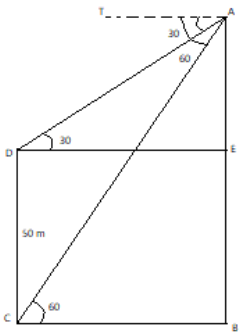
In the diagram, A represents the top of the tower, AB represents the height of the tower, DC represents the building of height 50 metres.
It is given in the question that the angle $\angle TAD$ is \[30^\circ \] and the angle $\angle TAC$ is \[60^\circ \].
By the property of the corresponding angles of the parallel lines, we can say that the angle $\angle ADE$is \[30^\circ \] and the angle $\angle ACB$ is \[60^\circ \].
In the triangle $ADE$, we can say
\[\tan {30^ \circ } = \dfrac{{{\text{AE}}}}{{DE}}\]
On further simplifying
$
\dfrac{1}{{\sqrt 3 }} = \dfrac{{{\text{AE}}}}{{DE}} \\
\sqrt 3 {\text{AE = DE}} \\
$
Similarly, in the triangle ${\text{ACB}}$
\[\tan {60^ \circ } = \dfrac{{{\text{AB}}}}{{{\text{BC}}}}\]
On further simplifying
$
\sqrt 3 = \dfrac{{{\text{AB}}}}{{{\text{BC}}}} \\
\sqrt 3 {\text{BC = AB}} \\
$
From the figure we infer that,
${\text{BC = DE}}$
$
{\text{AB = AE + EB}} \\
{\text{EB = CD = 50}} \\
{\text{AB = AE + 50}} \\
$
Substituting the value ${\text{AE + 50}}$ for ${\text{AB}}$ and ${\text{DE}}$ for ${\text{BC}}$ in the equation \[\sqrt 3 {\text{BC = AB}}\], we get
\[\sqrt 3 {\text{DE = AE + 50}}\]
Also, \[\sqrt 3 {\text{AE = DE}}\]
Thus the expression becomes \[\sqrt 3 \left( {\sqrt 3 {\text{AE}}} \right){\text{ = AE + 50}}\]
We can solve the expression to find the value of ${\text{AE}}$
$
3{\text{AE = AE + 50}} \\
{\text{2AE = 50}} \\
{\text{AE = 25}} \\
$
Substituting the value 25 for ${\text{AE}}$ in the equation ${\text{AB = AE + 50}}$ to find the height of the tower, and in the equation \[\sqrt 3 {\text{AE = DE}}\] to find the horizontal distance between the building and the tower.
$
{\text{AB = 25 + 50}} \\
{\text{AB = 75}} \\
$
\[{\text{DE}} = \sqrt 3 \left( {25} \right)\]
Thus the height of the tower is 75 m, and the horizontal distance between the building and the tower is $25\sqrt 3 $m.
Note: In a right angled triangle, the $\tan \theta $ is the equal to $\dfrac{{{\text{Perpendicular}}}}{{{\text{Base}}}}$, where perpendicular is the side opposite to the angle $\theta $, and $\sin \theta $ is the equal to $\dfrac{{{\text{Perpendicular}}}}{{{\text{Hypotenuse}}}}$, where perpendicular is the side opposite to the angle $\theta $.
Complete step by step answer:
Since it is given that the angle observed from the top of the tower to the top and bottom of the building are \[30^\circ \] and \[60^\circ \]respectively, we can draw a diagram representing the condition.
In the diagram, A represents the top of the tower, AB represents the height of the tower, DC represents the building of height 50 metres.
It is given in the question that the angle $\angle TAD$ is \[30^\circ \] and the angle $\angle TAC$ is \[60^\circ \].
By the property of the corresponding angles of the parallel lines, we can say that the angle $\angle ADE$is \[30^\circ \] and the angle $\angle ACB$ is \[60^\circ \].
In the triangle $ADE$, we can say
\[\tan {30^ \circ } = \dfrac{{{\text{AE}}}}{{DE}}\]
On further simplifying
$
\dfrac{1}{{\sqrt 3 }} = \dfrac{{{\text{AE}}}}{{DE}} \\
\sqrt 3 {\text{AE = DE}} \\
$
Similarly, in the triangle ${\text{ACB}}$
\[\tan {60^ \circ } = \dfrac{{{\text{AB}}}}{{{\text{BC}}}}\]
On further simplifying
$
\sqrt 3 = \dfrac{{{\text{AB}}}}{{{\text{BC}}}} \\
\sqrt 3 {\text{BC = AB}} \\
$
From the figure we infer that,
${\text{BC = DE}}$
$
{\text{AB = AE + EB}} \\
{\text{EB = CD = 50}} \\
{\text{AB = AE + 50}} \\
$
Substituting the value ${\text{AE + 50}}$ for ${\text{AB}}$ and ${\text{DE}}$ for ${\text{BC}}$ in the equation \[\sqrt 3 {\text{BC = AB}}\], we get
\[\sqrt 3 {\text{DE = AE + 50}}\]
Also, \[\sqrt 3 {\text{AE = DE}}\]
Thus the expression becomes \[\sqrt 3 \left( {\sqrt 3 {\text{AE}}} \right){\text{ = AE + 50}}\]
We can solve the expression to find the value of ${\text{AE}}$
$
3{\text{AE = AE + 50}} \\
{\text{2AE = 50}} \\
{\text{AE = 25}} \\
$
Substituting the value 25 for ${\text{AE}}$ in the equation ${\text{AB = AE + 50}}$ to find the height of the tower, and in the equation \[\sqrt 3 {\text{AE = DE}}\] to find the horizontal distance between the building and the tower.
$
{\text{AB = 25 + 50}} \\
{\text{AB = 75}} \\
$
\[{\text{DE}} = \sqrt 3 \left( {25} \right)\]
Thus the height of the tower is 75 m, and the horizontal distance between the building and the tower is $25\sqrt 3 $m.
Note: In a right angled triangle, the $\tan \theta $ is the equal to $\dfrac{{{\text{Perpendicular}}}}{{{\text{Base}}}}$, where perpendicular is the side opposite to the angle $\theta $, and $\sin \theta $ is the equal to $\dfrac{{{\text{Perpendicular}}}}{{{\text{Hypotenuse}}}}$, where perpendicular is the side opposite to the angle $\theta $.
Recently Updated Pages
Mutually Exclusive vs Independent Events: Key Differences Explained

Area vs Volume: Key Differences Explained for Students
Difference Between Erosion and Corrosion: JEE Main 2027
Solved Questions of Atomic Structure | IIT JEE Chemistry
Some Important Compounds of Boron | Uses of Boron for JEE Chemistry
JEE Main 2025-26 Mock Test: Organic Compounds Containing Oxygen
Trending doubts
JEE Main Marks vs Percentile 2026: Predict Your Score Easily
JEE Main Cutoff 2026: Category-wise Qualifying Percentile
JEE Main 2026: Exam Dates, Session 2 Updates, City Slip, Admit Card & Latest News
JEE Main Marks vs Rank 2026: Expected Rank for 300 to 0 Marks
NIT Cutoff 2026: Tier-Wise Opening and Closing Ranks for B.Tech. Admission
JEE Mains 2027 Subject Wise Percentile Explained
Other Pages
CBSE Class 10 Maths Question Paper 2026 OUT Download PDF with Solutions
Complete List of Class 10 Maths Formulas (Chapterwise)
NCERT Solutions For Class 10 Maths Chapter 11 Areas Related To Circles - 2026-27 Free PDF Download (Login Required)
All Mensuration Formulas with Examples and Quick Revision
NCERT Solutions For Class 10 Maths Chapter 13 Statistics - 2026-27 Free PDF Download (Login Required)
NCERT Solutions For Class 10 Maths Chapter 14 Probability - 2026-27 Free PDF Download (Sign-in Required)