




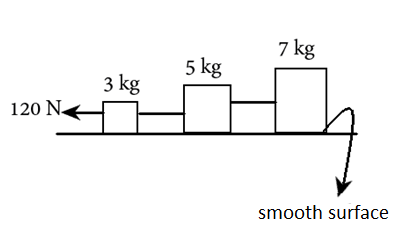
\[{T_1}\] and \[{T_2}\] in the given figure are
(A) 28 N, 48 N
(B) 48 N, 28 N
(C) 96 N, 56 N
(D) 56 N, 96 N
Answer
 Verified
268.2k+ views
Hint: We need to identify the force acting on each block. Perform a Newton’s second law analysis on each of the blocks separately. The acceleration of each object is equal to the acceleration of the system.
Formula used: In this solution we will be using the following formulae;
\[{F_{NET}} = ma\] where \[{F_{NET}}\] is the net force acting on a body, \[m\] is the mass of the body, and \[a\] is the acceleration of the body.
Complete Step-by-Step Answer:
A particular amount of force is acting upon a chain of objects, the tensions in the cords are asked to be determined. To do this, we must analyse the forces on each block independently and link them with the acceleration. The acceleration of the system is the acceleration of the blocks, hence, they are equal.
Newton’s second law can be written as
\[{F_{NET}} = ma\] where \[{F_{NET}}\] is the net force acting on a body, \[m\] is the mass of the body, and \[a\] is the acceleration of the body.
Applying on the 3kg body, we have
\[120 - {T_1} = ma\]
\[ \Rightarrow 120 - {T_1} = 3a\]
Similarly, on the 5kg block
\[{T_1} - {T_2} = 5a\]
And on the 7kg block
\[{T_2} = 7a\]
We shall solve this three equations simultaneously, hence,
Insert \[{T_2} = 7a\] into \[{T_1} - {T_2} = 5a\], then,
\[{T_1} - 7a = 5a\]
\[ \Rightarrow {T_1} = 12a\]
Inserting this into \[120 - {T_1} = 3a\], we have
\[120 - 12a = 3a\]
\[ \Rightarrow 120 = 15a\]
Dividing both sides by 10, we get
\[a = 8m{s^{ - 2}}\]
Then, \[{T_1}\] can be calculated from
\[120 - {T_1} = 3 \times 8\]
\[ \Rightarrow {T_1} = 120 - 24 = 96N\]
Then the tension in the second cord \[{T_2}\] can be calculated from
\[{T_2} = 7a\] as
\[{T_2} = 7 \times 8 = 56N\]
Hence, the correct option is C
Note: Alternatively, one could take the entire system as one block which will be the sum of all three blocks and calculate the acceleration as thus
\[a = \dfrac{{120}}{M} = \dfrac{{120}}{{3 + 5 + 7}} = \dfrac{{120}}{{15}}\]
Hence, by computation,
\[a = 8m{s^{ - 2}}\]
Formula used: In this solution we will be using the following formulae;
\[{F_{NET}} = ma\] where \[{F_{NET}}\] is the net force acting on a body, \[m\] is the mass of the body, and \[a\] is the acceleration of the body.
Complete Step-by-Step Answer:
A particular amount of force is acting upon a chain of objects, the tensions in the cords are asked to be determined. To do this, we must analyse the forces on each block independently and link them with the acceleration. The acceleration of the system is the acceleration of the blocks, hence, they are equal.
Newton’s second law can be written as
\[{F_{NET}} = ma\] where \[{F_{NET}}\] is the net force acting on a body, \[m\] is the mass of the body, and \[a\] is the acceleration of the body.
Applying on the 3kg body, we have
\[120 - {T_1} = ma\]
\[ \Rightarrow 120 - {T_1} = 3a\]
Similarly, on the 5kg block
\[{T_1} - {T_2} = 5a\]
And on the 7kg block
\[{T_2} = 7a\]
We shall solve this three equations simultaneously, hence,
Insert \[{T_2} = 7a\] into \[{T_1} - {T_2} = 5a\], then,
\[{T_1} - 7a = 5a\]
\[ \Rightarrow {T_1} = 12a\]
Inserting this into \[120 - {T_1} = 3a\], we have
\[120 - 12a = 3a\]
\[ \Rightarrow 120 = 15a\]
Dividing both sides by 10, we get
\[a = 8m{s^{ - 2}}\]
Then, \[{T_1}\] can be calculated from
\[120 - {T_1} = 3 \times 8\]
\[ \Rightarrow {T_1} = 120 - 24 = 96N\]
Then the tension in the second cord \[{T_2}\] can be calculated from
\[{T_2} = 7a\] as
\[{T_2} = 7 \times 8 = 56N\]
Hence, the correct option is C
Note: Alternatively, one could take the entire system as one block which will be the sum of all three blocks and calculate the acceleration as thus
\[a = \dfrac{{120}}{M} = \dfrac{{120}}{{3 + 5 + 7}} = \dfrac{{120}}{{15}}\]
Hence, by computation,
\[a = 8m{s^{ - 2}}\]
Recently Updated Pages
Algebra Made Easy: Step-by-Step Guide for Students

JEE Isolation, Preparation and Properties of Non-metals Important Concepts and Tips for Exam Preparation
JEE Energetics Important Concepts and Tips for Exam Preparation
Chemical Properties of Hydrogen - Important Concepts for JEE Exam Preparation
JEE General Topics in Chemistry Important Concepts and Tips
JEE Amino Acids and Peptides Important Concepts and Tips for Exam Preparation
Trending doubts
JEE Main 2026: Exam Dates, Session 2 Updates, City Slip, Admit Card & Latest News
JEE Main Participating Colleges 2026 - A Complete List of Top Colleges
Understanding the Electric Field of a Uniformly Charged Ring
Derivation of Equation of Trajectory Explained for Students
Understanding Atomic Structure for Beginners
How to Convert a Galvanometer into an Ammeter or Voltmeter
Other Pages
JEE Advanced 2026 Notification Out with Exam Date, Registration (Extended), Syllabus and More
JEE Advanced Percentile vs Marks 2026: JEE Main Cutoff, AIR & IIT Admission Guide
CBSE Notes Class 11 Physics Chapter 1 - Units And Measurements - 2025-26
JEE Advanced 2026 Marks vs Rank: Estimate IIT Rank from Your Score
NCERT Solutions For Class 11 Physics Chapter 1 Units And Measurements - 2025-26
Important Questions For Class 11 Physics Chapter 1 Units and Measurement - 2025-26