




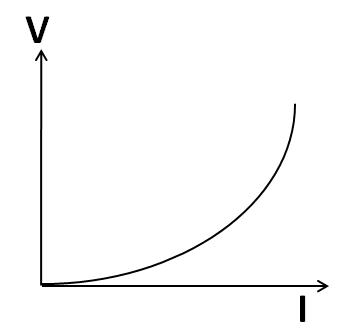
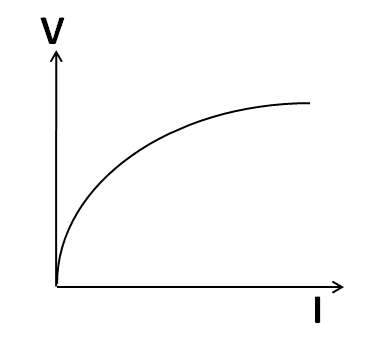
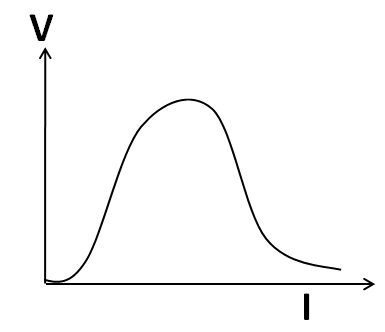
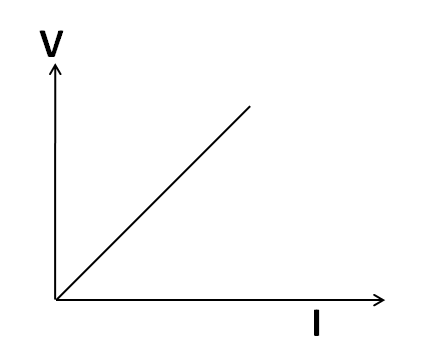
Suppose the drift velocity ${v_d}$ in a material varied with the applied electric field $E$ as: ${v_d} \propto \sqrt E $. Then V – I graph for a wire made of such a material is best given by
(A)
(B)
(C)
(D)
Answer
 Verified
273k+ views
Hint: To solve this question, we need to use the formula for the drift velocity in terms of the current. Then using the given relation we can get the relation between the current and the voltage with the help of which we can predict the shape of the plot.
Formula used: The formula used to solve this question is
$I = neA{v_d}$, here $I$ is the current in a conductor having area of cross section $A$, $n$ is the number density of the electrons of charge $e$ and drift velocity of ${v_d}$.
Complete step-by-step solution:
The relation between the drift velocity and the applied electric field is given in the question as
${v_d} \propto \sqrt E $
We know that we can replace the proportionality sign in a relation with the equal sign by introducing a constant in the right hand side of the relation. So we can write the above relation as as
${v_d} = k\sqrt E $
On squaring both sides of the above equation, we get
${v_d}^2 = {k^2}E$
$ \Rightarrow E = \dfrac{{{v_d}^2}}{{{k^2}}}$................(1)
Now, we know that the potential difference across a conductor is related to the uniform electric field present in the conductor by the relation
$V = \dfrac{E}{l}$ (here $l$ is the assumed length of the material given in the question)
Substituting (1) in the above equation, we get
$V = \dfrac{{{v_d}^2}}{{{k^2}l}}$ ……………….(2)
Now, we know that the current in a conductor is related to the drift velocity of the electrons of the conductor as
$I = neA{v_d}$...................(3)
$ \Rightarrow {v_d} = \dfrac{I}{{neA}}$........................(4)
Putting (4) in (2) we get
$V = \dfrac{{{{\left( {\dfrac{I}{{neA}}} \right)}^2}}}{{{k^2}l}}$
$V = \dfrac{{{I^2}}}{{{n^2}{e^2}{A^2}{k^2}l}}$
Now, we know that the number density, charge of electron, area of cross section of the material, and the length of the conductor are all constants. So we can write the above equation as
$V = c{I^2}$
Comparing the equation $y = k{x^2}$, we get the V-I relation as a parabolic equation. So its plot should a parabola as shown below
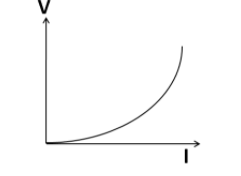
Hence, the correct answer is option A.
Note: From the Ohm’s law we know that the relation between the current and the voltage is linear across a conductor. So we should have got a linear plot according to the Ohm’s law. But the Ohm’s law is only valid if the resistance of the conductor is constant. In this case the resistance of the material used is not constant, and therefore we didn’t get a linear V-I plot.
Formula used: The formula used to solve this question is
$I = neA{v_d}$, here $I$ is the current in a conductor having area of cross section $A$, $n$ is the number density of the electrons of charge $e$ and drift velocity of ${v_d}$.
Complete step-by-step solution:
The relation between the drift velocity and the applied electric field is given in the question as
${v_d} \propto \sqrt E $
We know that we can replace the proportionality sign in a relation with the equal sign by introducing a constant in the right hand side of the relation. So we can write the above relation as as
${v_d} = k\sqrt E $
On squaring both sides of the above equation, we get
${v_d}^2 = {k^2}E$
$ \Rightarrow E = \dfrac{{{v_d}^2}}{{{k^2}}}$................(1)
Now, we know that the potential difference across a conductor is related to the uniform electric field present in the conductor by the relation
$V = \dfrac{E}{l}$ (here $l$ is the assumed length of the material given in the question)
Substituting (1) in the above equation, we get
$V = \dfrac{{{v_d}^2}}{{{k^2}l}}$ ……………….(2)
Now, we know that the current in a conductor is related to the drift velocity of the electrons of the conductor as
$I = neA{v_d}$...................(3)
$ \Rightarrow {v_d} = \dfrac{I}{{neA}}$........................(4)
Putting (4) in (2) we get
$V = \dfrac{{{{\left( {\dfrac{I}{{neA}}} \right)}^2}}}{{{k^2}l}}$
$V = \dfrac{{{I^2}}}{{{n^2}{e^2}{A^2}{k^2}l}}$
Now, we know that the number density, charge of electron, area of cross section of the material, and the length of the conductor are all constants. So we can write the above equation as
$V = c{I^2}$
Comparing the equation $y = k{x^2}$, we get the V-I relation as a parabolic equation. So its plot should a parabola as shown below
Hence, the correct answer is option A.
Note: From the Ohm’s law we know that the relation between the current and the voltage is linear across a conductor. So we should have got a linear plot according to the Ohm’s law. But the Ohm’s law is only valid if the resistance of the conductor is constant. In this case the resistance of the material used is not constant, and therefore we didn’t get a linear V-I plot.
Recently Updated Pages
WBJEE 2026 Result Live: Important Dates, Last Date Apply Online 2026

JoSAA Counselling 2026: JoSAA 2026 Mock Seat Allotment LIVE: Round 2 Result Released, Registration, Choice Filling and Ranks
Circuit Switching vs Packet Switching: Key Differences Explained
JEE General Topics in Chemistry Important Concepts and Tips
JEE Extractive Metallurgy Important Concepts and Tips for Exam Preparation
JEE Atomic Structure and Chemical Bonding important Concepts and Tips
Trending doubts
JEE Main 2026: Exam Dates, Session 2 Updates, City Slip, Admit Card & Latest News
JEE Main Participating Colleges 2026 - A Complete List of Top Colleges
Kinematics Mock Test for JEE Main 2025-26: Comprehensive Practice
Understanding the Electric Field of a Uniformly Charged Ring
Understanding Atomic Structure for Beginners
Derivation of Equation of Trajectory Explained for Students
Other Pages
CBSE Class 12 Physics Question Paper 2026: Download SET-wise PDF with Answer Key & Analysis
JEE Advanced 2026 Notification Out with Exam Date, Registration (Extended), Syllabus and More
JEE Advanced Percentile vs Marks 2026: JEE Main Cutoff, AIR & IIT Admission Guide
JEE Advanced Weightage Chapter Wise 2026 for Physics, Chemistry, and Mathematics
How to Convert a Galvanometer into an Ammeter or Voltmeter
Electron Gain Enthalpy and Electron Affinity Explained