




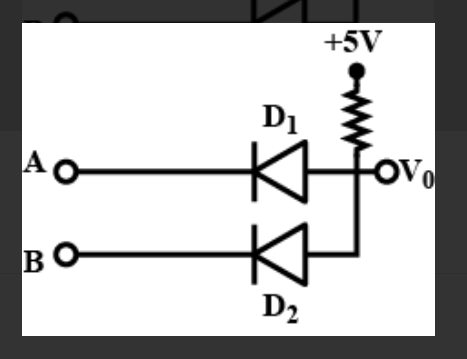
Study the circuit shown in the figure. Name the gate that the given circuit resembles.
(A) NAND
(B) AND
(C) OR
(D NOR
Answer
 Verified
270.3k+ views
Hint: We know that logic gates perform basic logical functions and are the fundamental building blocks of digital integrated circuits. Most logic gates take an input of two binary values, and output a single value of a 1 or 0. Some circuits may have only a few logic gates, while others, such as microprocessors, may have millions of them. Boolean logic is a very easy way to figure out the truth of an expression using the simple concept of true or false. In a nutshell, Boolean logic means you are working with stuff that is either TRUE or FALSE (and nothing else as Monty Python would say).
Complete step by step answer
We know that Logic gates are the basic building blocks of any digital system. It is an electronic circuit having one or more than one input and only one output. The relationship between the input and the output is based on a certain logic. Based on this, logic gates are named as AND gate, OR gate, NOT gate etc. Digital electronics relies on the actions of just seven types of logic gates, called AND, OR, NAND (Not AND), NOR (Not OR), XOR (Exclusive OR) XNOR (Exclusive NOR) and NOT. Because, in binary logic there are only two states, 1 and 0 or 'on and off,' NOT in the world of binary logic therefore means 'the opposite of'.
The circuit resembles an AND gate. The Boolean expression of this
circuit is $\mathrm{V}_{0}=\mathrm{A.B}$ that is $\mathrm{V}_{0}$ equals A AND B.
The truth table is given below:
So, the correct answer is option B.
Note: We can conclude that the AND gate is so named because, if 0 is called "false" and 1 is called "true," the gate acts in the same way as the logical "and" operator. The output is "true" when both inputs are "true." Otherwise, the output is "false." In other words, the output is 1 only when both inputs one AND two are 1. When a transistor is on, or open, then an electric current can flow through. When we string a bunch of these transistors together, then we get what's called a logic gate, which lets you add, subtract, multiply, and divide binary numbers in any way imaginable. In a physical circuit, these logic gates have: Inputs.
Complete step by step answer
We know that Logic gates are the basic building blocks of any digital system. It is an electronic circuit having one or more than one input and only one output. The relationship between the input and the output is based on a certain logic. Based on this, logic gates are named as AND gate, OR gate, NOT gate etc. Digital electronics relies on the actions of just seven types of logic gates, called AND, OR, NAND (Not AND), NOR (Not OR), XOR (Exclusive OR) XNOR (Exclusive NOR) and NOT. Because, in binary logic there are only two states, 1 and 0 or 'on and off,' NOT in the world of binary logic therefore means 'the opposite of'.
The circuit resembles an AND gate. The Boolean expression of this
circuit is $\mathrm{V}_{0}=\mathrm{A.B}$ that is $\mathrm{V}_{0}$ equals A AND B.
The truth table is given below:
| A | B | Y |
| 0 | 0 | 0 |
| 0 | 1 | 0 |
| 1 | 0 | 0 |
| 1 | 1 | 1 |
So, the correct answer is option B.
Note: We can conclude that the AND gate is so named because, if 0 is called "false" and 1 is called "true," the gate acts in the same way as the logical "and" operator. The output is "true" when both inputs are "true." Otherwise, the output is "false." In other words, the output is 1 only when both inputs one AND two are 1. When a transistor is on, or open, then an electric current can flow through. When we string a bunch of these transistors together, then we get what's called a logic gate, which lets you add, subtract, multiply, and divide binary numbers in any way imaginable. In a physical circuit, these logic gates have: Inputs.
Recently Updated Pages
Circuit Switching vs Packet Switching: Key Differences Explained

JEE General Topics in Chemistry Important Concepts and Tips
JEE Extractive Metallurgy Important Concepts and Tips for Exam Preparation
JEE Atomic Structure and Chemical Bonding important Concepts and Tips
JEE Amino Acids and Peptides Important Concepts and Tips for Exam Preparation
Electricity and Magnetism Explained: Key Concepts & Applications
Trending doubts
JEE Main 2026: Exam Dates, Session 2 Updates, City Slip, Admit Card & Latest News
JEE Main Participating Colleges 2026 - A Complete List of Top Colleges
Kinematics Mock Test for JEE Main 2025-26: Comprehensive Practice
Understanding the Electric Field of a Uniformly Charged Ring
Understanding Atomic Structure for Beginners
Derivation of Equation of Trajectory Explained for Students
Other Pages
CBSE Class 12 Physics Question Paper 2026: Download SET-wise PDF with Answer Key & Analysis
JEE Advanced 2026 Notification Out with Exam Date, Registration (Extended), Syllabus and More
JEE Advanced Percentile vs Marks 2026: JEE Main Cutoff, AIR & IIT Admission Guide
JEE Advanced 2026 Marks vs Rank: Estimate IIT Rank from Your Score
JEE Advanced Weightage Chapter Wise 2026 for Physics, Chemistry, and Mathematics
JEE Main Marking Scheme 2026- Paper-Wise Marks Distribution and Negative Marking Details