




What is the shape of $\text{C}{{\text{H}}_{4}}$?
(a) Pyramidal
(b) Trigonal planar
(c) Linear
(d) Tetrahedral
Answer
 Verified
271.5k+ views
Hint: The methods by which one can elucidate the shape of molecules are through the use of VSEPR theory. We can calculate the total bond pair of the molecule, after which geometry and shape can be predicted.
Complete step by step solution:
VSEPR stands for Valence Shell Electron Pair Repulsion theory. This theory is used to predict the shape of the molecules in a systematic way by using the number of electron pairs to determine the shape of the molecules.
Carbon is in group 4, and so has 4 outer electrons. It is forming 4 bonds to hydrogen, adding another 4 electrons-8 altogether, in 4 pairs. Because it is forming 4 bonds, these must all be bonding pairs.
Four electron pairs arrange themselves in space in what is called tetrahedral arrangement. A tetrahedron is a regular triangularly-based pyramid. The carbon atom would be at the centre and the hydrogen at the four corners. All the bond angles are ${{109.5}^{\text{o}}}$.
Shape:
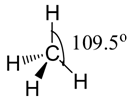
Hence, the correct option is (d) tetrahedral.
Note: It is important that you understand the use of various sorts of line to show 3-dimensional arrangement of the bonds. In diagrams of this sort, an ordinary line represents a bond in the plane of the screen or paper. A dotted line shows a bond going away from you into the screen or paper. A wedge shows a bond coming out towards you.
Complete step by step solution:
VSEPR stands for Valence Shell Electron Pair Repulsion theory. This theory is used to predict the shape of the molecules in a systematic way by using the number of electron pairs to determine the shape of the molecules.
Carbon is in group 4, and so has 4 outer electrons. It is forming 4 bonds to hydrogen, adding another 4 electrons-8 altogether, in 4 pairs. Because it is forming 4 bonds, these must all be bonding pairs.
Four electron pairs arrange themselves in space in what is called tetrahedral arrangement. A tetrahedron is a regular triangularly-based pyramid. The carbon atom would be at the centre and the hydrogen at the four corners. All the bond angles are ${{109.5}^{\text{o}}}$.
| $\text{C}{{\text{H}}_{4}}$ | |
| Central atom | Carbon |
| Valence electron on central atom | 4 |
| 4 Hydrogen atom (contributing 1 electron each) | 4 |
| Total | 8 |
| Divide by 2 | 4 |
| Shape as per VSEPR Theory | Tetrahedral |
Shape:
Hence, the correct option is (d) tetrahedral.
Note: It is important that you understand the use of various sorts of line to show 3-dimensional arrangement of the bonds. In diagrams of this sort, an ordinary line represents a bond in the plane of the screen or paper. A dotted line shows a bond going away from you into the screen or paper. A wedge shows a bond coming out towards you.
Recently Updated Pages
JoSAA Counselling 2026: JoSAA 2026 Mock Seat Allotment LIVE: Round 2 Result Released, Registration, Choice Filling and Ranks

Disproportionation Reaction: Definition, Example & JEE Guide
Hess Law of Constant Heat Summation: Definition, Formula & Applications
JEE General Topics in Chemistry Important Concepts and Tips
JEE Extractive Metallurgy Important Concepts and Tips for Exam Preparation
JEE Atomic Structure and Chemical Bonding important Concepts and Tips
Trending doubts
JEE Main 2026: Exam Dates, Session 2 Updates, City Slip, Admit Card & Latest News
JEE Main Participating Colleges 2026 - A Complete List of Top Colleges
Understanding the Electric Field of a Uniformly Charged Ring
Understanding Atomic Structure for Beginners
Derivation of Equation of Trajectory Explained for Students
Understanding the Different Types of Solutions in Chemistry
Other Pages
JEE Advanced 2026 Notification Out with Exam Date, Registration (Extended), Syllabus and More
JEE Advanced Percentile vs Marks 2026: JEE Main Cutoff, AIR & IIT Admission Guide
JEE Advanced Weightage Chapter Wise 2026 for Physics, Chemistry, and Mathematics
JEE Main Marking Scheme 2026- Paper-Wise Marks Distribution and Negative Marking Details
NCERT Solutions For Class 11 Chemistry In Hindi Chapter 1 Some Basic Concepts Of Chemistry - 2025-26
How to Convert a Galvanometer into an Ammeter or Voltmeter