




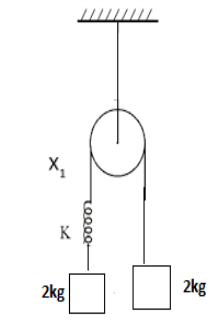
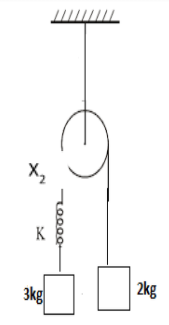
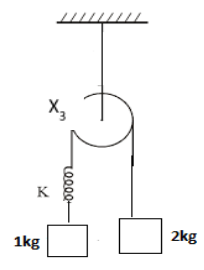
Same spring is attached with 2kg, 3kg and 1 kg blocks in three different cases as shown in figure. If x1, x2, x3 be the extension in the three cases then,
A) x1=0, x3 >x2
B) x1>x2>x3
C) x3>x2>x1
D) x2>x1>x3
Answer
 Verified
249.6k+ views
Hint: Above problem is based on connected motion concept with the presence of second law of motion (Newton’s law of motion). In the connected system tension (force applied upwards due to the presence of pulley) is given as:
$T = \dfrac{{2{m_1}{m_2}g}}{{{m_1} + {m_2}}}$
Forces acting on a body balance each other, the force which is greater in magnitude exists in the system.
Like in the question pulley will move down if the downward force (mg) will be greater than tension.
Using the similar concept we will solve the problem.
Complete step by step solution:
We have ${x_1},{x_2},{x_3}$ proportional to tension T of the pulley:
So, we will find the tension T of the springs in each three cases by using the formula for tension of the connected system of motion.
$
\Rightarrow {T_1} = \dfrac{{2{m_1}{m_2}g}}{{{m_1} + {m_2}}} \\
\Rightarrow {T_1} = \dfrac{{2 \times 2 \times 2g}}{{2 + 2}} \\
\Rightarrow {T_1} = 2g \\
$
We have substituted the value of masses in the formula given and calculated T1.
Now, we will calculate tension for second diagram
$
\Rightarrow {T_2} = \dfrac{{2 \times 3 \times 2g}}{{3 + 2}} \\
\Rightarrow {T_2} = \dfrac{{12g}}{5} = 2.4g \\
$ (Tension calculated for second diagram)
Now, we will move on to the third figure:
$
\Rightarrow {T_3} = \frac{{2 \times 1 \times 2g}}{{2 + 1}} \\
\Rightarrow {T_3} = \frac{{4g}}{3} = 1.66g \\
$(Tension in figure 3 is calculated)
By observation we got;
${T_2} > {T_1} > {T_3}$
As $T \propto x$
Therefore, we can write as:
${x_2} > {x_1} > {x_3}$
Option: (D) is correct.
Note: We have a number of daily life examples where we are observing Newton’s second law of motion such as, hitting the golf ball, cricket ball, football with a force the more we exert force the more we will observe the reaction. As in our question above force having higher magnitude was existing in the system.
$T = \dfrac{{2{m_1}{m_2}g}}{{{m_1} + {m_2}}}$
Forces acting on a body balance each other, the force which is greater in magnitude exists in the system.
Like in the question pulley will move down if the downward force (mg) will be greater than tension.
Using the similar concept we will solve the problem.
Complete step by step solution:
We have ${x_1},{x_2},{x_3}$ proportional to tension T of the pulley:
So, we will find the tension T of the springs in each three cases by using the formula for tension of the connected system of motion.
$
\Rightarrow {T_1} = \dfrac{{2{m_1}{m_2}g}}{{{m_1} + {m_2}}} \\
\Rightarrow {T_1} = \dfrac{{2 \times 2 \times 2g}}{{2 + 2}} \\
\Rightarrow {T_1} = 2g \\
$
We have substituted the value of masses in the formula given and calculated T1.
Now, we will calculate tension for second diagram
$
\Rightarrow {T_2} = \dfrac{{2 \times 3 \times 2g}}{{3 + 2}} \\
\Rightarrow {T_2} = \dfrac{{12g}}{5} = 2.4g \\
$ (Tension calculated for second diagram)
Now, we will move on to the third figure:
$
\Rightarrow {T_3} = \frac{{2 \times 1 \times 2g}}{{2 + 1}} \\
\Rightarrow {T_3} = \frac{{4g}}{3} = 1.66g \\
$(Tension in figure 3 is calculated)
By observation we got;
${T_2} > {T_1} > {T_3}$
As $T \propto x$
Therefore, we can write as:
${x_2} > {x_1} > {x_3}$
Option: (D) is correct.
Note: We have a number of daily life examples where we are observing Newton’s second law of motion such as, hitting the golf ball, cricket ball, football with a force the more we exert force the more we will observe the reaction. As in our question above force having higher magnitude was existing in the system.
Recently Updated Pages
JEE Isolation, Preparation and Properties of Non-metals Important Concepts and Tips for Exam Preparation

Isoelectronic Definition in Chemistry: Meaning, Examples & Trends
Ionisation Energy and Ionisation Potential Explained
Iodoform Reactions - Important Concepts and Tips for JEE
Introduction to Dimensions: Understanding the Basics
Instantaneous Velocity Explained: Formula, Examples & Graphs
Trending doubts
JEE Main 2026: Exam Dates, Session 2 Updates, City Slip, Admit Card & Latest News
Hybridisation in Chemistry – Concept, Types & Applications
JEE Main 2026 Application Login: Direct Link, Registration, Form Fill, and Steps
Understanding the Electric Field of a Uniformly Charged Ring
Derivation of Equation of Trajectory Explained for Students
JEE Main Marking Scheme 2026- Paper-Wise Marks Distribution and Negative Marking Details
Other Pages
JEE Advanced Marks vs Ranks 2025: Understanding Category-wise Qualifying Marks and Previous Year Cut-offs
JEE Advanced 2026 - Exam Date (Released), Syllabus, Registration, Eligibility, Preparation, and More
CBSE Notes Class 11 Physics Chapter 1 - Units And Measurements - 2025-26
Important Questions For Class 11 Physics Chapter 1 Units and Measurement - 2025-26
NCERT Solutions For Class 11 Physics Chapter 1 Units And Measurements - 2025-26
CBSE Notes Class 11 Physics Chapter 4 - Laws of Motion - 2025-26