




What is the product formed in the following reaction \[({C_6}{H_5}OH + CC{l_4} \xrightarrow[(ii)H^{+}]{(i)NaOH}) \]
A. p-hydroxybenzoic acid
B. o-hydroxybenzoic acid
C. Benzaldehyde
D. Salicylaldehyde
Answer
 Verified
268.8k+ views
Hint: The reaction between phenol and carbon tetrachloride in presence of sodium hydroxide is a type of nucleophilic substitution reaction. Here, carbon tetrachloride is used as a solvent.
Complete Step by Step Solution:
The reaction between phenol and carbon tetrachloride in presence of sodium hydroxide takes place in four steps.
Step 1: In the first step the lone pair of hydroxide ions of sodium hydroxide abstract the proton of phenol to form phenoxide ion and water.
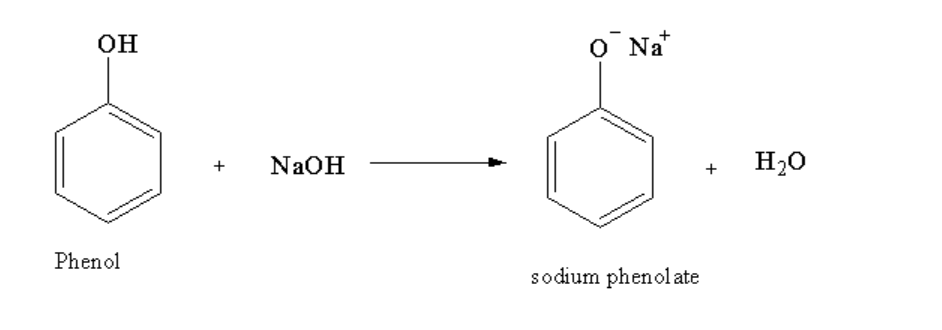
Image: Formation of sodium phenolate
Step 2: In the second step, the phenoxide ion attack the carbon of carbon tetrachloride is form a complex.
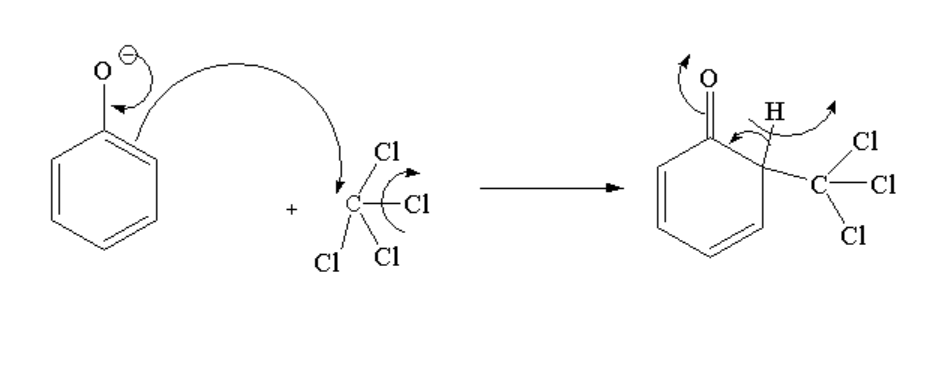
Image: Reaction of phenoxide ion and carbon tetrachloride
Step 3: In the third step the complex reacts with sodium hydroxide. Here, a nucleophilic substitution reaction takes place. First, the halide group (leaving group) is detached from the carbon and then the hydroxide ion (nucleophile) attacks the carbon to form an unstable complex.
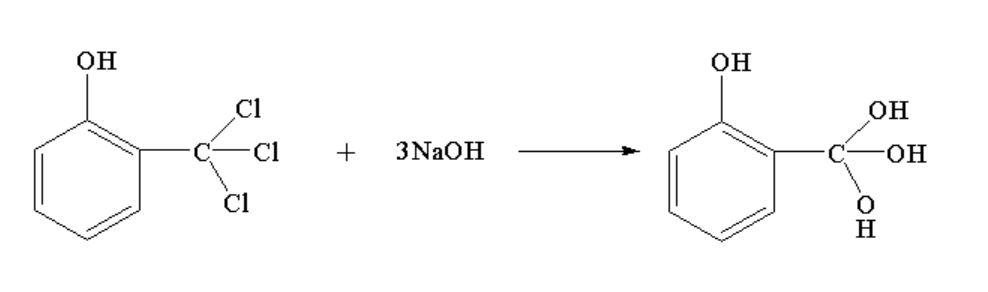
Image: Formation of unstable complex
Step 4: In the fourth step, the water molecule is removed to form a stable compound with a carboxylic group forming a benzoic acid and hydroxy group at the ortho position. The compound name of o-hydroxy benzoic acid.
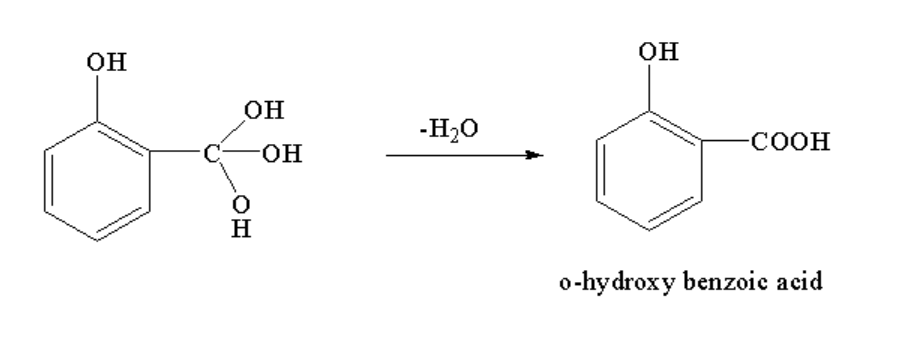
Image: Formation of o-hydroxy benzoic acid
Therefore, the correct option is B.
Note: In the given reaction, NaOH should be taken in excess amount because phenoxide ion is formed first. The nucleophilic substitution involved is SN1 which takes place in two-step and the reaction rate depends on one reactant.
Complete Step by Step Solution:
The reaction between phenol and carbon tetrachloride in presence of sodium hydroxide takes place in four steps.
Step 1: In the first step the lone pair of hydroxide ions of sodium hydroxide abstract the proton of phenol to form phenoxide ion and water.
Image: Formation of sodium phenolate
Step 2: In the second step, the phenoxide ion attack the carbon of carbon tetrachloride is form a complex.
Image: Reaction of phenoxide ion and carbon tetrachloride
Step 3: In the third step the complex reacts with sodium hydroxide. Here, a nucleophilic substitution reaction takes place. First, the halide group (leaving group) is detached from the carbon and then the hydroxide ion (nucleophile) attacks the carbon to form an unstable complex.
Image: Formation of unstable complex
Step 4: In the fourth step, the water molecule is removed to form a stable compound with a carboxylic group forming a benzoic acid and hydroxy group at the ortho position. The compound name of o-hydroxy benzoic acid.
Image: Formation of o-hydroxy benzoic acid
Therefore, the correct option is B.
Note: In the given reaction, NaOH should be taken in excess amount because phenoxide ion is formed first. The nucleophilic substitution involved is SN1 which takes place in two-step and the reaction rate depends on one reactant.
Recently Updated Pages
Disproportionation Reaction: Definition, Example & JEE Guide

Hess Law of Constant Heat Summation: Definition, Formula & Applications
JEE General Topics in Chemistry Important Concepts and Tips
JEE Extractive Metallurgy Important Concepts and Tips for Exam Preparation
JEE Atomic Structure and Chemical Bonding important Concepts and Tips
JEE Amino Acids and Peptides Important Concepts and Tips for Exam Preparation
Trending doubts
JEE Main 2026: Exam Dates, Session 2 Updates, City Slip, Admit Card & Latest News
JEE Main Participating Colleges 2026 - A Complete List of Top Colleges
Understanding the Electric Field of a Uniformly Charged Ring
Derivation of Equation of Trajectory Explained for Students
Understanding Atomic Structure for Beginners
JEE Main Marking Scheme 2026- Paper-Wise Marks Distribution and Negative Marking Details
Other Pages
JEE Advanced 2026 Notification Out with Exam Date, Registration (Extended), Syllabus and More
JEE Advanced Percentile vs Marks 2026: JEE Main Cutoff, AIR & IIT Admission Guide
JEE Advanced 2026 Marks vs Rank: Estimate IIT Rank from Your Score
JEE Advanced Weightage Chapter Wise 2026 for Physics, Chemistry, and Mathematics
Understanding the Different Types of Solutions in Chemistry
NCERT Solutions For Class 11 Chemistry In Hindi Chapter 1 Some Basic Concepts Of Chemistry - 2025-26