




pH of tomato juice is 4, that means is:
(A) Basic
(B) Acidic
(C) Neutral
(D) None of these
Answer
 Verified
266.4k+ views
Hint: When there are more hydronium ions present in the solution than hydroxyl ions, the solution is said to be acidic. When there are more hydroxyl ions present in the solution than hydronium ions, then the solution is called a basic solution.
Step by step answer:
- Tomato contains more than more than 10 different types of acids. But out of them, tomatoes have two acids that occur in tomatoes at a very large percentage. These acids are citric acid and malic acid. Tomatoes also contain another essential acid like ascorbic acid, which is better known by its common name vitamin C. Structure of Citric acid and Malic acid is shown below.
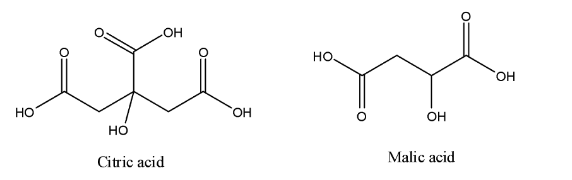
Citric Acid: The most abundant acid that is present in tomatoes is citric acid. Citric acid is slightly less acidic than vinegar.
Malic Acid: The amount of malic acid in a tomato juice is half that of citric acid. We use malic acid in energy production, where it's needed to complete a step in the chain reaction. We should understand that malic acid may help prevent calcium oxalate kidney stones.
- So, we are given that pH of the tomato juice is 4. Now, we know that there is a presence of various types of acid in this juice. So, we can say that the juice will be acidic in nature.
- In addition to that, we can also say that when the pH of any solution is between zero to 7 the solution is said to be an acidic solution. When the pH of the solution increases more than 7, then the solution is termed as a basic solution.
From the above discussion, we can say that tomato juice is acidic.
So, the correct answer is (B) acidic.
Note: Do not get confused between pH and pOH of the solution. Remember that when pH of the solution is between zero to 7, the solution is said to be acidic. When pOH of the solution is between 7 to 14, then the solution is said to be acidic.
Step by step answer:
- Tomato contains more than more than 10 different types of acids. But out of them, tomatoes have two acids that occur in tomatoes at a very large percentage. These acids are citric acid and malic acid. Tomatoes also contain another essential acid like ascorbic acid, which is better known by its common name vitamin C. Structure of Citric acid and Malic acid is shown below.
Citric Acid: The most abundant acid that is present in tomatoes is citric acid. Citric acid is slightly less acidic than vinegar.
Malic Acid: The amount of malic acid in a tomato juice is half that of citric acid. We use malic acid in energy production, where it's needed to complete a step in the chain reaction. We should understand that malic acid may help prevent calcium oxalate kidney stones.
- So, we are given that pH of the tomato juice is 4. Now, we know that there is a presence of various types of acid in this juice. So, we can say that the juice will be acidic in nature.
- In addition to that, we can also say that when the pH of any solution is between zero to 7 the solution is said to be an acidic solution. When the pH of the solution increases more than 7, then the solution is termed as a basic solution.
From the above discussion, we can say that tomato juice is acidic.
So, the correct answer is (B) acidic.
Note: Do not get confused between pH and pOH of the solution. Remember that when pH of the solution is between zero to 7, the solution is said to be acidic. When pOH of the solution is between 7 to 14, then the solution is said to be acidic.
Recently Updated Pages
States of Matter Chapter For JEE Main Chemistry

Types of Solutions in Chemistry: Explained Simply
Difference Between Crystalline and Amorphous Solid: Table & Examples
Know The Difference Between Fluid And Liquid
[Awaiting the three content sources: Ask AI Response, Competitor 1 Content, and Competitor 2 Content. Please provide those to continue with the analysis and optimization.]
Sign up for JEE Main 2026 Live Classes - Vedantu
Trending doubts
JEE Main 2026: Exam Dates, Session 2 Updates, City Slip, Admit Card & Latest News
JEE Main Participating Colleges 2026 - A Complete List of Top Colleges
Hybridisation in Chemistry – Concept, Types & Applications
Understanding the Electric Field of a Uniformly Charged Ring
Derivation of Equation of Trajectory Explained for Students
Understanding Atomic Structure for Beginners
Other Pages
JEE Advanced 2026 Notification Out with Exam Date, Registration (Extended), Syllabus and More
JEE Advanced Percentile vs Marks 2026: JEE Main Cutoff, AIR & IIT Admission Guide
JEE Advanced 2026 Marks vs Rank: Estimate IIT Rank from Your Score
JEE Advanced Weightage Chapter Wise 2026 for Physics, Chemistry, and Mathematics
NCERT Solutions For Class 11 Chemistry In Hindi Chapter 1 Some Basic Concepts Of Chemistry - 2025-26
How to Convert a Galvanometer into an Ammeter or Voltmeter