









How Do Pulley Systems Affect Motion and Constraints?
A pulley imposes a mechanical constraint on the connected bodies, mathematically relating their displacements, velocities, and accelerations through the inextensibility of the string and the characteristics of the pulley system.
Formal Constraint Equation in Ideal Pulley Systems
In any ideal pulley configuration, the total length of the inextensible string remains constant. For two bodies $A$ and $B$ attached by a light, inextensible string over a frictionless, massless pulley, let $x_A$ and $x_B$ denote their respective positions relative to a fixed reference. The constraint is expressed as
$x_A + x_B = \text{constant}$
Differentiating with respect to time yields the velocity constraint:
$v_A + v_B = 0$
A further differentiation gives the acceleration relation:
$a_A + a_B = 0$
This formalizes the fundamental link between linear kinematics of the connected bodies in simple pulley systems.
Mathematical Formulation of Pulley Constraint Relations
For a system involving multiple pulleys and strings, the general constraint is obtained by accounting for all movable blocks and fixed supports. For a massless, frictionless pulley, let $l$ be the total length of the string, which remains unchanged:
$l = f(x_1, x_2, ..., x_n)$
where $x_i$ are positions of the masses and pulleys. Each segment is measured from a fixed support to a block or pulley as appropriate. This leads to a linear relation among displacements, and hence among velocities and accelerations.
Tension Distribution in Massless Pulley Arrangements
In an ideal (massless, frictionless) pulley, the tension is the same throughout a continuous segment of the string. At a massless movable pulley supporting two symmetrical segments with tension $T$, the upward force is $2T$. If the supported mass is $m$, then at equilibrium:
$2T = m g$
Thus, the tension in each segment is $T = \frac{m g}{2}$. This result is central to analyzing Atwood's machine and other compound pulley systems.
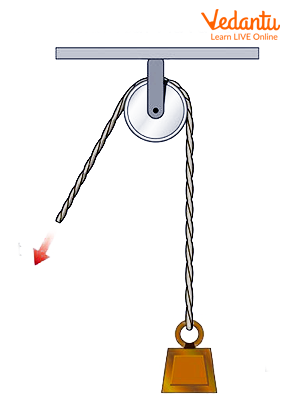
For further exploration, see Pulley And Constraint Relations.
General Expression for Power Delivered by Tension Forces
The mechanical constraint implies that the vector sum of the power delivered by all string tensions is zero for an ideal system:
$\sum_i \vec{T}_i \cdot \vec{v}_i = 0$
On differentiating, the analogous result for accelerations is:
$\sum_i \vec{T}_i \cdot \vec{a}_i = 0$
These relations are universal for all configurations of ideal pulleys and strings.
Constraint Analysis in Compound Pulley Systems
For systems involving movable pulleys, write the string-length constraint by examining the dependence of each string segment on the relevant blocks and pulleys. For example, if mass $A$ is suspended from a movable pulley and the ends of the string are attached to fixed supports, the total length equation is
$2 x_A + x_B = \text{constant}$
Here, $x_A$ is the displacement of the movable pulley (and attached body) and $x_B$ is the displacement of a second mass at the free end. Differentiation gives the velocity and acceleration relations:
$2 v_A + v_B = 0$
$2 a_A + a_B = 0$
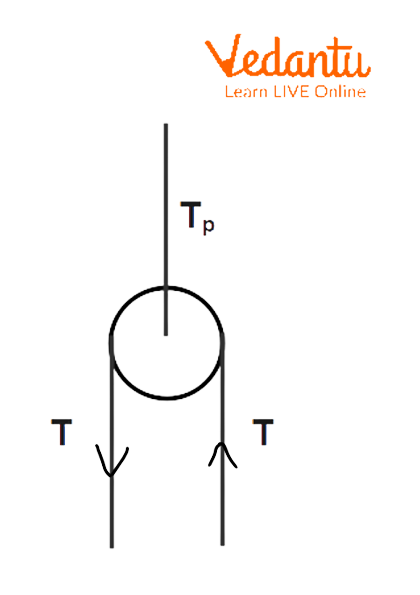
Solved Problem: Acceleration and Tension in Two-Block Pulley System
Example. Consider two masses $m_1 = 7\,\mathrm{kg}$ and $m_2 = 9\,\mathrm{kg}$ suspended from either side of a light, frictionless pulley. Find the acceleration of the blocks and the tension in the string.
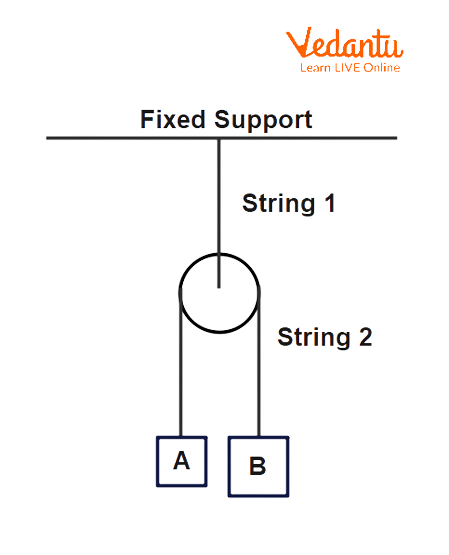
Solution.
Let $T$ be the tension, $a$ the magnitude of acceleration (down for $m_2$, up for $m_1$ by the constraint $a_1 + a_2 = 0$). Apply Newton’s second law to each block:
$T - m_1 g = m_1 a$
$m_2 g - T = m_2 a$
Add the equations:
$m_2 g - m_1 g = (m_1 + m_2)a$
Substitute $m_1 = 7$ kg, $m_2 = 9$ kg, $g = 10$ m/s$^2$ for calculation:
$a = \dfrac{(9 - 7)\times 10}{7 + 9} = \dfrac{20}{16} = 1.25\,\mathrm{m/s^2}$
Now, $T = m_1 g + m_1 a = 7 \times 10 + 7 \times 1.25 = 70 + 8.75 = 78.75\,\mathrm{N}$.
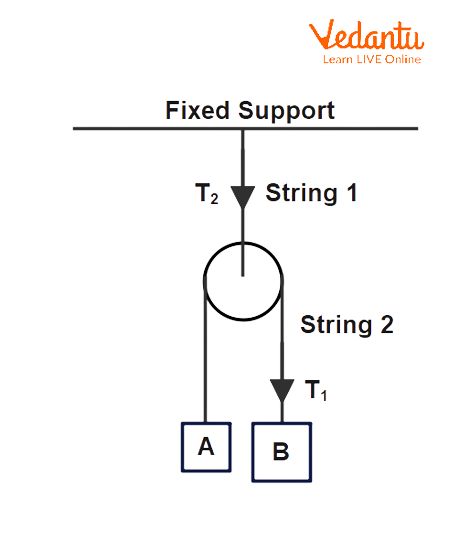
A comprehensive study of pulleys also covers tension computation, frictional corrections, and energy methods—refer to Forces On Pulleys 404 for advanced cases.
Common Pulley Systems in JEE Main Problems
- Simple Atwood machine
- Movable pulley doubling tension
- Multiple connected pulleys
- Two blocks with single/multiple pulleys
- Pulleys with fixed and movable supports
- Inclined plane systems with pulleys
Constraint Misconceptions and Exam Cautions
A frequent error is to overlook the impact of movable pulleys on the kinematic constraints. Always identify whether a pulley is fixed or movable, and count each segment of string separately when writing the constraint equation.
Compound systems may require the application of multiple constraints simultaneously. Draw all free-body diagrams carefully and label tensions and accelerations with consistent signs.


FAQs on Understanding Pulley and Constraint Relations in Physics
1. What is a pulley and how does it work?
Pulley is a simple machine that helps change the direction of applied force and makes lifting heavier objects easier.
- A pulley consists of a wheel with a groove and a rope passing through it.
- It can be fixed or movable depending on its application.
- Pulleys work on the principle of mechanical advantage, reducing the effort needed to lift heavy loads by distributing weight.
2. What is the constraint relation in a pulley system?
Constraint relation in a pulley system expresses the relationship between movements of different parts of the system.
- It shows how the displacement of one mass is linked to the displacement of other masses via the connecting rope.
- For a single movable pulley, if mass A moves up by x meters, mass B moves down by x meters (in opposite directions).
- The equation expresses this as xA + xB = constant length of rope.
3. How do you calculate acceleration in a two-pulley system?
Acceleration in a two-pulley system can be determined using Newton's laws and the constraint relation.
- Apply F = ma for each mass.
- Write tension equations for all ropes.
- Use the constraint relation to link accelerations (e.g., if one mass goes up, the other comes down at the same rate).
- Solve the equations simultaneously for acceleration.
4. What assumptions are made in ideal pulley problems?
Ideal pulley problems are based on key simplifying assumptions:
- The pulley and ropes are massless.
- No friction exists between the rope and pulley.
- The rope is inextensible (does not stretch).
- All forces act vertically unless specified.
5. What is mechanical advantage in a pulley system?
Mechanical advantage is the factor by which a machine multiplies the input force.
- It is calculated as: Mechanical Advantage = Load / Effort.
- For a single movable pulley, mechanical advantage is 2.
- Pulley systems allow lifting heavier loads with less effort.
6. What are the types of pulleys?
Pulleys are classified based on their structure and application:
- Fixed Pulley: Changes direction of force only.
- Movable Pulley: Moves with load, reduces effort needed.
- Compound Pulley (Block and Tackle): Combination of fixed and movable pulleys, gives greater mechanical advantage.
7. How does the direction of force change in a fixed pulley?
Fixed pulleys change only the direction of the applied force, not its magnitude.
- Pulling down on the rope lifts the load up.
- It makes it easier to use your own weight to lift loads.
8. State an example of a constraint relation in a two-mass pulley system.
A common constraint relation in a two-mass pulley system is:
- If mass m1 moves up by x meters, then mass m2 moves down by x meters.
- The sum of their displacements remains constant: x1 + x2 = constant.
9. Why is the rope considered inextensible in pulley problems?
The rope is considered inextensible so that its length does not change as masses move.
- This ensures that any displacement at one end is matched by a related displacement at the other end.
- It simplifies calculations and defines the constraint relation between connected objects.
10. What is the acceleration of a system if both masses are equal in a pulley arrangement?
If both masses are equal in a pulley system, the net acceleration will be zero.
- Both masses balance each other, so the system remains in equilibrium.
- No net force acts to accelerate the system in any direction.
11. What is the function of a compound pulley?
A compound pulley combines several pulleys to increase mechanical advantage.
- It allows you to lift heavy objects with much less effort.
- Commonly used in hoisting machinery, cranes, and block-and-tackle systems.
12. What is the formula for tension in an ideal single pulley system?
In an ideal single pulley system with two masses m1 and m2, the tension (T) can be calculated as:
- T = 2*m1*m2g / (m1 + m2), where g is acceleration due to gravity.
- This formula is derived using Newton's second law and the constraint relation.
