




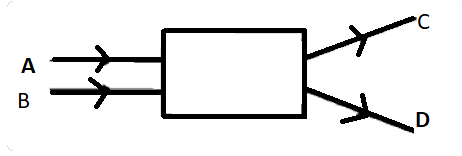
Light rays A and B fall on an optical component and come out as C and D. The optical component is a:
A) Prism
B) Concave Lens
C) Concave Mirror
D) Convex Lens
Answer
 Verified
274.8k+ views
Hint: Here, in the diagram the two rays are diverging after going through the optical components. The diverging or converging of light rays depends on the angle of incidence of the light rays on to the lens or mirror and the type of lens and mirror is used.
Complete solution:
Here we need to evaluate each option carefully. Prism is a glass object which disperses and refracts light but it disperses light at a particular direction. In the given diagram the light is getting dispersed in two different directions. Concave mirror, whether concave or convex it reflects light and the image formed is behind the mirror so, as per the given diagram concave mirror is ruled out. Convex lens as the name indicates is converging in nature that means if any two parallel incident rays pass through the convex lens then the two rays will cross each other and here there is no such thing happening. Concave lens on the other hand is diverging in nature and if two parallel rays pass through the concave lens the lens will disperse the two rays in two different directions.
Option (B) is correct. Therefore, the optical component is a concave lens.
Note: Here, we need to see the nature of each lens or mirror and describe their function as to whether they diverge or converge the light rays passing through it. Mention the role of each lens and find out the lens or mirror that the diagram depicts.
Complete solution:
Here we need to evaluate each option carefully. Prism is a glass object which disperses and refracts light but it disperses light at a particular direction. In the given diagram the light is getting dispersed in two different directions. Concave mirror, whether concave or convex it reflects light and the image formed is behind the mirror so, as per the given diagram concave mirror is ruled out. Convex lens as the name indicates is converging in nature that means if any two parallel incident rays pass through the convex lens then the two rays will cross each other and here there is no such thing happening. Concave lens on the other hand is diverging in nature and if two parallel rays pass through the concave lens the lens will disperse the two rays in two different directions.
Option (B) is correct. Therefore, the optical component is a concave lens.
Note: Here, we need to see the nature of each lens or mirror and describe their function as to whether they diverge or converge the light rays passing through it. Mention the role of each lens and find out the lens or mirror that the diagram depicts.
Recently Updated Pages
Wheatstone Bridge – Principle, Formula, Diagram & Applications

Mass vs Weight: Key Differences Explained for Students
Circuit Switching vs Packet Switching: Key Differences Explained
Uniform Acceleration Explained: Formula, Examples & Graphs
Young’s Double Slit Experiment Derivation Explained
Classification of Drugs in Chemistry: Types, Examples & Exam Guide
Trending doubts
JEE Main 2026: Exam Dates, Session 2 Updates, City Slip, Admit Card & Latest News
Understanding the Electric Field of a Uniformly Charged Ring
Understanding Atomic Structure for Beginners
Derivation of Equation of Trajectory Explained for Students
Electron Gain Enthalpy and Electron Affinity Explained
How to Convert a Galvanometer into an Ammeter or Voltmeter
Other Pages
CBSE Class 12 Physics Question Paper 2026: Download SET-wise PDF with Answer Key & Analysis
JEE Advanced 2026 Notification Out with Exam Date, Registration (Extended), Syllabus and More
JEE Advanced Percentile vs Marks 2026: JEE Main Cutoff, AIR & IIT Admission Guide
JEE Advanced Weightage Chapter Wise 2026 for Physics, Chemistry, and Mathematics
Understanding Electromagnetic Waves and Their Importance
Understanding Combined Translation and Rotational Motion