




Is it possible that any battery has some constant value of e.m.f. but the potential between the plates is zero?
(A) No
(B) Yes, if another identical battery is joined in series
(C) Yes, if another identical battery is joined in opposition in series
(D) Yes, if another similar battery is joined in parallel
Answer
 Verified
300.9k+ views
Hint: The potential difference between the plates of the battery is nothing but the voltage drop across the terminals of the battery. For this question, a combination of batteries is required which makes the voltage drop zero while not affecting the electromotive force (e.m.f.)
Complete step by step solution:
The e.m.f. of a battery is the potential difference between the terminals of a battery when there is no flow of current. As such both plates can never be at the same potential unless the potential is zero and the battery dries up completely. So, to achieve this, we need to combine more than one battery into some kind of a formation.
Batteries are combined for two purposes, either to increase their voltage output or to increase their current output. This combination typically has two modes. The batteries can either be connected in series or in parallel.
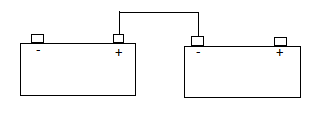
Series combination, as depicted in the image above, has only one use which is to increase the voltage output of the combination. Using this method, the overall voltage of the system is enhanced and as such, the potential difference between the plates does not become zero, rather it increases. Thus, option B is incorrect
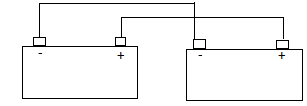
Parallel combination, as depicted in the image above, also has one only use which is to increase the current output of the combination. Using this method, the overall voltage of the system remains same and as such, the potential difference between the plates of each battery in the combination also remains same, not becoming zero. As such option D is also incorrect.
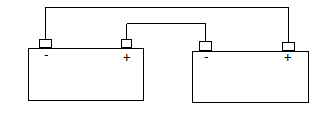
Outside of the conventional methods is a method of connecting batteries which is rather explosive. This is to first connect the batteries in series and then make a reverse feedback loop which connects the batteries in the opposite direction. This method is said to be explosive, not because of its ingenuity, but because it literally causes the batteries to explode. This happens because the potential in both the loops, forward and reverse (loop 1 and 2 respectively) is the same, making the potential difference at the plates of the batteries zero but the e.m.f. still remains which starts heating up the battery and if the connection is not broken in time, the batteries will surely explode. As such option C is the correct choice.
Note:
When the positive and negative terminals in the wiring of your house touch, it causes a short circuit. It happens due to this phenomenon only. The incoming current acts as a huge battery and the connection of its ends causes the battery to react violently and the short circuit devices in your houses are installed to sever the connection in such cases.
Also please don’t try this at home because it can be dangerous when using heavy power batteries.
Complete step by step solution:
The e.m.f. of a battery is the potential difference between the terminals of a battery when there is no flow of current. As such both plates can never be at the same potential unless the potential is zero and the battery dries up completely. So, to achieve this, we need to combine more than one battery into some kind of a formation.
Batteries are combined for two purposes, either to increase their voltage output or to increase their current output. This combination typically has two modes. The batteries can either be connected in series or in parallel.
Series combination, as depicted in the image above, has only one use which is to increase the voltage output of the combination. Using this method, the overall voltage of the system is enhanced and as such, the potential difference between the plates does not become zero, rather it increases. Thus, option B is incorrect
Parallel combination, as depicted in the image above, also has one only use which is to increase the current output of the combination. Using this method, the overall voltage of the system remains same and as such, the potential difference between the plates of each battery in the combination also remains same, not becoming zero. As such option D is also incorrect.
Outside of the conventional methods is a method of connecting batteries which is rather explosive. This is to first connect the batteries in series and then make a reverse feedback loop which connects the batteries in the opposite direction. This method is said to be explosive, not because of its ingenuity, but because it literally causes the batteries to explode. This happens because the potential in both the loops, forward and reverse (loop 1 and 2 respectively) is the same, making the potential difference at the plates of the batteries zero but the e.m.f. still remains which starts heating up the battery and if the connection is not broken in time, the batteries will surely explode. As such option C is the correct choice.
Note:
When the positive and negative terminals in the wiring of your house touch, it causes a short circuit. It happens due to this phenomenon only. The incoming current acts as a huge battery and the connection of its ends causes the battery to react violently and the short circuit devices in your houses are installed to sever the connection in such cases.
Also please don’t try this at home because it can be dangerous when using heavy power batteries.
Recently Updated Pages
If the magnetizing field on a ferromagnetic material class 12 physics JEE_Main

A point charge is placed at the corner of a cube The class 12 physics JEE_Main
What changes occur if the monochromatic light used class 12 physics JEE_Main
The unit of specific conductance is A Ohm B Ohmmetre class 12 physics JEE_Main
Which lens is used in magnifying glass A Concave lens class 12 physics JEE_Main
Sir C V Raman won the Nobel Prize in which year A 1928 class 12 physics JEE_Main
Trending doubts
JEE Main 2026: Exam Dates, Session 2 Updates, City Slip, Admit Card & Latest News
Understanding the Electric Field of a Uniformly Charged Ring
Electron Gain Enthalpy and Electron Affinity Explained
Derivation of Equation of Trajectory Explained for Students
Understanding Atomic Structure for Beginners
Understanding Uniform Acceleration in Physics
Other Pages
CBSE Class 12 Physics Question Paper 2026: Download SET-wise PDF with Answer Key & Analysis
JEE Advanced Percentile vs Marks 2026: JEE Main Cutoff, AIR & IIT Admission Guide
How to Convert a Galvanometer into an Ammeter or Voltmeter
Hybridisation in Chemistry – Concept, Types & Applications
What Are Elastic Collisions in One Dimension?
Effective Nuclear Charge for JEE