




In electro-refining of copper, some gold is deposited as:
(A) Cathode mud
(B) Electrolyte
(C) Anode mud
(D) None of these
Answer
 Verified
273.6k+ views
Hint: The Refining itself means to remove impurities or undesirable substances from a substance. So, electro-refining is a process to remove impurities using electricity. Basically, it's a process of refining in metals using electrolysis.
Complete step by step answer:
Here we will take an example of electrolytic copper refining to understand the process more clearly. Copper is typically mined from its coal referred to as copper. It is about 98 to 99 percent pure. However, the electro-refining process can easily make it 99.95% pure which makes it a good product to be used in electrical components.
A block of impure copper is taken as an anode or positive electrode. Copper sulphate which is acidified with vitriol is employed as a graphite-coated electrolyte alongside pure copper tubes, as a cathode or negative electrode. In this phase of electrolysis copper sulphate divides into a positive ion of copper ($C{{u}^{2+}}$) and a negative ion of sulphate ($S{{O}_{4}}^{-}$). The positive copper ion ($C{{u}^{2+}}$) or cations travel towards the negative electrode made from pure copper where it absorbs the electrons from the cathode. Cu atoms are deposited on the cathode’s graphite layer.
The cathode is coated with graphite in the process of electrolytic metal processing or merely electro grinding so that the concentrated material can be easily removed. This is one of the most growing electrolysis procedures.
Electrolytic Refining of Copper
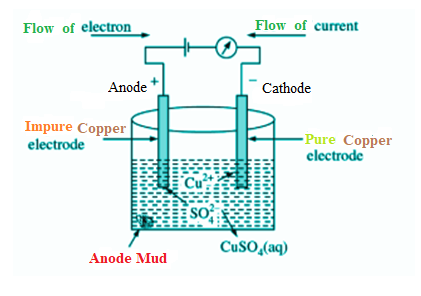
However, anode’s metallic impurities are also mixed with $S{{O}_{4}}$, forming metallic sulphate in the electrolyte solution and dissolving. In this above process, some impurities get dissolved in the solution while some deposits as anode mud below the anode electrode. Impurities which dissolve within the solution are Fe, Ni, Zn while impurities like Au, Ag and Pt deposits as anode mud below the anode electrode.
So, we can say that gold (Au) is deposited as Anode mud below the anode electrode.
Therefore, among the options if we check then option (C)Anode mud is the correct answer of the question.
Note:
- ${{H}^{+}}$from the electrolyte isn't reduced to ${{H}_{2}}$ (g) at the cathode.
-$C{{u}^{2+}}$lies below ${{H}^{+}}$within the table of ordinary reduction potentials.
-$C{{u}^{2+}}$is a stronger oxidant than ${{H}^{+}}$.
-$C{{u}^{2+}}$is more easily reduced than ${{H}^{+}}$.
-Keep in mind the impurities like Fe, Ni, Zn get dissolved within the solution but impurities like Au, Ag and Pt are deposited as anode mud below the anode.
Complete step by step answer:
Here we will take an example of electrolytic copper refining to understand the process more clearly. Copper is typically mined from its coal referred to as copper. It is about 98 to 99 percent pure. However, the electro-refining process can easily make it 99.95% pure which makes it a good product to be used in electrical components.
A block of impure copper is taken as an anode or positive electrode. Copper sulphate which is acidified with vitriol is employed as a graphite-coated electrolyte alongside pure copper tubes, as a cathode or negative electrode. In this phase of electrolysis copper sulphate divides into a positive ion of copper ($C{{u}^{2+}}$) and a negative ion of sulphate ($S{{O}_{4}}^{-}$). The positive copper ion ($C{{u}^{2+}}$) or cations travel towards the negative electrode made from pure copper where it absorbs the electrons from the cathode. Cu atoms are deposited on the cathode’s graphite layer.
The cathode is coated with graphite in the process of electrolytic metal processing or merely electro grinding so that the concentrated material can be easily removed. This is one of the most growing electrolysis procedures.
Electrolytic Refining of Copper
However, anode’s metallic impurities are also mixed with $S{{O}_{4}}$, forming metallic sulphate in the electrolyte solution and dissolving. In this above process, some impurities get dissolved in the solution while some deposits as anode mud below the anode electrode. Impurities which dissolve within the solution are Fe, Ni, Zn while impurities like Au, Ag and Pt deposits as anode mud below the anode electrode.
So, we can say that gold (Au) is deposited as Anode mud below the anode electrode.
Therefore, among the options if we check then option (C)Anode mud is the correct answer of the question.
Note:
- ${{H}^{+}}$from the electrolyte isn't reduced to ${{H}_{2}}$ (g) at the cathode.
-$C{{u}^{2+}}$lies below ${{H}^{+}}$within the table of ordinary reduction potentials.
-$C{{u}^{2+}}$is a stronger oxidant than ${{H}^{+}}$.
-$C{{u}^{2+}}$is more easily reduced than ${{H}^{+}}$.
-Keep in mind the impurities like Fe, Ni, Zn get dissolved within the solution but impurities like Au, Ag and Pt are deposited as anode mud below the anode.
Recently Updated Pages
WBJEE 2026 Result Live: Important Dates, Last Date Apply Online 2026

JoSAA Counselling 2026: JoSAA 2026 Mock Seat Allotment LIVE: Round 2 Result Released, Registration, Choice Filling and Ranks
Disproportionation Reaction: Definition, Example & JEE Guide
Hess Law of Constant Heat Summation: Definition, Formula & Applications
JEE General Topics in Chemistry Important Concepts and Tips
JEE Extractive Metallurgy Important Concepts and Tips for Exam Preparation
Trending doubts
JEE Main 2026: Exam Dates, Session 2 Updates, City Slip, Admit Card & Latest News
JEE Main Participating Colleges 2026 - A Complete List of Top Colleges
Understanding the Electric Field of a Uniformly Charged Ring
Understanding Atomic Structure for Beginners
Derivation of Equation of Trajectory Explained for Students
Understanding the Different Types of Solutions in Chemistry
Other Pages
JEE Advanced 2026 Notification Out with Exam Date, Registration (Extended), Syllabus and More
JEE Advanced Percentile vs Marks 2026: JEE Main Cutoff, AIR & IIT Admission Guide
JEE Advanced Weightage Chapter Wise 2026 for Physics, Chemistry, and Mathematics
NCERT Solutions For Class 11 Chemistry In Hindi Chapter 1 Some Basic Concepts Of Chemistry - 2025-26
How to Convert a Galvanometer into an Ammeter or Voltmeter
Electron Gain Enthalpy and Electron Affinity Explained