




In a potentiometer a standard cell of EMF 5V and of negligible resistance maintains a steady current through the potentiometer wire of length 5 meter. Two primary cells of emf ${E_1}$ and ${E_2}$, are joined in series. (i) same polarity, (ii) opposite polarity. The configuration is connected to a galvanometer and a jockey to the potentiometer. The balancing lengths in the two cases are found to be 350 cm and 5 cm respectively.
A) Draw the necessary circuit diagram.
B) Find the value of the emf’s of the two cells,
Answer
 Verified
300.9k+ views
Hint: In a potentiometer the jockey is used to slide over the wire to find the balancing length. The polarity is different in the two cases.
Complete step by step solution:
Here the first step is to understand the questions and the conditions given.
There is wire AB of length 5 meter. It is connected to a 5 volt cell. So let us start drawing the circuit.
The first part of the circuit:
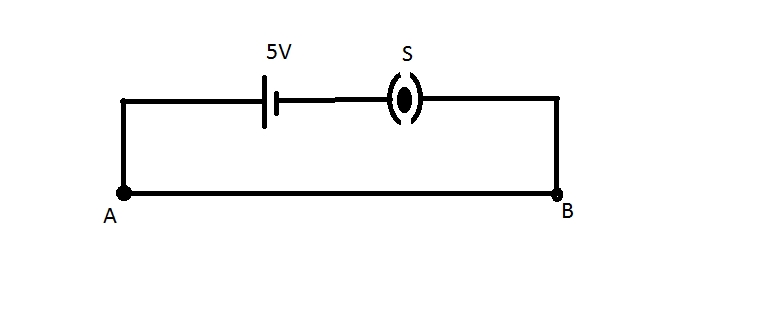
The above diagram is the first part of the circuit.
Now for the second part the two cells are connected in series. So for the next part we are going to add them to the first part directly without drawing it separately.
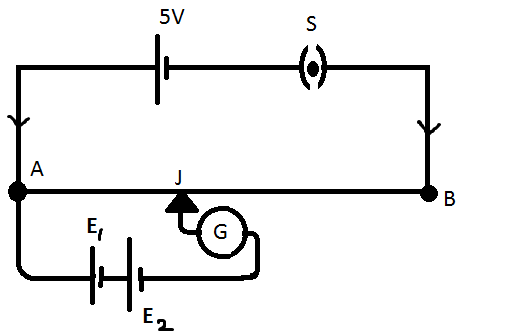
The above diagram shows the final circuit for the given condition.
Now for the second part of the question;
The potential gradient is to be calculated.
Hence if emf is 5 volts and length is 5 meters the potential gradient of AB is given by;
$k = \dfrac{V}{{{l_{cm}}}}$ here V is potential difference across the length and ${l_{cm}}$ is the length of AB in centimeter
So $k = \dfrac{{5V}}{{500cm}} = \dfrac{{1}}{{100}}$
Now case 1: the cells have same polarity-
Thus ${E_1} + {E_2} = kl$, here, l is the balancing length for the same polarity, so, l= 350cm.
Hence, ${E_1} + {E_2} = \dfrac{1}{{100}} \times 350 = 3.5$ (equation: 1)
Now for Case 2: the polarities of the cell are opposite-
Hence, ${E_1} - {E_2} = kl'$ here $l'$ is the balancing length for opposite polarity, so $l' = 5cm$.]
Thus, ${E_1} - {E_2} = \dfrac{1}{{100}} \times 5 = 0.05$ (equation: 2)
Now we solve the equations 1 and 2;
First adding equation 2 to equation 1, we get;
$2{E_1} = 3.55$
Thus, ${E_1} = \dfrac{{3.55}}{2} = 1.78V$
Now substituting the value of ${E_1}$ in equation 1 we get;
$1.78 + {E_2} = 3.5$
Hence, ${E_2} = 3.5 - 1.78 = 1.72V$
Therefore, the emf’s are 1.78 and 1.72 volts respectively.
Note: The polarity is a very important character. It should be carefully considered.
Whenever a question of a potentiometer like this comes, the first step should be to draw the diagram for better understanding of the conditions and the second step should be finding the potential gradient.
Complete step by step solution:
Here the first step is to understand the questions and the conditions given.
There is wire AB of length 5 meter. It is connected to a 5 volt cell. So let us start drawing the circuit.
The first part of the circuit:
The above diagram is the first part of the circuit.
Now for the second part the two cells are connected in series. So for the next part we are going to add them to the first part directly without drawing it separately.
The above diagram shows the final circuit for the given condition.
Now for the second part of the question;
The potential gradient is to be calculated.
Hence if emf is 5 volts and length is 5 meters the potential gradient of AB is given by;
$k = \dfrac{V}{{{l_{cm}}}}$ here V is potential difference across the length and ${l_{cm}}$ is the length of AB in centimeter
So $k = \dfrac{{5V}}{{500cm}} = \dfrac{{1}}{{100}}$
Now case 1: the cells have same polarity-
Thus ${E_1} + {E_2} = kl$, here, l is the balancing length for the same polarity, so, l= 350cm.
Hence, ${E_1} + {E_2} = \dfrac{1}{{100}} \times 350 = 3.5$ (equation: 1)
Now for Case 2: the polarities of the cell are opposite-
Hence, ${E_1} - {E_2} = kl'$ here $l'$ is the balancing length for opposite polarity, so $l' = 5cm$.]
Thus, ${E_1} - {E_2} = \dfrac{1}{{100}} \times 5 = 0.05$ (equation: 2)
Now we solve the equations 1 and 2;
First adding equation 2 to equation 1, we get;
$2{E_1} = 3.55$
Thus, ${E_1} = \dfrac{{3.55}}{2} = 1.78V$
Now substituting the value of ${E_1}$ in equation 1 we get;
$1.78 + {E_2} = 3.5$
Hence, ${E_2} = 3.5 - 1.78 = 1.72V$
Therefore, the emf’s are 1.78 and 1.72 volts respectively.
Note: The polarity is a very important character. It should be carefully considered.
Whenever a question of a potentiometer like this comes, the first step should be to draw the diagram for better understanding of the conditions and the second step should be finding the potential gradient.
Recently Updated Pages
If the magnetizing field on a ferromagnetic material class 12 physics JEE_Main

A point charge is placed at the corner of a cube The class 12 physics JEE_Main
What changes occur if the monochromatic light used class 12 physics JEE_Main
The unit of specific conductance is A Ohm B Ohmmetre class 12 physics JEE_Main
Which lens is used in magnifying glass A Concave lens class 12 physics JEE_Main
Sir C V Raman won the Nobel Prize in which year A 1928 class 12 physics JEE_Main
Trending doubts
JEE Main 2026: Exam Dates, Session 2 Updates, City Slip, Admit Card & Latest News
Understanding the Electric Field of a Uniformly Charged Ring
Electron Gain Enthalpy and Electron Affinity Explained
Derivation of Equation of Trajectory Explained for Students
Understanding Atomic Structure for Beginners
How to Convert a Galvanometer into an Ammeter or Voltmeter
Other Pages
CBSE Class 12 Physics Question Paper 2026: Download SET-wise PDF with Answer Key & Analysis
JEE Advanced Percentile vs Marks 2026: JEE Main Cutoff, AIR & IIT Admission Guide
Understanding Uniform Acceleration in Physics
Hybridisation in Chemistry – Concept, Types & Applications
Effective Nuclear Charge for JEE
Understanding Elastic Collisions in Two Dimensions