




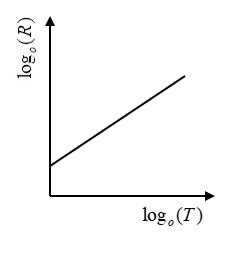
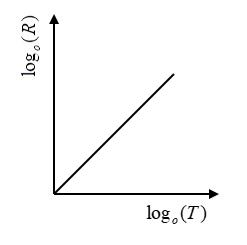
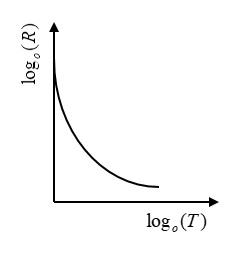
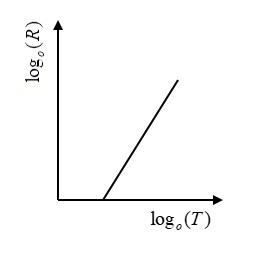
If an object at absolute temperature (T) radiates energy at rate $R$, then select the correct graph showing the variation of ${\log _0}R$ with ${\log _0}(T)$.
A)
B)
C)
D)
Answer
 Verified
251.1k+ views
Hint: Rate of radiation of energy is known as power. We need to know the relation between rate of energy radiated and absolute temperature. Also understand what is meant by absolute temperature. Remember that absolute temperature and absolute zero temperature are related to each other but they are not the same.
Complete step by step solution:
When we start measuring temperature as $0K$ at the lowest possible energy state then temperature measured with respect to this zero is known as the absolute temperature of the object.
This measured $0K$ is known as the absolute zero temperature of the object.
Stefan-Boltzmann law gives us the relation between the power radiated and the absolute temperature of the object.
The law states that the power radiated by the object is directly proportional to the fourth power of the absolute temperature.
$P \propto {T^4}$
Mathematically, the equation is given as
$P = \varepsilon \sigma A{T^4}$
Where $P$ is the power radiated
$\varepsilon $ is the emissivity
$\sigma $ is the Stefan’s constant
$A$ is the radiating area
$T$ is the absolute temperature
Here in this question, the power radiated or the rate of energy radiated is represented as $R$ .
$ \Rightarrow R = \varepsilon \sigma A{T^4}$
Taking ${\log _0}$ on both sides of the equation, we get
$ \Rightarrow {\log _0}R = {\log _0}(\varepsilon \sigma A{T^4})$
$ \Rightarrow {\log _0}R = {\log _0}\varepsilon + {\log _0}\sigma + {\log _0}A + {\log _0}{T^4}$
$\because \varepsilon ,\sigma ,A$ are all constants ${\log _0}$ of all constants is also constant.
Therefore we can substitute ${\log _0}\varepsilon + {\log _0}\sigma + {\log _0}A = k$
$ \Rightarrow {\log _0}R = k + {\log _0}{T^4}$
We can represent this equation as a linear graph of ${\log _0}R$ VS ${\log _0}T$ with $k$ as the intercept.
Therefore, option $(A)$ is the correct graph where ${\log _0}R$ starts with an initial value of $k$ and then increases linearly with increase in the value of ${\log _0}T$ .
Note: Stefan’s constant $\sigma = 5.670 \times {10^8}watts/{m^2}{K^4}$ . It is the constant of proportionality in the Stefan-Boltzmann law. The emissivity $\varepsilon = 1$ for black body and $\varepsilon < 1$ for grey bodies. Stefan-Boltzmann law is used to calculate the temperature of the Sun.
Complete step by step solution:
When we start measuring temperature as $0K$ at the lowest possible energy state then temperature measured with respect to this zero is known as the absolute temperature of the object.
This measured $0K$ is known as the absolute zero temperature of the object.
Stefan-Boltzmann law gives us the relation between the power radiated and the absolute temperature of the object.
The law states that the power radiated by the object is directly proportional to the fourth power of the absolute temperature.
$P \propto {T^4}$
Mathematically, the equation is given as
$P = \varepsilon \sigma A{T^4}$
Where $P$ is the power radiated
$\varepsilon $ is the emissivity
$\sigma $ is the Stefan’s constant
$A$ is the radiating area
$T$ is the absolute temperature
Here in this question, the power radiated or the rate of energy radiated is represented as $R$ .
$ \Rightarrow R = \varepsilon \sigma A{T^4}$
Taking ${\log _0}$ on both sides of the equation, we get
$ \Rightarrow {\log _0}R = {\log _0}(\varepsilon \sigma A{T^4})$
$ \Rightarrow {\log _0}R = {\log _0}\varepsilon + {\log _0}\sigma + {\log _0}A + {\log _0}{T^4}$
$\because \varepsilon ,\sigma ,A$ are all constants ${\log _0}$ of all constants is also constant.
Therefore we can substitute ${\log _0}\varepsilon + {\log _0}\sigma + {\log _0}A = k$
$ \Rightarrow {\log _0}R = k + {\log _0}{T^4}$
We can represent this equation as a linear graph of ${\log _0}R$ VS ${\log _0}T$ with $k$ as the intercept.
Therefore, option $(A)$ is the correct graph where ${\log _0}R$ starts with an initial value of $k$ and then increases linearly with increase in the value of ${\log _0}T$ .
Note: Stefan’s constant $\sigma = 5.670 \times {10^8}watts/{m^2}{K^4}$ . It is the constant of proportionality in the Stefan-Boltzmann law. The emissivity $\varepsilon = 1$ for black body and $\varepsilon < 1$ for grey bodies. Stefan-Boltzmann law is used to calculate the temperature of the Sun.
Recently Updated Pages
JEE Isolation, Preparation and Properties of Non-metals Important Concepts and Tips for Exam Preparation

Isoelectronic Definition in Chemistry: Meaning, Examples & Trends
Ionisation Energy and Ionisation Potential Explained
Iodoform Reactions - Important Concepts and Tips for JEE
Introduction to Dimensions: Understanding the Basics
Instantaneous Velocity Explained: Formula, Examples & Graphs
Trending doubts
JEE Main 2026: Exam Dates, Session 2 Updates, City Slip, Admit Card & Latest News
JEE Main Marking Scheme 2026- Paper-Wise Marks Distribution and Negative Marking Details
Hybridisation in Chemistry – Concept, Types & Applications
JEE Main 2026 Application Login: Direct Link, Registration, Form Fill, and Steps
Understanding the Electric Field of a Uniformly Charged Ring
Derivation of Equation of Trajectory Explained for Students
Other Pages
JEE Advanced Marks vs Ranks 2025: Understanding Category-wise Qualifying Marks and Previous Year Cut-offs
JEE Advanced 2026 - Exam Date (Released), Syllabus, Registration, Eligibility, Preparation, and More
CBSE Notes Class 11 Physics Chapter 1 - Units And Measurements - 2025-26
Important Questions For Class 11 Physics Chapter 1 Units and Measurement - 2025-26
NCERT Solutions For Class 11 Physics Chapter 1 Units And Measurements - 2025-26
CBSE Notes Class 11 Physics Chapter 4 - Laws of Motion - 2025-26