



If a parabola whose length of latus rectum is 4a touches both coordinate axis then find the locus of its focus.
a) ${{x}^{2}}{{y}^{2}}={{a}^{2}}\left( {{x}^{2}}+{{y}^{2}} \right)$
b) ${{x}^{2}}{{y}^{2}}={{a}^{2}}\left( {{x}^{2}}-{{y}^{2}} \right)$
c) ${{x}^{2}}{{y}^{2}}={{a}^{3}}\left( {{x}^{3}}+{{y}^{2}} \right)$
d) None of these
Answer
 Verified
309.9k+ views
Hint: Consider the point on parabola in the form of $(a{{t}^{2}},2at)$ and draw tangents to the parabola. Then, we can use the distance between focus given by $(a,0)$ and tangents to formulate equations. The two tangents drawn to the parabola will be perpendicular to each other, so we can apply conditions for slopes of perpendicular lines to solve further.
Complete step-by-step solution -
It is given that the latus rectum is $4a$. So, let the given parabola ${{y}^{2}}=4ax$. Let the graph of parabola be like that which cuts both coordinates at A and B.
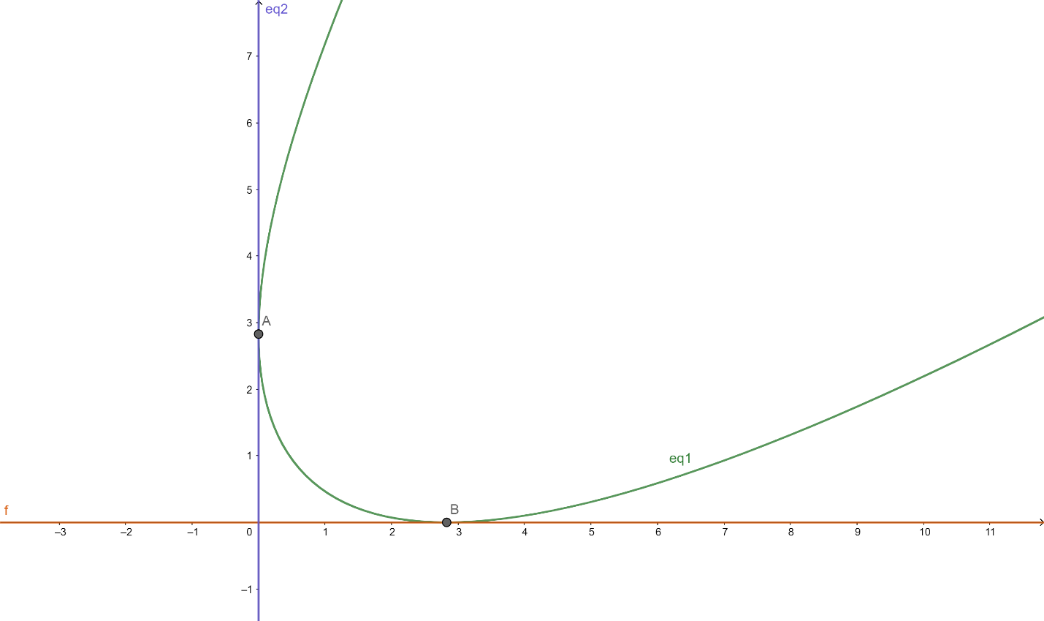
Let a point on parabola be $(a{{t}^{2}},2at)$. We have to find $\dfrac{dy}{dx}$ of the curve at a given point. Slope of tangent to given point $(a{{t}^{2}},2at)$ $=\dfrac{dy}{dx}$.
${{y}^{2}}=4ax$
We know $\dfrac{d{{x}^{n}}}{dx}=n{{x}^{n-1}}$, so we get
$2y\dfrac{dy}{dx}=4a$
The given point is $(a{{t}^{2}},2at)$, so, $y=2at$
$\begin{align}
& \dfrac{dy}{dx}=\dfrac{4a}{2(2at)} \\
& \dfrac{dy}{dx}=\dfrac{1}{t} \\
\end{align}$
So the slope of tangent passes through point $(a{{t}^{2}},2at)$ is $=\dfrac{1}{t}\ldots \ldots \left( 1 \right)$
Now, we can substitute the points and the slope write the equation of tangent using the formula $y-{{y}_{1}}=m(x-{{x}_{1}})$ as
$\begin{align}
& y-2at=\dfrac{1}{t}(x-a{{t}^{2}}) \\
& t\left( y-2at \right)=x-a{{t}^{2}} \\
& ty-2a{{t}^{2}}=x-a{{t}^{2}} \\
& x-ty+a{{t}^{2}}=0 \\
\end{align}$
Let A $(a{{s}^{2}},2as)$ be a point on the parabola, on the x-axis. So, from the above discussion and using equation (1), we can conclude that the slope of tangent passing through $(a{{s}^{2}},2as)$ is $=\dfrac{1}{s}$. We can substitute it in the equation of tangent and we get $x-sy+a{{s}^{2}}=0$.
Now, we know the focus of parabola ${{y}^{2}}=4ax$ must be at $(a,0)$. Then the distance of focus from the tangent of the equation $x-sy+a{{s}^{2}}=0$ can be calculated using the formula of distance of a point from line. If we have a line $ax+by+c=0$, then the perpendicular distance from a point $(x,y)$ to line is given by $d=\left| \dfrac{xa+yb+c}{\sqrt{{{a}^{2}}+{{b}^{2}}}} \right|$.
Now let the distance from focus point $(a,0)$ be x. Then we have,
$\begin{align}
& x=\left| \dfrac{a-0+a{{s}^{2}}}{\sqrt{{{1}^{2}}+{{s}^{2}}}} \right| \\
& x=\left| \dfrac{a\left( 1+{{s}^{2}} \right)}{\sqrt{{{1}^{2}}+{{s}^{2}}}} \right| \\
& x=\left| a\sqrt{{{1}^{2}}+{{s}^{2}}} \right|\ldots \ldots \ldots \left( 2 \right) \\
\end{align}$
Similarly, let B $(a{{r}^{2}},2ar)$ be a point on the parabola, on the y-axis. So, from the above discussion and using equation (1), we can conclude that the slope of tangent passing through $(a{{r}^{2}},2ar)$ is $=\dfrac{1}{r}$. We can substitute it in the equation of tangent and we get $x-ry+a{{r}^{2}}=0$.
Similarly, we can find the distance from focus point $(a,0)$ as $y$. So, we will get
$\begin{align}
& y=\left| \dfrac{a-0+a{{r}^{2}}}{\sqrt{{{1}^{2}}+{{r}^{2}}}} \right| \\
& y=\left| \dfrac{a\left( 1+{{r}^{2}} \right)}{\sqrt{{{1}^{2}}+{{r}^{2}}}} \right| \\
& y=\left| a\sqrt{{{1}^{2}}+{{r}^{2}}} \right|\ldots \ldots \ldots \left( 3 \right) \\
\end{align}$
Now, we know that the tangents are perpendicular to each other. So, the product of their slope is equal to -1. Applying it, we will get
$\dfrac{1}{r}\times \dfrac{1}{s}=-1$
$rs=-1\ldots \ldots \ldots \left( 4 \right)$
Now using equation (2), we get
$\begin{align}
& \dfrac{x}{a}=\left( \sqrt{{{1}^{2}}+{{s}^{2}}} \right) \\
& {{\left( \dfrac{x}{a} \right)}^{2}}=\left( {{1}^{2}}+{{s}^{2}} \right) \\
& {{\left( \dfrac{x}{a} \right)}^{2}}-1={{s}^{2}}\ldots \ldots \ldots \left( 5 \right) \\
\end{align}$
Now using equation (3), we get
$\begin{align}
& \dfrac{y}{a}=\left( \sqrt{{{1}^{2}}+{{r}^{2}}} \right) \\
& {{\left( \dfrac{y}{a} \right)}^{2}}=\left( {{1}^{2}}+{{r}^{2}} \right) \\
& {{\left( \dfrac{y}{a} \right)}^{2}}-1={{r}^{2}}\ldots \ldots \ldots \left( 6 \right) \\
\end{align}$
Multiplying equation (5) and (6), we get
$\begin{align}
& \left( {{\left( \dfrac{y}{a} \right)}^{2}}-1 \right)\left( {{\left( \dfrac{x}{a} \right)}^{2}}-1 \right)={{r}^{2}}{{s}^{2}} \\
& \left( {{\dfrac{y}{{{a}^{2}}}}^{2}}-1 \right)\left( {{\dfrac{x}{{{a}^{2}}}}^{2}}-1 \right)={{r}^{2}}{{s}^{2}} \\
\end{align}$
Now, simplifying terms inside bracket and using equation (4), we get
$\begin{align}
& \dfrac{{{x}^{2}}{{y}^{2}}}{{{a}^{2}}{{a}^{2}}}-\dfrac{{{x}^{2}}}{{{a}^{2}}}-\dfrac{{{y}^{2}}}{{{a}^{2}}}+1={{(-1)}^{2}} \\
& \dfrac{{{x}^{2}}{{y}^{2}}-{{a}^{2}}({{x}^{2}}+{{y}^{2}})}{{{a}^{4}}}+1=1 \\
& \dfrac{{{x}^{2}}{{y}^{2}}-{{a}^{2}}({{x}^{2}}+{{y}^{2}})}{{{a}^{4}}}=0 \\
& {{x}^{2}}{{y}^{2}}-{{a}^{2}}({{x}^{2}}+{{y}^{2}})=0 \\
& {{x}^{2}}{{y}^{2}}={{a}^{2}}({{x}^{2}}+{{y}^{2}}) \\
\end{align}$
A parabola whose length of latus rectum is 4a touches both coordinate axis then the locus of its focus is ${{x}^{2}}{{y}^{2}}={{a}^{2}}({{x}^{2}}+{{y}^{2}})$.
So, the correct option must be a).
Note: Equation of a tangent to a parabola passing through point $(a{{t}^{2}},2at)$ can be taken as $x-ty+a{{t}^{2}}=0$ directly instead of deriving it. We must memorise this as it is very helpful in solving such questions and it will save time in the exam. In this question, latus rectum value is given through which we can find the focus of parabola and its equation.
Complete step-by-step solution -
It is given that the latus rectum is $4a$. So, let the given parabola ${{y}^{2}}=4ax$. Let the graph of parabola be like that which cuts both coordinates at A and B.
Let a point on parabola be $(a{{t}^{2}},2at)$. We have to find $\dfrac{dy}{dx}$ of the curve at a given point. Slope of tangent to given point $(a{{t}^{2}},2at)$ $=\dfrac{dy}{dx}$.
${{y}^{2}}=4ax$
We know $\dfrac{d{{x}^{n}}}{dx}=n{{x}^{n-1}}$, so we get
$2y\dfrac{dy}{dx}=4a$
The given point is $(a{{t}^{2}},2at)$, so, $y=2at$
$\begin{align}
& \dfrac{dy}{dx}=\dfrac{4a}{2(2at)} \\
& \dfrac{dy}{dx}=\dfrac{1}{t} \\
\end{align}$
So the slope of tangent passes through point $(a{{t}^{2}},2at)$ is $=\dfrac{1}{t}\ldots \ldots \left( 1 \right)$
Now, we can substitute the points and the slope write the equation of tangent using the formula $y-{{y}_{1}}=m(x-{{x}_{1}})$ as
$\begin{align}
& y-2at=\dfrac{1}{t}(x-a{{t}^{2}}) \\
& t\left( y-2at \right)=x-a{{t}^{2}} \\
& ty-2a{{t}^{2}}=x-a{{t}^{2}} \\
& x-ty+a{{t}^{2}}=0 \\
\end{align}$
Let A $(a{{s}^{2}},2as)$ be a point on the parabola, on the x-axis. So, from the above discussion and using equation (1), we can conclude that the slope of tangent passing through $(a{{s}^{2}},2as)$ is $=\dfrac{1}{s}$. We can substitute it in the equation of tangent and we get $x-sy+a{{s}^{2}}=0$.
Now, we know the focus of parabola ${{y}^{2}}=4ax$ must be at $(a,0)$. Then the distance of focus from the tangent of the equation $x-sy+a{{s}^{2}}=0$ can be calculated using the formula of distance of a point from line. If we have a line $ax+by+c=0$, then the perpendicular distance from a point $(x,y)$ to line is given by $d=\left| \dfrac{xa+yb+c}{\sqrt{{{a}^{2}}+{{b}^{2}}}} \right|$.
Now let the distance from focus point $(a,0)$ be x. Then we have,
$\begin{align}
& x=\left| \dfrac{a-0+a{{s}^{2}}}{\sqrt{{{1}^{2}}+{{s}^{2}}}} \right| \\
& x=\left| \dfrac{a\left( 1+{{s}^{2}} \right)}{\sqrt{{{1}^{2}}+{{s}^{2}}}} \right| \\
& x=\left| a\sqrt{{{1}^{2}}+{{s}^{2}}} \right|\ldots \ldots \ldots \left( 2 \right) \\
\end{align}$
Similarly, let B $(a{{r}^{2}},2ar)$ be a point on the parabola, on the y-axis. So, from the above discussion and using equation (1), we can conclude that the slope of tangent passing through $(a{{r}^{2}},2ar)$ is $=\dfrac{1}{r}$. We can substitute it in the equation of tangent and we get $x-ry+a{{r}^{2}}=0$.
Similarly, we can find the distance from focus point $(a,0)$ as $y$. So, we will get
$\begin{align}
& y=\left| \dfrac{a-0+a{{r}^{2}}}{\sqrt{{{1}^{2}}+{{r}^{2}}}} \right| \\
& y=\left| \dfrac{a\left( 1+{{r}^{2}} \right)}{\sqrt{{{1}^{2}}+{{r}^{2}}}} \right| \\
& y=\left| a\sqrt{{{1}^{2}}+{{r}^{2}}} \right|\ldots \ldots \ldots \left( 3 \right) \\
\end{align}$
Now, we know that the tangents are perpendicular to each other. So, the product of their slope is equal to -1. Applying it, we will get
$\dfrac{1}{r}\times \dfrac{1}{s}=-1$
$rs=-1\ldots \ldots \ldots \left( 4 \right)$
Now using equation (2), we get
$\begin{align}
& \dfrac{x}{a}=\left( \sqrt{{{1}^{2}}+{{s}^{2}}} \right) \\
& {{\left( \dfrac{x}{a} \right)}^{2}}=\left( {{1}^{2}}+{{s}^{2}} \right) \\
& {{\left( \dfrac{x}{a} \right)}^{2}}-1={{s}^{2}}\ldots \ldots \ldots \left( 5 \right) \\
\end{align}$
Now using equation (3), we get
$\begin{align}
& \dfrac{y}{a}=\left( \sqrt{{{1}^{2}}+{{r}^{2}}} \right) \\
& {{\left( \dfrac{y}{a} \right)}^{2}}=\left( {{1}^{2}}+{{r}^{2}} \right) \\
& {{\left( \dfrac{y}{a} \right)}^{2}}-1={{r}^{2}}\ldots \ldots \ldots \left( 6 \right) \\
\end{align}$
Multiplying equation (5) and (6), we get
$\begin{align}
& \left( {{\left( \dfrac{y}{a} \right)}^{2}}-1 \right)\left( {{\left( \dfrac{x}{a} \right)}^{2}}-1 \right)={{r}^{2}}{{s}^{2}} \\
& \left( {{\dfrac{y}{{{a}^{2}}}}^{2}}-1 \right)\left( {{\dfrac{x}{{{a}^{2}}}}^{2}}-1 \right)={{r}^{2}}{{s}^{2}} \\
\end{align}$
Now, simplifying terms inside bracket and using equation (4), we get
$\begin{align}
& \dfrac{{{x}^{2}}{{y}^{2}}}{{{a}^{2}}{{a}^{2}}}-\dfrac{{{x}^{2}}}{{{a}^{2}}}-\dfrac{{{y}^{2}}}{{{a}^{2}}}+1={{(-1)}^{2}} \\
& \dfrac{{{x}^{2}}{{y}^{2}}-{{a}^{2}}({{x}^{2}}+{{y}^{2}})}{{{a}^{4}}}+1=1 \\
& \dfrac{{{x}^{2}}{{y}^{2}}-{{a}^{2}}({{x}^{2}}+{{y}^{2}})}{{{a}^{4}}}=0 \\
& {{x}^{2}}{{y}^{2}}-{{a}^{2}}({{x}^{2}}+{{y}^{2}})=0 \\
& {{x}^{2}}{{y}^{2}}={{a}^{2}}({{x}^{2}}+{{y}^{2}}) \\
\end{align}$
A parabola whose length of latus rectum is 4a touches both coordinate axis then the locus of its focus is ${{x}^{2}}{{y}^{2}}={{a}^{2}}({{x}^{2}}+{{y}^{2}})$.
So, the correct option must be a).
Note: Equation of a tangent to a parabola passing through point $(a{{t}^{2}},2at)$ can be taken as $x-ty+a{{t}^{2}}=0$ directly instead of deriving it. We must memorise this as it is very helpful in solving such questions and it will save time in the exam. In this question, latus rectum value is given through which we can find the focus of parabola and its equation.
Recently Updated Pages
JEE Main 2023 (January 30th Shift 2) Chemistry Question Paper with Answer Key

JEE Main 2022 (July 29th Shift 1) Maths Question Paper with Answer Key
JEE Main 2023 (January 29th Shift 2) Chemistry Question Paper with Answer Key
JEE Main 2022 (June 29th Shift 1) Maths Question Paper with Answer Key
JEE Main 2022 (July 25th Shift 2) Physics Question Paper with Answer Key
JEE Main 2023 (January 25th Shift 1) Physics Question Paper with Answer Key
Trending doubts
JEE Main 2026: Exam Dates, Session 2 Updates, City Slip, Admit Card & Latest News
Understanding the Electric Field of a Uniformly Charged Ring
Derivation of Equation of Trajectory Explained for Students
Understanding Atomic Structure for Beginners
Electron Gain Enthalpy and Electron Affinity Explained
Hybridisation in Chemistry – Concept, Types & Applications
Other Pages
NCERT Solutions For Class 11 Maths Chapter 9 Straight Lines - 2026-27 Free PDF Download (Sign-in Required)
NCERT Solutions For Class 11 Maths Chapter 6 Permutations And Combinations - 2026-27 Free PDF Download (Login Required)
NCERT Solutions For Class 11 Maths Chapter 8 Sequences And Series - 2026-27 Free PDF Download (Login Required)
NCERT Solutions For Class 11 Maths Chapter 4 Complex Numbers And Quadratic Equations - 2026-27 Free PDF Download (Login Required)
JEE Advanced Percentile vs Marks 2026: JEE Main Cutoff, AIR & IIT Admission Guide
NCERT Solutions For Class 11 Maths Chapter 5 Linear Inequalities - 2026-27 Free PDF Download (Sign-in Required)
NCERT Solutions For Class 11 Maths Chapter 9 Straight Lines - 2026-27 Free PDF Download (Sign-in Required)
NCERT Solutions For Class 11 Maths Chapter 6 Permutations And Combinations - 2026-27 Free PDF Download (Login Required)
NCERT Solutions For Class 11 Maths Chapter 8 Sequences And Series - 2026-27 Free PDF Download (Login Required)